Short handwritten note by Eleni Cavafy to Cavafy on the verso of a postcard. A view of Venice on the recto. This is the poet's niece, daughter of his brother, Alexandros. [Venice]
Kavafi, EleniHandwritten note by Athina Emm. Maximou to Cavafy. The Maximou couple intends to relinquish the management of Eleni Cavafy's (the daughter of the poet's brother, Alexandros) estate to her. [Alexandria]
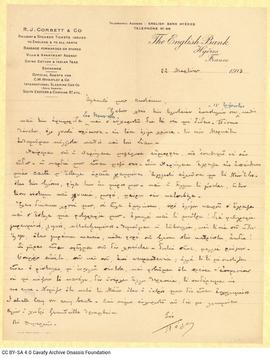
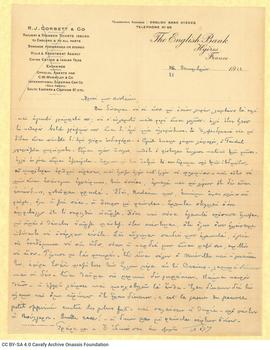
Maximou, Athina Emm.Handwritten letter by Paul Cavafy to C. P. Cavafy from Hyères, France, according to the letterhead. Paul comments on his health, expressing his concern, while he refers nostalgically to members of their family. (Hyères)
[Cavafy], Polis [Paul]Handwritten letter by Paul Cavafy to C. P. Cavafy from Hyères, France, on all sides of a bifolio. It is a reply to a letter by the poet, dated 24 July. Paul comments on issues apparently mentioned by C. P. Cavafy, such as his absence from his work and his health problems, and describes his own situation in detail. He also refers to people they both know in Alexandria and informs him of a book he published as well as of his intention to broaden his journalistic activity. Of note is the use of English words and phrases in the flow of written discourse. (Hyères)
[Cavafy], Polis [Paul]Handwritten letter by Paul Cavafy to C. P. Cavafy from Hyères, France, according to the letterhead. Paul refers to members of the family and wants to learn their news; he briefly describes what he did in the time since his last letter and repeats his request for the despatch of his personal notes (diaries). Of note is the use of English words and phrases in the flow of written discourse. (Hyères)
[Cavafy], Polis [Paul]Handwritten letter by Paul Cavafy to C. P. Cavafy from Hyères, France. He expresses his worry about the interruption of the correspondence between the two brothers as well as his concern about securing his pension, on the occasion of events in Egypt.
[Cavafy], Polis [Paul]Handwritten letter by Paul Cavafy to C. P. Cavafy from Hyères, France, on both sides of a letterhead. It is a reply to a letter by the poet. Paul conveys his strong impressions from his experience of observing an airplane (biplane) flight; he comments extensively on issues relating to their family and to their social circle - mostly individuals from his prior service with the Municipality of Alexandria. He refers to his personal diaries, which apparently are gradually sent by C. P. Cavafy, and informs him on his trips and his stay at a seaside place in the area. Of note is the use of English and French words and phrases in the flow of written discourse. (Hyères)
[Cavafy], Polis [Paul]Handwritten letter by Paul Cavafy to C. P. Cavafy from Hyères, France, according to the letterhead, on both sides of two sheets. It is a reply to a letter by the poet, dated 30 September. Arguments raised by Paul in favour of his stay in France, contrary to the suggestion of John Cavafy to return to Alexandria. Comments on World War I events, which is still in progress, and are linked to the previous subject. Reference to members of their family; Paul thanks C. P. Cavafy for intervening in a matter regarding Paul's pension. Of note is the use of English and French words and phrases in the flow of written discourse. (Hyères)
[Cavafy], Polis [Paul]Handwritten letter by Paul Cavafy to C. P. Cavafy from Hyères, France, according to the letterhead, on two sheets, to the recto of the second. It is a reply to a letter by the poet, dated 19 November. Paul comments on World War I; mention of problems and delays regarding the remittance of his pension; interest in individuals from their family circle; detailed account of his everyday life. Of note is the frequent use of English and French words and phrases in the flow of written discourse. A small part of the text is written entirely in French. (Hyères)
[Cavafy], Polis [Paul]Handwritten letter by Paul Cavafy to C. P. Cavafy from France, according to the content and the sequence of his previous and following letters. The text is on both sides of a sheet. It is a reply to a letter by the poet, in which Paul expresses his personal thoughts on his life; he refers to news he learns from his brother regarding their circle of family and friends as well as to details regarding his journalistic activities. He also asks his brother to send him a photograph of their mother. Of note is the use of interpolated English and French words and phrases.
[Cavafy], Polis [Paul]Handwritten letter by Paul Cavafy to C. P. Cavafy from Hyères, France, on both sides of a letterhead. In the largest part of the letter he comments on the death of Thelxiopi Cavafy and expresses his concern on the future of her daughter, Eleni. Of note is the use of English and French words and expressions in the flow of written discourse. (Hyères)
[Cavafy], Polis [Paul]Handwritten letter by Paul Cavafy to C. P. Cavafy from France, dated "16 March 1912", in the first three pages of a bifolio. It is a reply to a letter he had received from Cavafy. Update on his health, his plans to stay at Hyères as well as on other current matters. He also comments on theatrical events, as he went to the play by Henry Kistemaeckers, La flambée. Of note is the frequent use of English and French words and phrases in the flow of written discourse.
[Cavafy], Polis [Paul]Handwritten letter by Paul Cavafy to C. P. Cavafy from Hyères, France, according to the letterhead. Paul comments on his health, his life at Hyères as well as on news from Alexandria. He also refers to the First Balkan War in response to a remark apparently made by C. P. Cavafy in a previous letter. Of note is the use of English and French words and phrases in the flow of written discourse. (Hyères)
[Cavafy], Polis [Paul]Handwritten letter by Paul Cavafy to C. P. Cavafy from Hyères, France, on both sides of a letterhead. It is a reply to a letter by the poet, dated 16 May. Paul comments extensively on the Khedive's visit to Alexandria, stating his dislike. Having received his diaries, he talks of his nostalgia for the past and expresses his admiration for the early works of C. P. Cavafy that he located among his personal items. He also refers to the stay of his niece, Eleni, in Austria and his desire to meet his family soon. Of note is the use of English words and phrases in the flow of written discourse. (Hyères)
[Cavafy], Polis [Paul]Handwritten letter by Paul Cavafy to C. P. Cavafy from Hyères, France, on a bifolio with notes to the recto of the second sheet. It is a reply to a letter by C. P. Cavafy, dated 22 November - the date is noted in different ink. Comments on individuals related to their family and social circle as well as other matters set forth in the previous letter by C. P. Cavafy. He describes his place of residence, mentions the collection of letters of P. Mérimée Lettres à une inconnue, and informs about his health, mentioning events of the past. Of note is the use of French words and phrases in the flow of written discourse.
[Cavafy], Polis [Paul]Handwritten letter by Charikleia Cavafy (Valieri) to Cavafy on the first three pages of a bifolio. The last page is blank. Announcement of the death of Paul in Hyères, France, and reference to various procedural matters. [Cairo]
[Cavafy (Valieri)], HaricliaTypewritten copy of decision No. 126 of the Greek Consular Court of Alexandria, by virtue of which Cavafy's will is probated, in the first three pages of a double sheet notepaper. Two copies of a French translation of the previous decision, in the first two pages of double sheet notepapers with the embossed seal of the Roussos & Pandelidis law firm. Certificates from the Greek Consulate of Alexandria confirming the death of Cavafy, the absence of any descendants and other heirs as well as the absence of any contestations against the will. They are accompanied by French translations. Typewritten French translation of Cavafy's will.
Greek Consular Court (Alexandria)Two typewritten documents by virtue of which the two nieces of Cavafy, Eleni Coletti and Charikleia Valieri, accept their inheritance and the payment of the respective tax and waive any further claims on the Cavafy estate. Bank receipt for the payment of money by Singopoulo to Charikleia Valieri. Correspondence between the law firms that dealt with Valieri's inheritance (four typewritten letters).
Koletti, Eleni Max.Three typewritten tax returns and inheritance fees of Constantine P. Cavafy. The first two (Α’ and Β’) were written by the lawyer Anastasios Stylianoudis and are signed by Alekos Singopoulo. They were filed with the Greek Consulate of Alexandria. They are accompanied by the typewritten service acknowledgment documents. The third return (Γ’) is signed by Singopoulo's attorney-at-law; it was filed with the 7th Tax Office of Athens. It is accompanied by a filing acknowledgment document, an additional tax notice, as well as four receipt duplicates for the taxes due. The documents also include a typewritten French translation of a certificate by the Financial Inspector of Athens that Singopoulo had filed the required inheritance returns.
Stylianoudis, AnastasiosHandwritten list for the distribution of the 1915 onwards Collection consisting of five sheets of paper, initially folded in bifolios, with notes on both sides, except for the last one which bears notes only on one. The names of individuals are recorded in chronological order (1920-1926); next to the names is the number of issues sent to each of them as well as notes by Cavafy regarding the person who mediates for the acquisition of the issue or who will be the final recipient. At the top of the list it is stated that the distribution started in August 1920. The total of issues distributed is recorded at the end of each page and then it is carried forward to the top of the next one.
Cavafy, C. P.Handwritten list for the distribution of the 1908-14 Collection consisting of four cut small-sized sheets initially folded in bifolios and with notes on both sides as well as of one folded sheet with notes on both sides. The names of individuals are recorded chronollogically (1920-1926); next to the names is the number of issues sent to each of them as well as notes by Cavafy regarding the person who mediates for the acquisition of the issue or who will be the final recipient. An the top of the list it is stated that the distribution started in April 1920. The total of issues distributed is recorded at the end of each page and then it is carried forward to the top of the next one.
Cavafy, C. P.