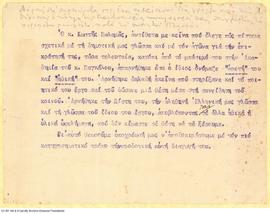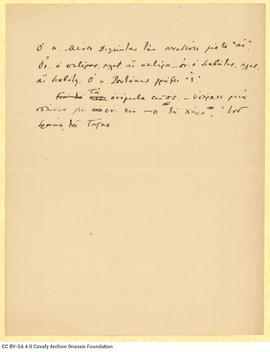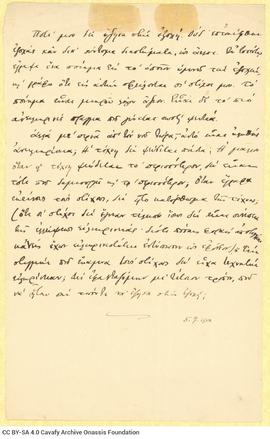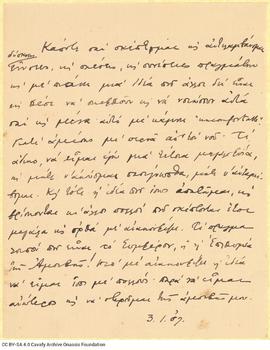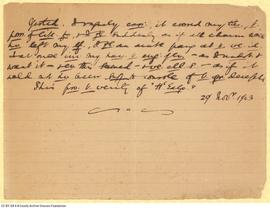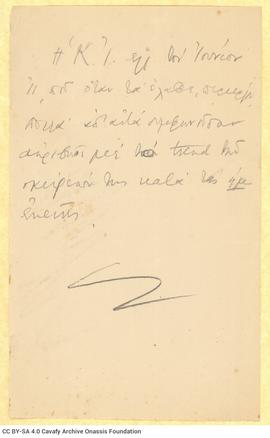
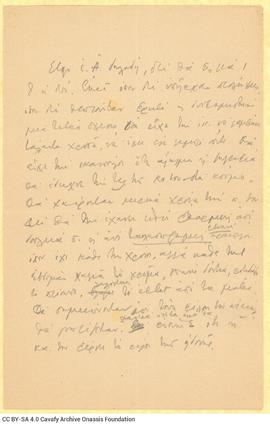
Handwritten notes on one side of a sheet and on one side of a piece of paper; abbreviations. Interpolated phrases in English; references to publication. The verso of both is blank.
Cavafy, C. P.Handwritten notes by Cavafy on pieces of paper of various sizes, placed in some of the volumes of the work The History of the Decline and Fall of the Roman Empire by Edward Gibbon (London1820), specifically in the following sites: pages 38 and 98 of volume Ι, pp. 136, 146, 384 of vol. ΙΙ, pp. 113 and 248 of vol. IV, pp. 107, 178, 334 of vol. V, p. 264 of vol. VI, p. 143 of vol. VII, p. 87 of vol. ΙΧ, p. 162 of vol. Χ and pp. 97, 170 of vol. ΧΙΙ. The notes are written in English but also include several quotes from Greek authors. Almost no quote, be it Greek or foreign, is accompanied by bibliographical or other references. Most notes are of historical nature and include comments and remarks on the content and method of Gibbon, corrections of erroneous statements and conclusions by the historian as well as historical details. Some of the comments are of literary nature, while there is also a note on metrics. Most are signed "C." and one is signed "C.F.C.".
Cavafy, C. P.Handwritten notes by Cavafy on one side of a ruled sheet, initially folded in a bifolio. crossed out titles of poems of his on the verso. The abbreviated notes on the recto analyse in English the meaning of the phrase "I think of nothing else", which precedes them. Date at bottom right ("30.12.'16").
Cavafy, C. P.Abbreviated notes in pencil on the first page of a ruled double sheet notepaper. Draft of an official letter and notes, also in pencil, on the second page. On its last two pages, quotes in ink from a book and bibliographical reference regarding a ceremony in an ancient Gymnasium. On another ruled sheet, quotes on the recto and notes on the verso (some crossed out). Extensive use of abbreviations. The quotes correlate the item with the poem "Alexandrian Kings".
Cavafy, C. P.Handwritten notes on the poem "The Satrapy" on both sides of a ruled paper. The notes on the verso have been crossed out.
Cavafy, C. P.Handwritten notes on one side of a sheet, folded in bifolio. Cavafy's comments on one of his poems.
Cavafy, C. P.Handwritten notes on the verso of a printed broadsheet containing fragment of the poem "A Great Procession of Priests and Laymen". Cavafy's comments on one of his poems.
Cavafy, C. P.Handwritten notes on all pages of a ruled double sheet notepaper; abbreviations, cancellations and emendations. References to French poets.
Cavafy, C. P.Handwritten note with a quote from a work by Marcel Proust and bibliographical reference, on one side of a ruled sheet. Blank verso.
Cavafy, C. P.Handwritten titles of folk songs on two double sheet notepapers, accompanied by page numbers. The pages are numbered "α-ζ". The name of [Nikolaos] Politis on the first and last pages of one of the bifolios.
Cavafy, C. P.Handwritten notes on the recto of two pieces of paper and bibliographical references to 1907 and 1911 printed media. The verso of both is blank.
Cavafy, C. P.Handwritten quotes from poems, copied by Cavafy on all four sides of four half sheets. Every page is numbered at top left. The note "Apo tin "Argo" tou Ermona" (poem by Petros Vlastos) in ink on the first page.
Cavafy, C. P.Handwritten notes by Cavafy on both sides of two sheets. The poet copies excerpts from Greek and foreign literary works, both prose and poetic, with similarities among them. Most quotes are written in English and French, and some in Greek. Bibliographical references; abbreviations. The notes are placed inside a four-page folder of paperboard; the title "Coincidences of Similarities in Literary Works" is written by Cavafy in the first page. The remaining pages are blank.
Cavafy, C. P.Handwritten note by Cavafy in a bifolio placed in the volume The English Poets by James Russell Lowell (James Russell Lowell) (Leipzig/ London1891). It is located between pages 232 and 233, in the chapter on the poet Wordsworth, and contains a copied quote from a study by Ingleby and a bibliographical reference. Signed "C." at the end of the text.
Cavafy, C. P.Handwritten notes on one side of a ruled piece of paper; cancellations. Comments on a Grammar of the Greek language, most probably by Hubert Pernot, and bibliographical reference. Interpolated phrase in French.
Cavafy, C. P.Handwritten notes of linguistic nature on one side of a ruled sheet. Blank verso. List of idiomatic expressions that Cavafy had heard. Reference to Korais.
Cavafy, C. P.Handwritten notes on nine sheets forming a homemade notepad. Linguistic remarks. Quotes from poems by Palamas, Drosinis, Krystallis, Valaoritis, etc. Bibliographical references to publications and journals of the period 1903-1908. Press clipping from the newspaper Astrapi (1904), with a poem by Achillefs Venetas. Abbreviations. Handmade paperboard folder, entitled "Linguistics of C. P. Cavafy", in a handwriting other than Cavafy's (most likely Rica Singopoulo's).
Cavafy, C. P.Handwritten notes on one side of a ruled sheet, initially folded in a bifolio. Indexing of words from the collection Poems of Stefanos Martzokis (1901 edition).
Cavafy, C. P.Handwritten notes with entries for the Dictionary on the verso of a commercial print.
Cavafy, C. P.Handwritten notes by Cavafy on both sides of half a ruled sheet. Two quotes and bibliographical reference to Dio Cassius. The first quote refers to Pythia and the Oracle of Delphi. Abbreviations.
Cavafy, C. P.Handwritten quote on Charmides on both sides of a ruled piece of paper.
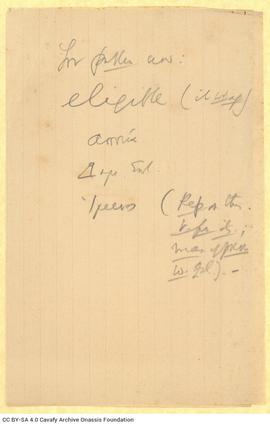
Cavafy, C. P.Handwritten notes on one side of a ruled sheet. The titles of three poems by Cavafy are noted ("Absence", "Of Demetrius Soter", "Imenus") as well as the word "eligible". Abbreviations.
Cavafy, C. P.Handwritten notes on both sides of a sheet; abbreviations. Explanatory comments on a poem, regarding the hero's emotional state.
Cavafy, C. P.Handwritten notes on one side of a ruled sheet. Blank verso. Comment by Cavafy, most probably on one of his poems.
Cavafy, C. P.Handwritten notes on one side of a ruled sheet. Cavafy's comments on one of his poems. Blank verso.
Cavafy, C. P.Handwritten notes on both sides of a sheet; abbreviations. Cavafy comments on two of his poems, most probably "The Seleucid's Displeasure" and "Of Demetrius Soter (162-150 B.C.)".
Cavafy, C. P.Handwritten notes on both sides of a sheet and on the recto of a smaller sheet. Pages 2 and 3 are numbered. Remarks on a French translation.
Cavafy, C. P.Handwritten notes on one side of a ruled sheet. Copied phrases or verses. Extensive use of abbreviations. Phrase from The Wild Duck by Ibsen. Blank verso.
Cavafy, C. P.Handwritten notes on both sides of a cut paper. Quotes and references to pages of publications. Extensive use of abbreviations.
Cavafy, C. P.Handwritten notes ("From 1", "From 3") on two pieces of paper.
Cavafy, C. P.Handwritten notes by Cavafy on both sides of a ruled sheet. Cancellations. Comments on the Greek literary activity in Alexandria and Cairo.
Cavafy, C. P.Handwritten notes by Cavafy on one side of a sheet folded in a bifolio. Blank verso. Copied phrases and references to pages of a publication which is not mentioned. Extensive quote without indications.
Cavafy, C. P.Handwritten list of expenses in drachmas. The list has been written on 29 sheets, which form a handmade notepad bound with thread on the spine. It covers the period 12 August-18 October 1903, which coincides with a visit the poet made to Athens. Abbreviations. Notes.
Cavafy, C. P.Handwritten monthly list of expenses for the years 1932-1933, on four double sheet notepapers. Accompanied by a piece of paper with the total expenses for 1932.
Cavafy, C. P.Handwritten list of household items (lamps, crockery, cooking utensils, fabrics, etc.) on one side of a sheet, cut in half lengthwise. The upper part lists those acquired during the period 1/3 – 31/12/1899 and the lower part those acquired in the 1/1 – 31/12/1900 period. Interpolated phrases in Greek.
Cavafy, C. P.Undated list of the jewellery of Charikleia Cavafy, handwritten by C. P. Cavafy on the first three pages of a bifolio. The last page is blank. On the first page, the Cavafy family "crest" with the helmet and the motto "For Christ and the Land of the Romans". The last page is blank. Also included is a handwritten declaration by Alexandros Cavafy, by which he relinquishes his share of Charikleia's jewellery to his brother, C. P. Cavafy, on the first page of a bifolio. The remaining pages are blank. The short text is written by the poet in black ink. The signature and the date have been filled in by Alexandros in blue ink. Accompanied by an unmarked envelope.
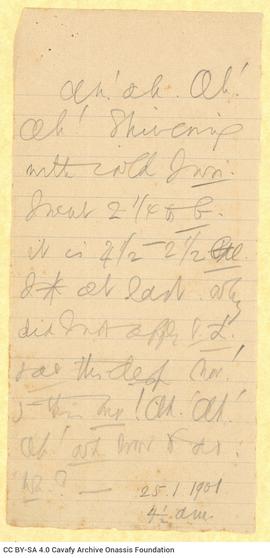
Kavafis, AlexandrosHandwritten note by Cavafy on one side of a piece of paper. Blank verso. Extensive use of abbreviations and frequent repetition of the exclamation "Ah!". Date at bottom right.
Cavafy, C. P.Handwritten notes by Cavafy on one side of a cut piece of paperboard. Two lines almost entirely abbreviated. Date at top right. Affixed label with the name and address of a paper- and bookstore in Alexandria on the verso.
Cavafy, C. P.Handwritten notes by Cavafy on the first three pages of a bifolio. The last page is blank. Extensive use of abbreviations. Reference to specific times of the day throughout the text.
Cavafy, C. P.Handwritten notes on both sides of a sheet, regarding various subjects. Cancellations. One of the notes is addressed to Alekos Singopoulo, while another contains the poet's address in Alexandria.
Cavafy, C. P.Handwritten note on one side of a blank envelope and fragment of a note on wrapping paper.
Cavafy, C. P.Handwritten notes by Cavafy on the first two pages of a bifolio. The last two pages are blank. Extensive use of abbreviations. Notes by the poet regarding his professional evaluations in the period 1891-1897.
Cavafy, C. P.Fourteen sheets and papers of various sizes with handwritten notes, remarks and comments on the second volume of the Grammaire grecque moderne by Hubert Pernot. Pages 26-28, 30-37, 40-44 are numbered. Cancellations and emendations.
Cavafy, C. P.Handwritten notes on both sides of two ruled sheets and on the verso of part of a printed medium with a fragment of the poem "Alexandrian Kings". Cancellations and emendation, some in ink. Pages 2-4 are numbered. Comments by Cavafy on the literary production of the Greeks in Egypt.
Cavafy, C. P.Handwritten notes on both sides of an envelope. On the recto are detailed the views of Grigorios Xenopoulos on the work of Cavafy and Kostis Palamas. On the verso, comment by Nikos Kazantzakis on Palamas. The handwriting on the verso could be Rica Singopoulo's.
[Unidentified]Handwritten notes regarding the translation of the poems "The Funeral of Sarpedon" and "That Is He", on both sides of a ruled leaf. The part of the text referring to the poem "The Funeral of Sarpedon" has been crossed out in pencil.
Cavafy, C. P.Handwritten notes on the first three pages of a double sheet notepaper. Instructions for the translation of the poem "Timolaus the Syracusan". Cancellations and emendations.
Cavafy, C. P.List of Cavafy's poem titles on the first page of a double sheet notepaper, recorded by Rica Singopoulo.
[Singopoulo, Rica]File 7: Literary notes. File 8: Notes on linguistic matters. File 9: Personal notes. File 10: Notes on historical matters. File 11: Working notes.
Handwriten notes on eight sheets of a notebook (most of which with text on both sides) as well as on one side of four small-size loose sheets. It is a record of thoughts, criticisms and episodes from Cavafy's life with date indications covering the period 28 March 1926-16 April 1930. Reference to the Grammata publishing house, to the journals Libre, Nea Zoi, Nea Techni, Panathinaia, Alexandrini Techni, Nea Epitheorisi and La Semaine égyptienne, to the newspapers I Proia, Tachydromos of Alexandria, Ethnos and The Times as well as to the Delphic Festival, the Nobel Prize, the work I politeia kai i monaxia by K. Palamas, the study O Palamas filosofos by D. Vezanis, the poem "Tragoudi gia tin Eleni" by S. Skipis and the books Skepsi kai zoi by A. Panagiotatou and [Ta gynaikeia pathi.] Afrodisia nosimata by A. Syngelakis. Eftychia Zelita is mentioned as having written down the notes. There is, however, a second handwritng, which is probably that of Makis Antaios, a person who appears to be reproducing the specific episodes.
[Zelita, Eftychia]Promotional notepad of the Stamelis Douras Cigarette Company of Alexandria, the logo of which adorns the front and rear covers. It includes a diary of 1914. Most of the pages contain abbreviated personal notes by Cavafy in Greek, English and French. Some of them refer to sales of English sovereigns (with dates and prices), to the liquidation of shares and to articles of clothing. The date indications cover the period 1898-1931. Cancellations. Few sheets have been removed.
Cavafy, C. P.Notebook with handwritten notes on the last five sheets. The remaining pages are blank. Book titles are recorded, some of which are marked "Ε". Two of the titles are marked "Returned". It is most likely a list of Greek and foreign books that were lent out.
[Singopoulo, Alekos D.]Typewritten note to Cavafy on a postcard of the Eleftheroudakis publishing house. Expression of thanks to the poet.
"Eleftheroudakis" Publishing House S.A.Handwritten note on behalf of the Processing Office of the newspaper Konstantinoupolis on a postal card to Cavafy, with notes on both sides. It refers to the publication of a text by Cavafy ("Traces of Greek Thought in Shakespeare") in the newspaper and the despatch of copies. The card bears printed details (in French and Turkish, in the Arabic alphabet), stamps of postal services (Istanbul; Alexandria); the name of the recipient and his address are handwritten in French.
Konstantinoupolis (newspaper)Typewritten text on one side of half a sheet. Addition of a word in ink. Note in pencil at the top, not by Cavafy. Blank verso. Negative views on Palamas and the language he uses.
Cavafy, C. P.Handwritten list of names of authors and intellectuals on both sides of a small piece of paper, not by the poet (it is probably written by Giannis Saregiannis).
UnknownHandwritten note to Cavafy on paperboard of the Banque d'Orient Alexandrie. He is asked for a collection of his poems to be sent to a third person (Giagkos Chelmis). The note is signed "Vasos".
UnknownHandwritten note on a visiting card of Andreas Michalakopoulos, Minister of Foreign Affairs of Greece and Vice-President of the Government, to Cavafy. On the occasion of the acquaintance of the two men, which, as mentioned occurred the previous day, Michalakopoulos expresses his thanks for Cavafy's initiative to send him his poems. The printed details of the visiting card (name and job title) are written in French; date indication: "14/3".
Mich., An. [Michalakopoulos, Andreas]Handwritten note by Timos Malanos to Cavafy on one side of a piece of paper folded in half. The author asks the poet to rescind accusations he hurled at him, otherwise he threatens to publish a relevant vignette.
Malanos, T.Handwritten note by Stylianos I. Theocharidis to Cavafy with thanks for the despatch of poems by the latter. (Nicosia)
Theocharidis, Styl. I.Handwritten note by Stefanos Pargas (Nikos Zelitas) to Cavafy regarding [M.] Rodas. The text is on the verso of a printed document of the "Grammata" publishing company of Stefanos Pargas, in which there is the announcement of a study authoring competition on the history of Egypt.
Pargas, S.Handwritten note by Rica Singopoulo on a piece of paper, regarding Cavafy and the recognition of his work. Cancellations and emendations in pencil. Number "5" at the top. Sketch or symbol in pencil at the bottom of the verso, which is otherwise blank. It appears to be a fragment of a more extensive text.
Segkopoulou, RikaHandwritten notes on both sides of a piece of paper, in a handwriting other than Cavafy's (most probably Rica Singopoulo's). List of names of authors and intellectuals.
[Singopoulo, Rica]Handwritten note by Paul Cavafy to C. P. Cavafy from Hyères, France, on a postcard. He expresses thanks to C. P. Cavafy for an issue of the [The Egyptian] Gazette he received. Short comment on the landscape depicted on the card. The card bears a postage stamp, mail service rubber stamps (Hyères, Alexandria) and recipient details. The date "12.9.'11" entered on the card indicates the time it was received (which coincides with the dates on the mail rubber stamps). Handwritten indication "27Α". The other side of the card depicts a chapel at Hyères ("Chapelle de l’Ermitage"). (Hyères)
[Cavafy], PaulHandwritten note by Paul Cavafy to C. P. Cavafy from Hyères, France, on a postcard. Paul informs him that he has received his letter of 8 September and that he has written to Mrs Theodorou (the name is abbreviated, "Mrs Th."). The card bears a postage stamp, mail service rubber stamps (Hyères, Alexandria) and recipient details. The date "21.9.'11" entered on the card indicates the time it was received (which coincides with the dates on the mail rubber stamps). Handwritten indication "28Α". The other side of the card depicts a church at Hyères ("Eglise St Paul"). (Hyères)
[Cavafy], PaulHandwritten note by Paul Cavafy to C. P. Cavafy from Hyères, France, on a postcard. Paul informs him that he has received his letter of 13 January. The card bears a postage stamp, mail service rubber stamps (Hyères, Alexandria) and recipient details. The indication "34Α" is noted in the margin, in pencil. The other side of the card depicts the "Hôtel Regina Hespérides" at Hyères. (Hyères)
[Cavafy], PaulHandwritten note by Paul Cavafy to C. P. Cavafy from Italy, on a postcard. The card bears a postage stamp, mail service rubber stamps (railroad service in Italy and Alexandria) and recipient details. The indication "40Α" is noted in the margin, in pencil. On the other side of the card, view of the Tower and Cathedral at Pisa.
[Cavafy], PaulHandwritten note by Paul Cavafy to C. P. Cavafy from Hyères, France, on a postcard. Paul informs him that he has received his letter of 17 November and that he is sending him the card to show him the view from the hotel at which he is staying. The card bears a postage stamp, mail service rubber stamps (Hyères) and recipient details (the word "Egypt" has been crossed out in red ink and another phrase has been written in its place in French, probably by C. P. Cavafy). The indication "31Α" in the margin, in pencil. The other side of the card depicts a view of the Boulevard Riondet in Hyères. (Hyères)
[Cavafy], PaulHandwritten note by Paul Cavafy to C. P. Cavafy from Italy, on a postcard. He informs him that he has returned to Como. The card bears a postage stamp, mail service rubber stamps (Como, Alexandria) and recipient details. The indication "39Α" is noted in the margin, in pencil. On the other side of the card, view of the Bellagio, in Lake Como. (Como)
[Cavafy], PaulHandwritten note by Paul Cavafy on a postcard to C. P. Cavafy, with notes on both sides. It is mentioned that Paul is leaving for London and Paris, having Alexandria as his final destination. Of note is the use of English words and phrases. The card bears a postage stamp; mail service rubber stamps (Buxton, Port Said – Alexandria); the address is written in French; handwritten notes in pencil. (Buxton)
[Cavafy], Polis [Paul]Handwritten note by Paul Cavafy on a postcard to C. P. Cavafy, with notes on both sides. It is mentioned that Paul intends to depart on 13 August from Marseille and that he is delaying his departure on account of his health. Of note is the use of English words and phrases. The card is marked as prepaid and bears mail service rubber stamps (Boulogne, Alexandria); handwritten notes in pencil by Cavafy; one of them records the date of despatch, mentioning the wrong year. (Boulogne sur Mer)
[Cavafy], Polis [Paul]Handwritten note by Paul Cavafy to C. P. Cavafy from Hyères, France, on a postcard. Paul thanks him for the letter he received on 19 January. The card bears a postage stamp as well as mail service rubber stamps (Hyères, Alexandria). The date in the margin reads "8.2.'11" and should be the date on which the card was received (it coincides with the dates on the mail rubber stamps). The indication "19Α" also in the margin. On the other side of the card, photograph of an airplane with reference to Elie Mollien. (Hyères)
[Cavafy], PaulHandwritten note of thanks by Paul Cavafy to C. P. Cavafy from Hyères, France, on a postcard, regarding a photograph he received. Except for the first phrase, which is written in English, Paul uses Latin characters in writing the message. The card bears a postage stamp, mail service rubber stamps (Hyères, Alexandria) and recipient details. The indication "24Α" in noted in pencil. On the other side of the card, photograph from Hyères ("Allée de Palmiers-Avenue de Beauregard"). (Hyères)
[Cavafy], PaulHandwritten note by Paul Cavafy to C. P. Cavafy from Hyères, France, on a postcard. The card bears a postage stamp and mail service rubber stamps (Hyères). The date "8.8.12" in pencil in the margin indicates the time the card was received, which coincides with the date on the mail rubber stamp (2/8/1912); handwritten indication "43Α". Photograph of the "Allouard" hotel at L'Almanarre, Hyères on the other side of the card. (Hyères)
[Cavafy], PaulHandwritten note by Paul Cavafy to C. P. Cavafy on a postcard, on one side of which the author's photographic portrait is printed. In a short text he explains that this is his most recent photograph. Of note is the use of English expressions in the flow of written discourse.
[Cavafy], Polis [Paul]Handwritten note by M. Ralli to Cavafy, regarding the cancellation of dinner plans.
Ralli, M[ichel] C.Handwritten note by Marios Vaianos on a letterhead of the Ministry of Transport. Blank verso. Disappointment in the prolonged silence of Cavafy to the sender of the note and anticipation for a letter by the poet.
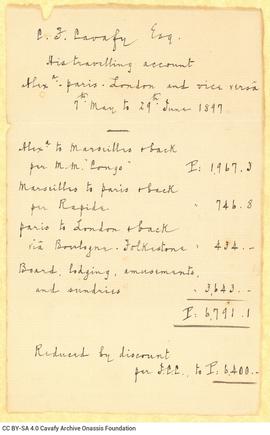
Vaïanos, MariosHandwritten note by John Cavafy with a list of his expenses during a trip he made together with C. P. Cavafy in the period May-June 1897 to Paris and London, via Marseilles. Written on one side of a piece of paper. Blank verso.
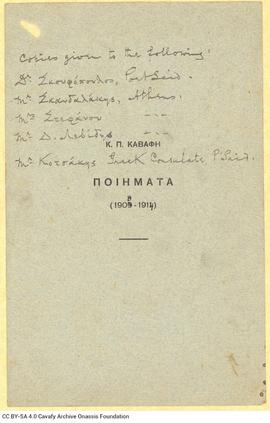
Cavafy, JohnHandwritten note with names of recipients of copies, on a printed cover of a Cavafy poem Collection of the 1908-1914 period (the dates have been corrected in ink over the original 1909-1911). The handwriting is that of the poet's brother, John. Blank verso.
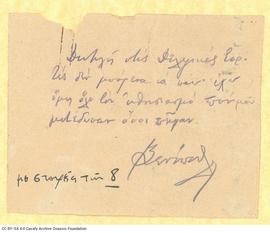
Cavafy, JohnHandwritten text regarding the Delphic Festival on a small piece of a paper. Note in ink in the margin, in ink (possibly addressed to the publisher).
Xenopoulos, G.Handwritten note by Giordanis T. Vamvakidis to Cavafy on a piece of paper, in which he asks him to send him his poems. (Athens)
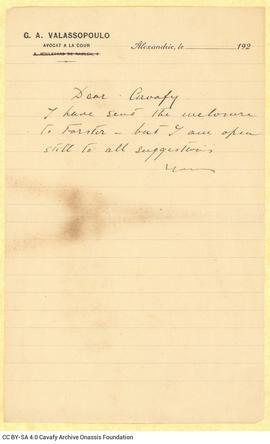
Vamvakidis, Giordanis T.Handwritten note by G. Valassopoulo to Cavafy on one side of a letterhead of the sender. Update on the sender's communication with Ε. M. Forster The printed details date the note in the 1920's. (Alexandria)
Valassopoulo, G. A.Handwritten note by Georges Brissimizakis to Cavafy on one side of a piece of paper. Blank verso. He asks to meet the poet so that they may examine together a typographical essay. [Alexandria].
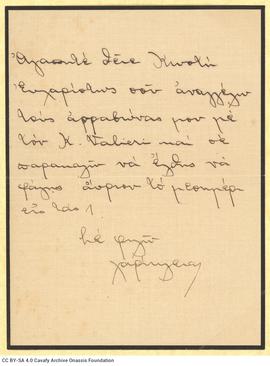
Vrisimitzakis, G.Handwritten note by Charikleia Cavafy, Cavafy's niece, in the first page of a bifolio. The remaining pages are blank. She announces her engagement to Geronymo Valieri and, on the occasion, invites her uncle to a meal. [Alexandria]
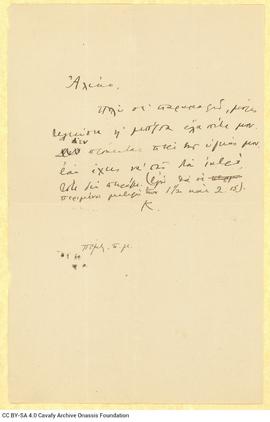
[Cavafy (Valieri)], CharikleiaHandwritten note by Cavafy to Alekos [Singopoulo] on one side of a piece of paper. The poet asks Singopoulo to return home earlier.
Cavafy, C. P.Handwritten note by Cavafy to Alekos [Singopoulo] on one side of a sheet. The poet informs Singopoulo of the time he wishes the latter to visit him in his apartment.
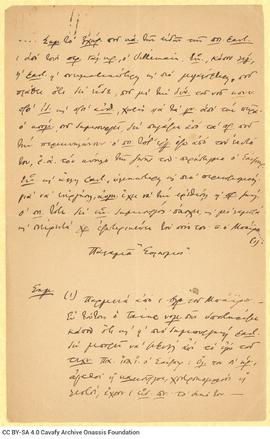
Cavafy, C. P.Handwritten notes by Cavafy on the poem "Alexandrian Kings", on both sides of a piece of paper. Note and bibliographical reference on the verso.
Cavafy, C. P.Handwritten note on one side of part of an official paper; abbreviations and cancellations. Probably (explanatory?) comments by Cavafy on one of his poems. Fragment of a crossed out official text of the 3rd Cycle of Irrigation on the verso.
Cavafy, C. P.Handwritten note by Cavafy on both sides of an envelope of the National Bank of Egypt, with him as recipient. The note contains the quote that appears in the poem "Julian, Seeing Indifference".
Cavafy, C. P.Handwritten note by Cavafy on one side of a piece of paper. Reference to an unmentioned publication. Blank verso.
Cavafy, C. P.Fragment of a handwritten note by Cavafy on both sides of two ruled sheets, numbered 4 and 5. Mention of the "Group of critics" of the journal Grammata, whose members are considered responsible for the presentation of the thematic categories.
Cavafy, C. P.Handwritten note on both sides of a sheet. Comments on a publication by Giorgos Theotokas drawing parallels between ethography and photography. The name "Ap. Konstantinidis" is written by Cavafy on the verso.
Cavafy, C. P.Handwritten note on one side of a sheet. Blank verso. Footnote. Quote from a text by Palamas on Dionysios Solomos.
Cavafy, C. P.Handwritten note of linguistic content in the first page of a bifolio. The remaining pages are blank.
Cavafy, C. P.Handwritten note on one side of a sheet. Date below the text. Cavafy's thoughts on art and its relation to honesty and lies. Comments on the role played by his contact with the non-urban environment on his poetry.
Cavafy, C. P.Handwritten note on one side of a paper with the poet's thoughts on his life and work. Date at bottom right. Blank verso.
Cavafy, C. P.Handwritten note on both sides of a ruled sheet with the poet's thoughts on the importance of seriousness and on people without intellectual interests and skills. Date below the text.
Cavafy, C. P.Handwritten note with abbreviations on one side of a ruled sheet. The date below the text. Reference to the poem "The Satrapy" at the end of the text. Blank verso.
Cavafy, C. P.Handwritten note on one side of a ruled sheet. Reference to fees from the publication of five poems translated into English ("Darius", "The City", "Theodotus", "Ithaca", "One of Their Gods") in the journals The Nation and Athenaeum, The Criterion and The Chapbook, as well as to the name of the translator, G. Valassopoulo.
Cavafy, C. P.Handwritten note on one side of a sheet. Date ("June '11") and reference to a person with the initials "Κ.Ι.", who appears to have received poems of his.
Cavafy, C. P.