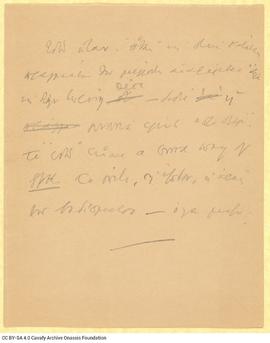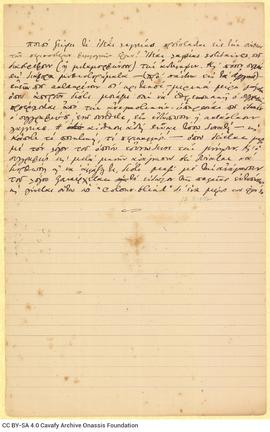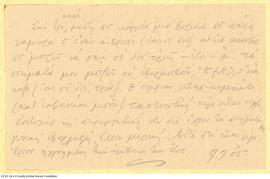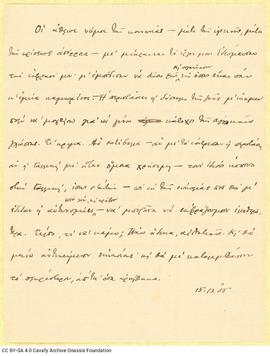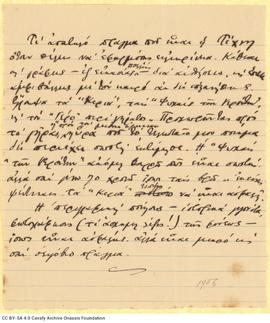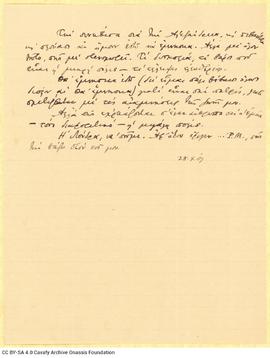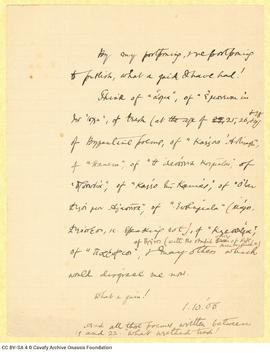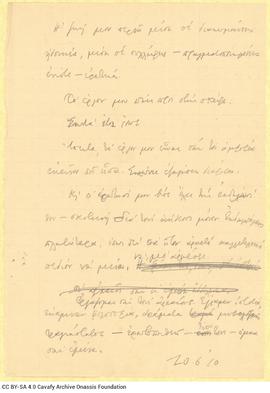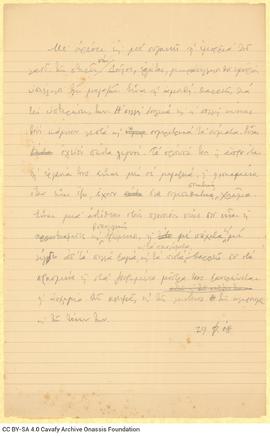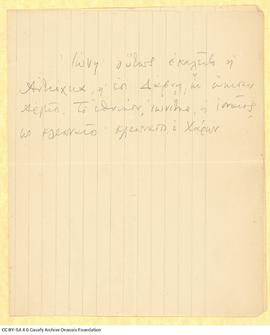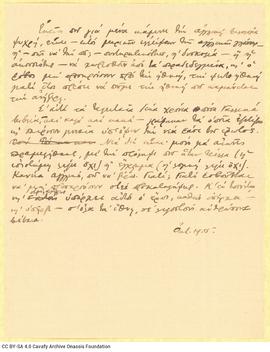
Handwritten text in English (most probably fragment of a letter) on three sheets. Numbering at top left of one of the pages: "4". Cancellations and emendations. Reference to the journal Grammata as well as instructions on the submission of articles.
Cavafy, C. P.Small piece of paper with two signatures by Cavafy in English ("C. P. Cavafy") on one side. The other side is blank.
Cavafy, C. P.Typewritten text on one side of a sheet, with handwritten additions of verses by Cavafy. The verses are from the French translation of the poem "Ithaca". Cancellations and emendations. Number "55" at the top of the verso. Comments on the French translation of the poem.
Cavafy, C. P.Handwritten note on one side of a ruled sheet on the use of "obsolete words".
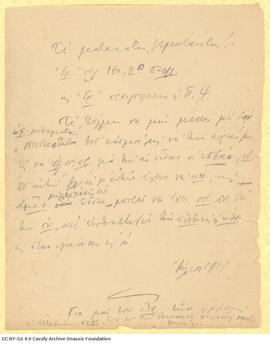
Cavafy, C. P.Handwritten note of linguistic content on the verso of a print with announcement of a performance by a French cast in June 1913. Cancellations and emendations in ink. Cavafy addresses a person and suggests the use of the word "lamperos" instead of "lampiros" / "lampyros" (he does not distinguish between the two spellings, despite the fact that the two words have completely different meanings in Greek).
Cavafy, C. P.Handwritten note on one side of a sheet. Blank verso. Comment on a poem with interpolated words in English.
Cavafy, C. P.Handwritten notes on either side of a piece of a ruled sheet. They are probably verses or comments on a poem.
Cavafy, C. P.Handwritten verses on one side of a small piece of paper.
Cavafy, C. P.Handwritten note by Cavafy on one side of part of a printed official paper. They are, most likely, verses. Fragment of a typewritten official text in English on the verso.
Cavafy, C. P.Handwritten note on one side of a ruled sheet. Use of English and French words. Date below the text. Blank verso. Cavafy's thoughts on his skills as an author and as a person as well as on his inherent inclination to literature.
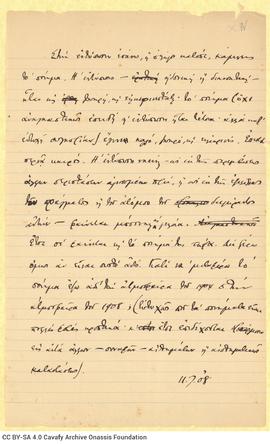
Cavafy, C. P.Handwritten note on both sides of two sheets. Thoughts by the poet on his life and work, on the occasion of a discussion with a young and poor author on poetic creation and livelihood. Date below the text. Three of the four pages are numbered. Cancellations and emendations in ink. The logo of the Public Works Department on the verso of one of the sheets (page "4").
Cavafy, C. P.Handwritten note on one side of half a sheet. Date at bottom right. Blank verso. Cavafy's thoughts on his own poetry.
Cavafy, C. P.Handwritten note on one side of a ruled sheet. Date at bottom right. Blank verso. Cavafy's thoughts on his own poetry.
Cavafy, C. P.Handwritten note on one side of a ruled sheet with Cavafy's thoughts on his poetry. Date in pencil at bottom right. Blank verso.
Cavafy, C. P.Handwritten note on one side of a notepaper with the poet's thoughts on his life in Alexandria and how much different it could have been, were he living in a large city abroad. Date below the text. Blank verso.
Cavafy, C. P.Handwritten note on the first page of a ruled double sheet notepaper. Reference to titles of poems of his, which Cavafy characterises as "garbage".
Cavafy, C. P.Handwritten note on one side of a ruled sheet with the poet's thoughts on his life and work. Date at bottom right. Cancellations. Blank verso.
Cavafy, C. P.Handwritten note on one side of a sheet with bibliographical reference and extensive use of abbreviations. Date at bottom right, repeated below a short note at the lowest part of the recto. The initials "P. Ps." are also noted.
Cavafy, C. P.Handwritten note by Cavafy on one side of an official letterheaded paper. Short quote from the Mercure de France, which probably contains a reference to the poet's work. Limited use of abbreviations.
Cavafy, C. P.Handwritten note on one side of a sheet. "V." below the text. It is probably a short quote.
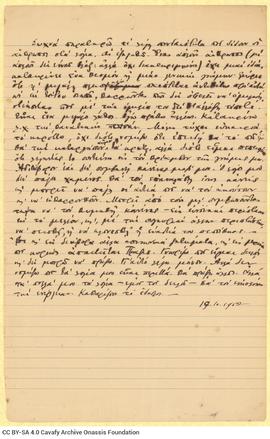
Cavafy, C. P.Handwritten note on one side of a ruled sheet. Date below the text. Blank verso. Cavafy expresses his thoughts on words and actions as well as on the importance of publicly expressing one's personal opinion.
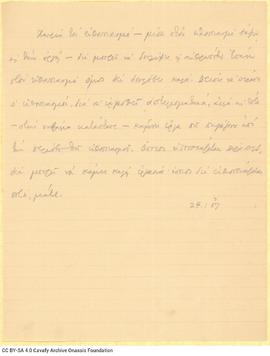
Cavafy, C. P.Handwritten note on one side of a ruled sheet containing Cavafy's thoughts on enthusiasm and its role in artistic creation. Date below the text. Blank verso.
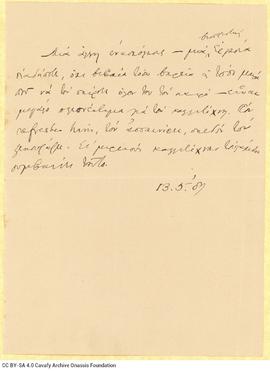
Cavafy, C. P.Handwritten note on one side of a notepaper with the poet's thoughts on work and its importance in the life and work of an artist. Date below the text. Blank verso.
Cavafy, C. P.Handwritten note on one side of a ruled sheet. Thoughts by the poet on society and special reference to the young people of financially weaker classes, whom he contrasts to those of wealthier classes. Date at bottom right. Blank verso.
Cavafy, C. P.Handwritten note on both sides of a ruled sheet with Cavafy's thoughts regarding power and authority in society. Date below the text. Cancellations and emendations.
Cavafy, C. P.Handwritten note on one side of an official sheet with date indication. On the verso, the typewritten phrase "Inspector General of Irrigation for Lower Egypt. A1" as well as crossed out notes. Cavafy's thoughts on the responsibility to future generations.
Cavafy, C. P.Handwritten text on both sides of half a ruled sheet and on the recto of a ruled sheet. Cavafy refers to a poem he composed inspired by the image of two beautiful youths and the melody they sang. Cancellations and emendations. Date indication.
Cavafy, C. P.Handwritten note on one side of a piece of paper. The date is noted in the bottom part of the last page. Abbreviated quote from the journal Mercure de France pertaining to Cavafy's poetry. Blank verso.
Cavafy, C. P.Handwritten note on one side of a ruled sheet, regarding the city Ioni. Blank verso.
Cavafy, C. P.Handwritten notes on truth and lie, old and new, on one side of a piece of ruled paper with date indication. Blank verso.
Cavafy, C. P.Handwritten note on three pieces of paper. The third one is numbered at top right of the recto. Blank verso. Citation and reference to the mythological figures of Thetis and Peleus.
Cavafy, C. P.Handwritten note regarding the lending money to J. Cavafy (it is obviously the poet's brother, John), repaid in 1912 and 1917. Blank verso.
Cavafy, C. P.Handwritten note on a piece of paper regarding the pension of Paul Cavafy.
Cavafy, C. P.Handwritten note mentioning domestic repairs (bedroom, kitchen, lavatory, etc.), on the first page of a ruled bifolio. The remaining pages are blank. The indication "1908-1914" at the top of the first page. Amounts of money noted in two cases.
Cavafy, C. P.Handwritten note by Cavafy related to household chores on both sides of a ruled sheet. Detailed description of periodic tasks having to do with the cleaning of the poet's apartment. Mention of the names of two housekeepers (Ahmet, Hassan), obviously Egyptians.
Cavafy, C. P.Handwritten note by Cavafy It refers to a person that is not named and pertains to an amount of money (183 Egyptian pounds). The dates mentioned cover the period 1907-1908.
Cavafy, C. P.Handwritten note on one side of a sheet with text in ancient Greek and bibliographical reference. The note "Dionysiou Kyzikinou" ("Of Dionysius Cyzicenus") at bottom left, by a hand other than the poet's. Blank verso.
Cavafy, C. P.Handwritten note on one side of a printed broadsheet, referring to Flavius Jovianus Augustus. The note probably correlates to the poem "A Great Procession of Priests and Laymen", given that Jovian is mentioned in its last verse. Bank verso.
Cavafy, C. P.Handwritten note on one side of a ruled sheet. Date below the text. Blank verso. Cavafy's thoughts on the English and French language and literature as well as on homosexual love.
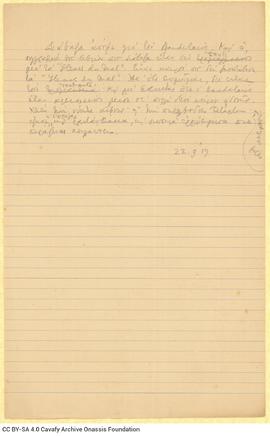
Cavafy, C. P.Handwritten note on one side of a ruled sheet with Cavafy's thoughts on Ch. Baudelaire and his work Les fleurs du mal. Date below the text. The remaining pages are blank.
Cavafy, C. P.Handwritten note on one side of a ruled sheet with Cavafy's thoughts on his poetry and the poem composition process. Date at bottom right. Blank verso.
Cavafy, C. P.Handwritten note on the verso of a printed item of the company Garoufalias & Co. Reference to a publication in the newspaper Patris, which, in turn, refers to an article by René Puaux in the Journal des Hellènes, on the dissemination of Greek literature in France.
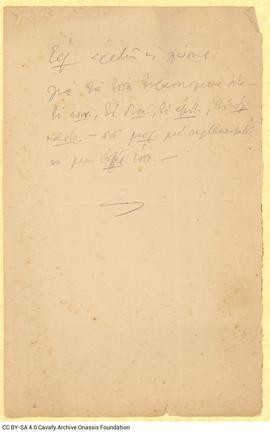
Cavafy, C. P.Handwritten note on one side of a ruled sheet. Comments on a poem. The note "Rep." on the verso.
Cavafy, C. P.Abbreviated handwritten note on one side of a sheet. One may distinguish the words "virtue" and "sadness".
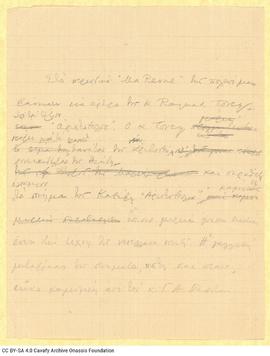
Cavafy, C. P.Handwritten note on one side of a ruled sheet regarding an article by Raymond Torcy on the poem "Aristobulus" by Cavafy, which appeared in the journal Ma Revue of Alexandria. The poem had been translated into French G. A. Papoutsakis.
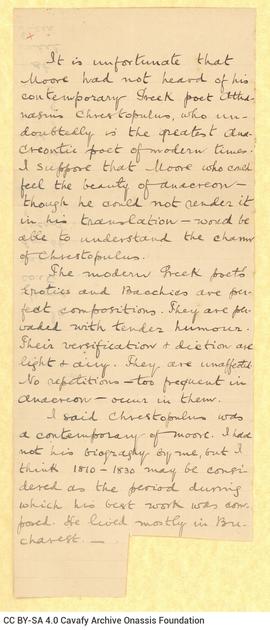
Cavafy, C. P.Handwritten note on one side of part of a ruled sheet referring to Thomas Moore and Athanasios Christopoulos.
Cavafy, C. P.Handwritten note on one side of a sheet. Blank verso. It is probably a short quote. The tilte "Manon Lescaut" is observed.
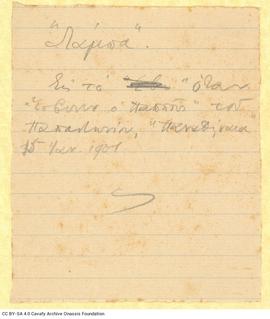
Cavafy, C. P.Handwritten note on one side of a piece of paper. Blank verso. Reference to a text by Zacharias Papantoniou published in the 1901 Panathinaia.
Cavafy, C. P.Handwritten note on one side of a piece of paper, regarding the poem "Temethus, an Antiochene: 400 A.D.".
Cavafy, C. P.Untitled handwritten text on both sides of a ruled sheet. Cancellations, emendations, extensive use of abbreviations. Possibly comments by Cavafy on one of his poems.
Cavafy, C. P.Handwritten notes by Cavafy on one side of a ruled paper. Reference to the titles of two works by Jane Austen, Pride and Prejudice and Emma.
Cavafy, C. P.Handwritten note on one side of a sheet, initially folded in half so as to form a handmade folder. Blank verso. The note refers to statements by prince Aziz regarding 1912 military operations in northern Thrace ("Statements of Prince Aziz about the military operations (1912) in the north of Thrace").
Cavafy, C. P.Handwritten note by Cavafy, of personal nature, on one side of a cut piece of paper folded in a bifolio. Cancellations. Addressed to an unknown individual, whom the poet would like to meet but does not know their address. Arithmetic operations on the verso.
Cavafy, C. P.Handwritten note by Antonios Ralli to Cavafy, related to the illness of his brother, Mike Th. Ralli, on the verso of a letterhead.
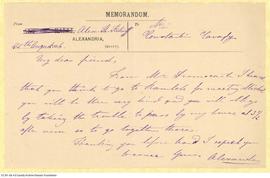
Ralli, Ant. [Totty]Handwritten note by Alexander Kitroeff to Cavafy on one sheet marked "Memorandum". The author is asking Cavafy to accompany him to Ramli, in order to meet Michel (Mike Th. Ralli).
[Kitroeff], AlexanderHandwritten note by Alexander Kitroeff to Cavafy on a sheet marked "Memorandum". Information about the arrival of Michel (Mike Th. Ralli) in Alexandria.
[Kitroeff], AlexanderHandwritten note by Alec Skouffi to Cavafy. It is an invitation on behalf of his sister, Aikaterini Trechaki, in order for Cavafy to make the acquaintance of Georgios Koromilas.
Scouffi, [Alec]Handwritten note by the director of the Alexandrian newspaper Tilegrafos A. Kyriakopoulos to Cavafy, on both sides of a business card of the former. The poet is announced that his collaboration with the newspaper is terminated.
Kiriacopoulo, A.Handwritten note by Athina Emm. Maximou to Cavafy. The Maximou couple intends to relinquish the management of Eleni Cavafy's (the daughter of the poet's brother, Alexandros) estate to her. [Alexandria]
Maximou, Athina Emm.Handwritten note by Apostolopoulos to Cavafy, with reference to the poems "The City" and "Ithaca". (Paris)
Apostolopoulos, [Apostolis]Handwritten recommendation note by C. P. Cavafy for Alekos Singopoulo.
Cavafy, C. P.Double-sheet cover made of hard paperboard of a British fire insurance company (1894-1895 edition). Handwritten note by Cavafy ("Old Menus – Various curiosities & familials, etc.") at the top of the first page. It has been used as a folder enclosing all items included in the specific file (of the original arrangement).
Cavafy, C. P.Untitled manuscript poem in English ([More happy thou...]), written on the recto of two pieces of paper with numbering at the top, "Νο 1" and "Νο 2" respectively. The handwriting is not Cavafy's. At the bottom of the recto of the second paper, the signature "C. P. Cavafy" is not written by the poet. Blank versos.
UnknownHandwritten poem by Cavafy on both sides of a ruled sheet that has been cut in half. It is entitled "Nichori"; date indication in brackets. Handwritten notes, some of which have been crossed out, on the verso, below the text of the poem. Numbers "46" and "47" at top right of the recto and at top left of the verso respectively. The title has been underlined and there is a line in red ink below the poem. Accompanied by a small-size piece of paper with the typewritten note "Not for publication; but may remain here-", which is completed in handwriting "as autobiographical".
Cavafy, C. P.Announcement of the death of Aristeidis Cavafy.
Tilegrafos (Alexandria), newspaperAnnouncement of a memorial service for Peter Cavafy, brother of C. P. Cavafy.
Tilegrafos (Alexandria), newspaperAnnouncement of the death and funeral of Peter Cavafy. Mention of his job title, detailed description of the ceremony.
Tilegrafos (Alexandria), newspaperThree copies of the newspaper Tilegrafos of Alexandria. On the first and second pages, an article by Cavafy entitled "Lamia", regarding the poem by Keats under the same title. The article is signed with the initials "C.F.C.".
Tilegrafos (Alexandria), newspaperTwo copies of the newspaper Tilegrafos of Alexandria. An article by Cavafy, on the first and second pages, regarding the poetry of Georgios Stratigis. It is signed "C.F.C.".
Tilegrafos (Alexandria), newspaperTwo issues of the Tilegrafos newspaper of Alexandria.
Tilegrafos (Alexandria), newspaperIssue No 2588 of the newspaper Tilegrafos of Alexandria. Cavafy's article "The Byzantine Poets", signed "C.F.C.", in the first page.
Tilegrafos (Alexandria), newspaperIssue of the newspaper Tilegrafos of Alexandria. Article by Cavafy, on the first page, entitled "The Cypriot Question" and signed "C.F.C.".
Tilegrafos (Alexandria), newspaperClipping from the weekly newspaper The Saturday Review, which contains an article by J. Churton Collins entitled "The authorship of "Rule Britannia" ". It is pasted on a piece of paper. The issue details are handwritten by Cavafy on the affixed piece of paper.
The Saturday Review (magazine)Announcement of the death of Alexandros Cavafy. Mention of the cause of his death.
The Egyptian Gazette (Alexandria), newspaperIssue No 3984 of the Piraeus newspaper Tharros. The poem "Monotony" is published on the second page, marked in red pencil. Cavafy's names and postage stamps on the first page.
Tharros (newspaper)Announcement of the death of Alexandros Cavafy. Reference to the cause of his death and to his family.
Tachydromos (Alexandria), newspaperIssue of the newspaper Tachydromos of Alexandria.
Tachydromos (Alexandria), newspaperIssue No 424 of the newspaper Salpinx of Limassol. The last part of the article by G. Siakallis on the Cyprus issue in the first page.
Salpinx (newspaper)Article regarding the funeral of George Fotiadis, Cavafy's maternal grandfather, in Istanbul. The ceremony is described in detail. In the margin of the printed text, the handwritten note in ink "Buried in the grave of our mother", possibly in the hand of Cavafy's mother, Charikleia.
The Oriental Advertiser - Le Moniteur Oriental (Istanbul), newspaperIssue of the newspaper Neon Asty of Athens. Article of linguistic content entitled "Talaiporos glossa", and reference to Ptochoprodromus.
Neon Asty (newspaper)Announcement of the death of Aristeidis Cavafy. Reference to his family.
Le Phare d'Alexandrie (newspaper)Issue no 146 of the French-language newspaper Le Phare d'Alexandrie.
Le Phare d'Alexandrie (newspaper)Seven editions of the Paris newspaper Le Matin and five editions of another Paris newspaper, Le Journal. They are accompanied by a piece of paperboard with the note "Les Noces Blanches", written by Cavafy. It is about the case of a scandal involving homosexuals in the atelier of the British painter Ernest Bulton, at Montparnasse, Paris. The police arrested the participants and the incident was considered a scandal. The newspapers referred to it using the title "Noces blanches" (white weddings). Cavafy follows the case through articles in the two newspapers.
Le Matin (newspaper)Issue No 38 of the Parisian newspaper Le Figaro.
Le Figaro (newspaper)Issue no 63 of the French-language newspaper La Réforme, published in Alexandria.
La Réforme (newspaper)Issue No 205 of the French-language newspaper La Réforme which was published in Alexandria.
La Réforme (newspaper)Ten issues of the French-language newspaper La Réforme of Alexandria (one of the issues is double). Only the first two pages of the first issue are preserved. Accompanied by a piece of paper with Cavafy's handwritten note "The Wardani Case". The poet is following up the trial of the Ibrahim (al-) Wardani case, who murdered the Prime Minister of Egypt, Butros Ghali, and was ultimately executed.
La Réforme (newspaper)The first two pages of issue No 159 of the French-language newspaper La Réforme of Alexandria. It contains an article on the Cretan issue on the first page.
La Réforme (newspaper)Three consecutive issues of the newspaper Konstantinoupolis ("143" to "145"). On the first page of each issue a study by Cavafy entitled "Lamia" is published, regarding the poem by Keats under the same title. The articles are signed "Const. F. Cavafy".
Konstantinoupolis (newspaper)Issue of the newspaper Konstantinoupolis. Article by Cavafy on the first page, entitled "Ellinika ichni en to Sakespiro" and signed "C. F. Cavafy".
Konstantinoupolis (newspaper)Issue No 144 of the daily newspaper "Konstantinoupolis" of July 1893 (year 27). It is accompanied by an envelope with Singopoulo's name. It contains an article by Cavafy entitled "Lamia" (second of a total of four parts).
Konstantinoupolis (newspaper)Issue 2154 of the newspaper Kairon. Announcement of the death of Cavafy's mother, Charikleia Cavafy.
Kairon (Cairo-Alexandria), newspaperIssue 323 of the weekly newspaper Foni tis Kyprou. It contains the republication of part of an article by Cavafy entitled "The Cypriot Question", originally published in the newspaper Tilegrafos newspaper of Alexandria.
Foni tis Kyprou (newspaper)Announcement of the death of Cavafy's mother, Charikleia Cavafy. Mention of the circumstances of her death.
Ermis (Cairo), newspaperAnnouncement of the wedding of Aristeidis Cavafy and Maria Vourou. Mention of people who attended the ceremony.
Elpis (Alexandria), newspaperIssue No 267 of the newspaper Elenchos, published in Florina. A presentation of the book Kritika simeiomata by Anastasios Fragkos, with positive comments on Cavafy's work is published in the the "Literary Column" of the second page. It is signed by Stefanos Myrtias. The column is marked in sky blue pencil. In the top right of the first page, the note: For Mr C. P. Cavafy".
Elenchos (newspaper)Issue of the French sports newspaper Paris-courses: Journal quotidien de sport in Paris.
Paris-courses: Journal quotidien de sport (newspaper)Issue numbered 135 of the French newspaper Le Vaudeville: Journal quotidien, indépendant.
Le Vaudeville: Journal quotidien, indépendant (newspaper)Issue of the French newspaper Le Palais-Royal: Journal quotidien indépendant in Paris.
Le Palais-Royal: Journal quotidien indépendant (newspaper)Issue of the French newspaper Le Jockey in Paris.
Le Jockey (newspaper)