
"The God Abandons Antony"

Elements area

Taxonomy

Code

Scope note(s)

    Source note(s)

      Display note(s)

        Hierarchical terms

        "The God Abandons Antony"

        "The God Abandons Antony"

          Equivalent terms

          "The God Abandons Antony"

            Associated terms

            "The God Abandons Antony"

              3 Archival description results for "The God Abandons Antony"

              3 results directly related Exclude narrower terms
              GR-OF CA CA-SF02-S01-SS01-F18-SF003-0045 (660) · Item · 10/23 March 1919
              Part of CAVAFY, C. P. FONDS

              Handwritten letter by Nikos Hayer Boufidis to Cavafy, in which he expresses his admiration for his work and asks to be sent poems. (Athens)

              Chager Boufidis, N.
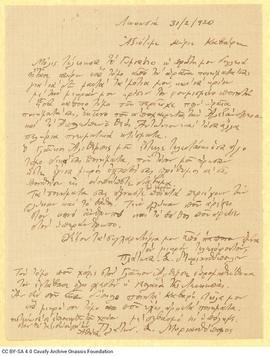
              GR-OF CA CA-SF02-S01-SS01-F18-SF003-0054 (668) · Item · February 1920
              Part of CAVAFY, C. P. FONDS

              Handwritten letter by Platon S. Myrianthopoulos to Cavafy, in which he expresses his admiration for the poet's work and asks to be sent a volume with his poems. He mentions that he became acquainted with Cavafy's work thanks to Glafkos Alithersis and notes that it is by now widespread amongst the youths of Nicosia, whence he is sending his letter. (31/2/1920 [sic])

              Myrianthopoulos, Platon S.
              GR-OF CA CA-SF02-S01-SS01-F18-SF003-0060 (512) · Item · 16/10/1920
              Part of CAVAFY, C. P. FONDS

              Handwritten letter by Polys Modinos to Cavafy in three sheets, with notes to the recto of the last. References to Hubert Pernot –Modinos urges Cavafy to write to him–, to J. Kefalinos, K. Varnalis –for whom there are comments on his personal opinion on K. Palamas– as well as to a poet who wrote a sonnet dedicated to Cavafy and intends to visit him in Alexandria. Extended reference to Miltos Kountouras and the opinion he expressed regarding Cavafy's poetry as well as to Psichari. The sheets are numbered (2, 3). Handwritten note in pencil ("Modinos"). at the end of the text, below the sender's name (Polys). (Paris)

              [Modinos], Polys