Advertisement card of the English apparel company Hope Brothers in London. On verso, information on the company’s branches in England.
Hope Brothers Ltd (London)London (England)
108 Archival description results for London (England)
Theatre programme of the Royal Strand Theatre in London for the plays The Queen’s Proctor by Herman Merivale and Doctor Johnson by Leo Trevor. Arthur Bourchier and Violet Vanbrugh are the protagonists. Advertisements on the back cover.
The Royal Strand Theatre (London)Handwritten catalogue of the periodicals in Cavafy's library, comprising five sheets, the last of which is blank. The first sheet is in lieu of cover. Cancellations and notes. The dates mentioned cover the period 1883-1905.
Cavafy, C. P.Two copies of a handwritten letter by Cavafy to The Hogarth Press publishing house, in two bifolios with notes on all sides. It is a reply by Cavafy to a letter he had received on 16 November, pertaining to the publication of translated poems of his. Commentary on the agreement between the two parties and the translation work per se, with references to G. Valassopoulo, E. M. Forster and L. Woolf. Cancellations and emendations. The word "Copy" marked in pencil in the first page of each bifolio. (Alexandria)
Cavafy, C. P.Two handwritten copies of receipts from The Nation and Athenaeum dated 9/8/1924 and 16/7/1924. (London)
Typewritten letter, accompanying a checque to Cavafy, from the management of the journal. The date, name, amount and month are handwritten. (London, 28/7/1924)
Envelope to the director of The Nation and Τhe Athenaeum and another envelope to Cavafy with mail rubber stamp of 28/7/1924 and handwritten note regarding its receipt on 5/8/1924.
Handwritten copy of a checque to Cavafy (written by himself) from The Nation and Athenaeum. Accompanied by envelope with the poet's name and address.
Cavafy, C. P.Typewritten copy of a letter by Alekos Singopoulo to Dimitrios Galanis on the recto of two sheets. Blank versos. The second page is numbered at top right. The sender asks the artist's opinion on the planned French publication of Cavafy' work and informs him on all other impending publications (in English, and anthology to be printed in Switzerland, an Italian anthology, and a Greek re-publication). (Alexandria)
[Singopoulo, Alekos D.]Typewritten copy of a letter by Alekos Singopoulo to Leonard Woolf on one side of a sheet. Blank verso. He informs him that he is sending the signed contract and hopes that the printing of the publication of Cavafy's poems will begin soon. Accompanied by the copy of a telegram, in which Singopoulo informs him that he accepts the terms and that he is sending the contract. Also accompanied by the printed four-page contract between The Hogarth Press and Singopoulo, signed by himself and Woolf.
[Singopoulo, Alekos D.]Typewritten copy of a letter by Alekos Singopoulo to The Hogarth Press on one side of a sheet. Blank verso. Handwritten notes at bottom right of the recto. The sender asks for an update on the delay of the English publication of Cavafy's poems and expresses his satisfaction with the result. He also asks for an update on the reception of the book by the British public and the relevant critique and proposes newspapers of Egypt to which copies could be sent. The letter is accompanied by a typewritten translation thereof on the recto of a sheet. (Alexandria)
[Singopoulo, Alekos D.]Handwritten copy of a receipt from a collaboration between Cavafy and The Criterion. Accompanied by the original typewritten letter of the journal. (London)
Cavafy, C. P.Handwritten copy of a checque to Cavafy from the Faber & Gwyer publishing house of London, on both sides of a paper. Notes in pencil. Typewritten letter by the same publishing house, accompanying the checque, for collaboration between the poet and the journal The Criterion. Cancellations, emendations and notes. (London)
Cavafy, C. P.Envelope sent to Cavafy from London with mail rubber stamp (26/5/1924) and handwritten note in pencil, which was received on 3/6/1924. Handwritten copy of a receipt for £3,30 from the director of The Nation and Athenaeum for the April 1924 collaboration, by Cavafy's hand (6/6/1924). Printed accompanying note regarding the despatch of a checque for £3,30 from the management of the journal on 26/5/1924. The date, amount, Cavafy's name and month are handwritten.
Cavafy, C. P.Handmade folder with the annotations "Dictionary 3" and "Dia-Euth". Pieces of paper and print clippings with notes and quotes for the Dictionary. It includes the entries "Diaisthisis-Euthymologos". Quotes from various bibliographical sources below each entry. The title and author of each work are cited and often the place of publication and the publishing house.
Cavafy, C. P.Handwritten list for the distribution of the collection of poems published after the 1910 Issue, consisting of four cut sheets of notepaper initially folded in bifolios with notes on all sides and of a broadsheet written on one side. The names of individuals are recorded in chronological order (1912-1918), and next to them the number of issues to be sent to each of them is mentioned; there are also notes by Cavafy regarding the person who mediates for the acquisition of the issue or who will be the final recipient. At the top of the list it is stated that the distribution started in April 1912. The total of issues distributed is recorded at the end of each column which is subsequently carried forward to the top of the next one.
Cavafy, C. P.Typewritten draft letter by Alekos Singopoulo to E. M. Forster on both sides of a sheet. The sender refers to the delay in the English publication of Cavafy's poems and agrees to pay the necessary amounts of money. He also refers to a planned publication of Cavafy's historical poems with an introduction by Valassopoulo. He asks, on behalf of Michalis Peridis, that the Cavafy-Forster correspondence be sent to him, so as to be used in the book that Peridis is preparing. Cancellations and handwritten emendations. (Alexandria)
Singopoulo, AlecoHandwritten draft letter by Cavafy to E. M. Forster on both sides of an undated printed broadsheet with the poem "The Satrapy" (with cancellations and emendations). He informs the latter of the completion of the English translation of the poem "Darius" by G. Valassopoulo.
Cavafy, C. P.Handwritten draft letter by John Cavafy to his brother, George Cavafy, on four sheets, the first, third and fourth of which are numbered. John informs him of the departure of their brother, Aristeidis, for Marseilles after having abandoned his wife, and of the relevant letters sent by Aristeidis to members of his family. His wife's family (Vouros) threatens to take harsh measures if Aristeidis does not return soon. The sender asks George to convince Aristeidis to return to Egypt as soon as possible. The draft letter has been written by at least two different persons, but not by John (seemingly by some of his brothers). Even John's name on the last page is written in a handwriting different from his own. (Alexandria)
Cavafy, JohnDraft letter by Cavafy to Leonard Woolf on the first page of a bifolio and second draft on both sides of a sheet (one of the sides has been crossed out). Cancellations. Cavafy expresses his joy for the publication of his poems and refers to the revision of the English translations of his poems. Envelope with the name and address of Leonard Woolf. (Alexandria)
Cavafy, C. P.Envelope of the English Craven Hotel in London. Inside the envelope, A. Aubert’s business card regarding the gold plating of jewelry in Paris.
The Craven Hotel (London)Handwritten draft of the poem "From the Unpublished History" on the recto of a sheet. On the verso, note with a reference to the publication J. Bury, History of the Later Roman Empire, London, MacMillan & Co., 1923. Handmade folder from a printed cover of a Cavafy poetry Collection of the 1915-1923 period ("1923" is handwritten, while all printed details have been crossed out). The handwritten title of the poem and the date on the verso of the cover.
Cavafy, C. P.Handwritten text on seven sheets and one piece of paper. On the recto of the first sheet, the title "Genealogical Gossip or Various bits of the History of our Father's & Mother's family thrown together" as well as the indication "5 May '83", in pencil. Blank verso. Sheets 2-6 are written on both sides. At the bottom of the verso of the sixth sheet, the poet's signature, the date and the place: "Constantine Cavafy / 15 April 1883 / Yenikeuy (Constantinople) / At Mons. G. Fotiadis villa". "Addenda to Genealogical Gossip" " on the recto of the seventh sheet. On the piece of paper, notes, most likely by John Cavafy, on the family branch in London and in Liverpool. It should be dated to a period postdating the rest of the text, as the latest year recorded is 1891. The text refers to all that the poet heard and learned in Istanbul from his grandfather George Fotiadis and from his aunt Roxandra Plessou, his father's sister, regarding the ancestors of the Cavafy and Fotiadis families.
Cavafy, C. P.Manuscript on two large-size sheets affixed to one another so as to form a double sheet paper. It contains the Cavafy family tree, going back to the generation of their father, Peter John Cavafy. The date of birth and death of the family members is recorded as well as other relevant information. There is also record of the Cavafy family crests and crowns as well as other "Notes", explanatory of the family tree.
[Unidentified]Printed note of The Nation and The Athenaeum with payment note for £3,3 to Cavafy for publishing in the journal in October. The date, name and amount are handwritten. Accompanied by envelope with the poet's address. (London)
The Nation and The Athenaeum (journal)Handwritten letter by Charikleia Cavafy to her sons, Constantine and John, on all four pages of a bifolio with mourning border. The two siblings are in London and are preparing to return to Alexandria via Paris and Marseilles. Charikleia refers to her correspondence with her sons and their return. She also conveys news about the weather and social life in Alexandria, and expresses her concern about the typhoid outbreak in Marseilles. Interpolated words and phrases in English and French. (Alexandria)
K., X. [Cavafy (Fotiadi), Charikleia]Handwritten letter by Charikleia Cavafy to C. P. Cavafy and his brother John in all four pages of a bifolio with mourning border. The two siblings are in France and will continue their journey to England. Their mother refers to the correspondence between them, the weather and her health, as well as to her visit to the house of the Moss family. Interpolated words and phrases in English and French. (Alexandria)
Cavafy, Ch. [Charikleia]Handwritten letter by D. P. Petrokokkinos to Cavafy on one side of a sheet. Embossed address at top right. He thanks Cavafy for the despatch of three poetry collections to Samuel Baud-Bovy. Accompanied by a second sheet with a quote from a study by J. N. Mavrogordatos with reference to Cavafy and his work (London, MacMillan & Co, 1931). (Athens)
Petrokokkinos, D. P.Handwritten note by E. M. Forster to Cavafy, signed "Fellow-poet". The note mentions the London Reform Club as the place of dispatch, but the postage rubber stamp on the envelope mentions Weybdridge, with the same date. The sender expresses his disappointment in Cavafy's protracted silence in a satirical quatrain.
Forster, E. M.Handwritten letter by E. M. Forster to Cavafy on a double sheet letterheaded notepaper of the Reform Club. It pertains to the possible publication of a collection of Cavafy's poems by the Hogarth Press and to the publication of "Darius" in The Nation. Accompanied by envelope. (London)
Forster, E. M.Letter by E. M. Forster to Cavafy on both sides of a sheet with the printed address "Harnham, Monument Green, Weybridge". Discussion on the possibility of an English edition of Cavafy's poems; the issue of the publishers is raised once more. Accompanied by envelope.
Forster, E. M.Handwritten letter by E. M. Forster to Cavafy on the first and last pages of a bifolio. It pertains to the article that was published on the latter's work in The Athenaeum. Accompanied by its envelope. (Harnham Monument Green, Weybridge)
Forster, E. M.Handwritten letter by E. M. Forster to Cavafy on both sides of a sheet. He informs him that the Hogarth Press would be interested in publishing poems of his and urges him to send them translations thereof. Accompanied by envelope. (London)
Forster, E. M.Handwritten letter by E. M. Forster to Alekos Singopoulo on both sides of a letterhead with his address in Dorking, England, printed. He thanks him for the despatch of three copies of the publication of Cavafy's poems and refers to the prospect of publishing them in English as well.
Forster, E. M.Handwritten letter by George Cavafy from Manchester. It is addressed to his brother, Peter John, the poet's father, who is in London. The letter is written on the recto of a sheet. The address of Peter John is written on the verso. The sender refers to a financial facilitation to his brother, for which he explains that he should not feel bad. He also refers to the prospect of becoming involved in commerce in Egypt.
[Cavafy], Georgios [I.]Handwritten letter by I. Stamatiadis to Paul Cavafy in four bifolios. The third page of the second bifolio is blank. On the fourth, the note "J. Stamatiadis". Personal and social news. (Istanbul)
Stamatiadis, I.Handwritten letter by John Cavafy to C. P. Cavafy on the first and third pages of two double sheet leterheads of R. J. Moss & Co., Alexandria. Pages 2-4 are numbered at top right. Comments on religion and atheism, and update on the situation in Alexandria. Linguistic remarks and comment on the origin of "ΟΚ". Short quote in French.
Cavafy, JohnHandwritten letter by John Cavafy to C. P. Cavafy on three letterhead of R. J. Moss & Co., Alexandria. Pages 2-5 are numbered. Social news from Alexandria. Quote from Past and Present by Thomas Carlyle.
Cavafy, JohnHandwritten letter by John Cavafy to C. P. Cavafy on the first and third pages of a double sheet letterhead of the R. J. Moss & Co., Alexandria. The sender refers to the warm weather and to the cholera epidemic, which, however, has not yet reached the city. Comments on international and family matters. (Alexandria)
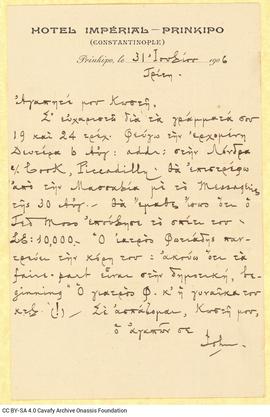
Cavafy, JohnHandwritten letter by John Cavafy to C. P. Cavafy in the first page of a bifolio of the Imperial-Prinkipo Hotel. The sender informs about his impending trip to London. He also conveys family and social news, and makes an acrimonious reference to the wedding of doctor Fotiadis' daughter because of the demotic language used in the invitation. (Istanbul)
Cavafy, JohnHandwritten letter by John Cavafy to C. P. Cavafy on the recto of six ruled letterheads of R. J. Moss & Co., Alexandria. Sheets 2-6 are numbered at top right. Family and financial issues are raised, as well as poetry, Cavafy's genealogical notes, the political situation in Alexandria and Egypt in general. Commentary on poems composed by John.
Cavafy, JohnHandwritten letter by John Cavafy to C. P. Cavafy on the first and third pages of a double sheet letterhead of R. J. Moss & Co., Alexandria. The sender refers to family correspondence and comments positively on his brother's way of writing. He also refers to financial and social matters.
Cavafy, JohnHandwritten letter by John Cavafy to C. P. Cavafy on the first and third pages of two double sheet letterheads of R. J. Moss & Co., Alexandria. Pages 3 and 4 are numbered at top right. Update on current affairs and on the developments in Alexandria. Thoughts on literary works.
Cavafy, JohnHandwritten letter by John Cavafy to C. P. Cavafy, on the first and third pages of a double sheet notepaper of R. J. Moss & Co., Alexandria. Comments on one pf his poems; linguistic remarks. Social news.
Cavafy, JohnHandwritten letter by John Cavafy to C. P. Cavafy on both sides of a sheet. Page 2 is numbered. John expresses his optimism that the Egyptian Government will soon pay the indemnities. He also informs his brother about the despatch of a book. (Alexandria)
Cavafy, JohnHandwritten letter by John Mavrogordato to Cavafy on both sides of a sheet. The author asks Cavafy to send him his latest poems and comments on the way one may acquire access to them. Reference to the poem "Before Time Could Alter Them" and to the journal Protoporia. Accompanied by the envelope which contained the letter. (London)
Mavrogordato, JohnAutograph typewritten letter by Leonard Woolf on one side of a letterhead of The Hogarth Press. He expresses his optimism on the publication of a volume with Cavafy's poems the following spring. (London)
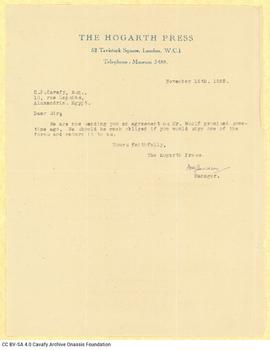
Woolf, LeonardAutograph typewritten letter by Leonard Woolf to Cavafy on one side of a letterhead of The Hogarth Press. He proposes the publication of the English translations of Cavafy's poems as well as the financial terms of the agreement. Accompanied by envelope. (London)
Woolf, LeonardHandwritten letter by Maria (Marigo) Cavafy to Paul Cavafy on all pages of a bifolio. Embossed address "10, Fourth Avenue, Hove" at top right of the first page. Personal news. (Hove)
Cavafy, MarigoHandwritten letter by Maria (Marigo) Cavafy to Paul Cavafy on a bifolio. Her printed monogram at top left of the first page. Information on Barbette Valieri, her dowry and family. (London)
Cavafy, MarigoHandwritten letter by Maria (Marigo) Cavafy to Paul Cavafy on the first three pages of a bifolio. The last page is blank. Her address in print at top right of the first page. She asks Paul to meet her in London. (Hove)
Cavafy, MarigoHandwritten letter by Maria (Marigo) Cavafy to Paul Cavafy on the first three pages of a bifolio. The last page is blank. Marigo's printed monogram at top left of the first page. Update on Barbette Valieri' dowry. She does not foresee a positive outcome for the matchmaking. (London)
Cavafy, MarigoHandwritten letter by Maria (Marigo) Cavafy to Paul Cavafy in a bifolio with mourning border. The address "10, Fourth Avenue, Hove" at top right of the first page. Thanks for the family's condolences for the death of her brother. Personal and family news. (Hove)
Cavafy, MarigoHandwritten letter by Mike Ralli to Cavafy on both sides of a sheet. He informs him about the previous letter he has sent and comments on books he has read (Secret History of the Court of England by Anne Hamilton, Life of William Pitt by T. Macaulay) or wishes to acquire (The History of England by T. Macaulay, The French Revolution by T. Carlyle). He briefly describes his schedule for the following day, giving details on clubs and entertainments in Alexandria and urges Cavafy to return. Cancellations and emendations. (Alexandria)
Ralli, M[ichael Th.]Handwritten letter by Mike Ralli to Cavafy on two sheets, with notes until the recto of the second. It is a reply to a letter dated 3 November. Reference to the matter of his eyesight and to the book How to use our eyes [and how to preserve them by the aid of spectacles] by J. Browning, with whom he is in correspondence. He expresses satisfaction for his business with a foreign publishing house (Routledge); he mentions, inter alia, the work "Theodora" by Kl. Ragkavis. On the occasion of his engagement in hunting, he gives information regarding the regime of entry into privately owned areas ("Pastré’s Gardens"). (Alexandria)
Ralli, M[ichael Th.]Handwritten letter by Mike Ralli to Cavafy on the recto of three sheets. Remarks on the 1884 crisis ("Change panic") and its impact on the financial activity in the area, with references to companies that went bankrupt. Commentary on persons of the social circle of Alexandria. Description of entertainment and free time habits of the time. Sheet numbers are indicated (2-3). (Alexandria)
Ralli, M[ichael Th.]Handwritten letter by Mike Ralli to Cavafy on two bifolios, with notes on all sides. It is a reply to a letter by Cavafy. The author describes his stay in England, with reference to persons from his family circle but also from the broader social circle of the two men. (Liverpool)
[Ralli], Mike [Th.]Handwritten letter by Mike Ralli to Cavafy in two bifolios with mourning border, with notes on all sides. The author describes his stay in London and mentions all known sights and other places in the city (Zoological Garden, Madame Tussauds Museum, Royal Academy of Arts, Doré Gallery). He also provides information and expresses his views on performances ("Ruy Blas", "Faust", "The Mikado") that are on in London and that time. Commentary on people from his family circle but also from the broader social circle of the two men. (London)
R., M. [Ralli, Michael Th.]Handwritten letter by Mike Ralli to Cavafy on the first three pages of a bifolio. Information about the author's return to Egypt. Commentary on individuals of the friendly and broader social circle of the two men. (Liverpool)
[Ralli], Michael [Th.]Handwritten letter by Mike Ralli to Cavafy on three bifolios, with notes on all sides. The author describes his stay in London. Commentary on people from his family circle but also from the broader social circle of the two men as well as on events that reflect the mores of the time. Reference to the "Exhibition" –it is probably the "International Inventions Exhibition"– and to the Métropole Hotel. (London)
Ralli, M[ichael Th.]Handwritten letter by Mike Ralli to Cavafy on the recto of four sheets. It is a reply to a letter dated 28 February. Extensive description of an encounter of personal nature, which reflects the mores of the time. Detailed commentary on persons of the social circle of Alexandria. Underlined French words and expressions in the text. The second sheet is numbered. (Alexandria)
Ralli, Michael [Th.]Handwritten letter by Mike Ralli to Cavafy, in two distinct parts, comprising one bifolio and one sheet with notes on all sides. Information about the author's return to Egypt. Commentary on individuals of the friendly circle of the two men. Reference to the author's personal expenses and to the eyesight problems he is facing. He expresses his opinion regarding a potential job in England. Cancellations. (Liverpool)
[Ralli], Miké [Th.]Handwritten letter by Mike Ralli to Cavafy on the first three pages of a bifolio with mourning border. It is a reply to a letter dated 6 August. The author expresses his enthusiasm regarding the possibility of Cavafy's return to Alexandria. Information on individuals of the Ralli family. (Alexandria)
Ralli, M[ichael Th.]Handwritten letter to Cavafy on both sides of a letterhead of the Waldorf hotel. The author informs the poet about a meeting he had with Ε. M. Forster and their discussion regarding the publication of translated poems by Cavafy. Signed: "Pericles" (most probably Anastasiadis). Accompanied by envelope. (London)
[Anastasiadis], PericlesHandwritten diary-type letter by Paul Cavafy to his mother on all sides of a bifolio. The address "30, Westbourne Terrace, Hyde Park, W." at top right of the first page. Paul is preparing to leave London and return to Egypt via Paris and Marseille. He expresses his enthusiasm about the city. Use of interpolated English and French words and phrases. (London)
[Cavafy], Polis [Paul]Handwritten diary-type letter by Paul Cavafy to his brothers and mother on five numbered bifolios, three of which bear the logo of St George's Club in London. Paul expresses his enthusiasm about the city. He details his impressions from the stores in London and describes the guesthouse in which he is staying. He also refers to a visit he made in the area and to the house where he lived in his childhood. Extensive use of English and French words and phrases. Accompanied by envelope with John Cavafy's address at R. J. Moss & Co. (London)
[Cavafy], Polis [Paul]Handwritten letter by Paul Vanderborght to Cavafy on the rectos of two sheets. Blank versos. The second page is numbered. The author refers to an imminent event in honour of the poet and asks him to participate in the committee on Rupert Brooke. The letter is accompanied by a typewritten text on one side of a sheet, regarding the erection of a monument to Brooke on Skyros. (Cairo)
Vanderborght, PaulHandwritten letter by Paul Cavafy to C. P. Cavafy on both sides of a sheet. Paul comments on his dire financial situation and his debts. From the content it is surmised that he is still in Hyères, France. He expresses his concern for the fact that he is still to receive his pension, while he stresses that he is alone and that his health is impaired. Of note is the use of English and French words and phrases. (Hyères)
[Cavafy], P[aul]Handwritten letter by Paul Cavafy to C. P. Cavafy from Hyères, France, on both sides of a letterhead. It is a reply to a letter by the poet, dated 16 May. Paul comments extensively on the Khedive's visit to Alexandria, stating his dislike. Having received his diaries, he talks of his nostalgia for the past and expresses his admiration for the early works of C. P. Cavafy that he located among his personal items. He also refers to the stay of his niece, Eleni, in Austria and his desire to meet his family soon. Of note is the use of English words and phrases in the flow of written discourse. (Hyères)
[Cavafy], Polis [Paul]Handwritten letter by Paul Cavafy to C. P. Cavafy from Hyères, France, on both sides of a letterhead. Paul expresses concern for the interruption of correspondence between the two brothers after 16 May, at which time the poet sent Paul a newspaper (La Réforme) and his personal diaries. He refers to various individuals from their social circle in Alexandria and London. He briefly comments on the political situation (whence the social change is perceived, with the example of England, in this case). He informs him on his everyday life, while he repeats some personal thoughts of his. Of note is the use of English words and phrases in the flow of written discourse. (Hyères)
[Cavafy], Polis [Paul]Handwritten letter by Paul Cavafy to John Cavafy on both sides of a sheet. It is a reply to a letter by John, dated 25 February. Commentary on Paul's health and his personal debts. On several occasions, he expresses his refusal to return to Alexandria. Reference to the matter of the pension –he claims that he is considered a beneficiary as of 5 January– and promises to concede his income to C. P. Cavafy, as he intends -after settling his financial obligations- to reside in Boulogne and work there. Despite all that, he repeats his ongoing request for financial assistance. Of note is the use of English and French words and phrases.
[Cavafy], Polis [Paul]Handwritten letter by Paul Cavafy to C. P. Cavafy and John Cavafy, on both sides of a cut sheet. In a short text he comments on the matter of his pension as well as on his health. Of note is the use of English words and phrases in the flow of written discourse. Accompanied by a document of financial content (stock dividend of The Egyptian Delta Light Railways Limited), in which the letter is referred to, dated 24/12/1908.
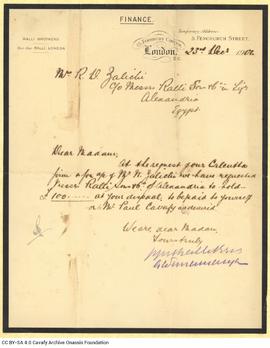
[Cavafy], Polis [Paul]Handwritten letter on a letterhead of Ralli Brothers with mourning border to Romylia Zalichi. Reference to a sum of one hundred pounds, collectable by her or Paul Cavafy. (London)
Ralli BrothersTypewritten letter with handwritten additions, by Richard Dawkins to Rica Singopoulo, on two sheets with notes on all sides. It is a reply to a previous letter by Singopoulo, along with which the sender appears to have also received works by Cavafy. Positive comments on the style and language of Cavafy's poetry and its reception England. Mention of the poet's poor health and his hospitalisation in Athens. In a postscript, Dawkins asks Singopoulo's assistance in locating a publication on Greek popular poetry (Ν. Mavris / E. Papadopoulos, Dodekanisiaki lyra. Tomos protos. Kasiaki lyra, itoi dimodis poiisis kai mousiki tis nisou Kasou. Port Said 1928, print. Nea Icho). The citation, in Greek, is not written by the author, who has made handwritten additions in English. Emendations in the typewritten text. The postscript is written on a smaller piece of paper - it is possible that it was added after the main text had been finalised by its author. (Oxford)
Dawkins, Richard M.Handwritten letter by Stephen Schilizzi to Cavafy on all sides of two bifolios. Detailed description of the author's trip to Scotland with reference to the places he visited (Glasgow, Scottish Lochs, Edinburgh Castle, Glasgow Cathedral). Comments on the development of the cholera epidemic as well as on the Casamicciola earthquake, on the island of Ischia, Italy. Information about people from their family circle as well as the broader social circle of Alexandria. Reference to The Lady of the Lake by W. Scott. Cancellations.
[Schilizzi, Stephen]Handwritten letter by Stephen Schilizzi to Cavafy on all sides of a bifolio. The author refers to the re-opening of the school of Konstantinos Papazis, describing in detail the classes he attends and their syllabus. He comments on persons from his friendly circle and the broader social circle of Alexandria as well as on events related to them; he also expresses his interest in rumours of a war between England and Turkey. He refers to the journal Parnassos and to Lord Byron's Childe Harold's Pilgrimage. Cancellations and emendations. Numbers in pencil at the top of the first page. (Alexandria)
Schilizzi, S.Handwritten diary-type letter by Stephen Schilizzi to Cavafy on all sides of two bifolios. The author describes the trip of his return from England to Egypt. He gives detailed information on the sights he visited while in London (Tower of London, St. Paul's Cathedral, Big Ben, The Monument to the Great Fire of London, Houses of Parliament, Westminster Abbey, National Gallery, British Museum, Madame Tussauds Exhibition, The International Fisheries Exhibition) and Paris (Musée des arts et métiers-Conservatoire national des arts et métiers, Notre Dame, Panthéon, Morgue de Paris). Commentary on people from their friendly circle as well as from the broader social circle of Alexandria. Reference to the cholera epidemic in Egypt. Cancellations and additions. The author's initials at the end of the first bifolio. The date "[...] 31st Oct 1883" in the second bifolio.
Schilizzi, S.Handwritten letter by Stephen Schilizzi to Cavafy on two sides of a bifolio. It is a reply to a letter dated 17 February. Information regarding the spectacles offered at that time by an Arabian troupe; reference to the performance "Sarlaman imperador Frangi [or Charlemagne emperor of the French]". Commentary on people from the broader social circle of Alexandria as well as on events related to them. Of note is the use of French words and phrases in the flow of written discourse. (Alexandria)
[Schilizzi, Stephen]Handwritten letter by Stephen Schilizzi to Cavafy on all sides of a bifolio. Extensive reference to the issue between the Synadinos family and a bank (Banque Générale) and its financial repercussions. Commentary on people from the broader social circle of Alexandria as well as on events related to them. Reference to newspaper The Egyptian Gazette, as well as to George Ohnet's Lise Fleuron. Cancellations, additions; use of French words and expressions in the flow of written discourse. (Alexandria)
[Schilizzi, Stephen]Handwritten letter by Stephen Schilizzi to Cavafy on all sides of two bifolios. It is a reply to two letters from December. The author expresses his views on personal remarks made by Cavafy in their previous correspondence, which appear to cause conflict between them. Extensively detailed reference to performances and events he attended while in London ("Bluebeard", "Promenade Concerts", "Iolanthe [or the Peer and the Peri]", "M.P.", "A private wire") and Paris ("Faust", "L'Africaine", "Les Rantzau", "Le jour et la nuit", 'Frou Frou", "Excelsior"). Reference to the cholera epidemic in Egypt and to a fire in the city of Alexandria. Commentary on people from their friendly and broader social circle. Reference to the publications The Egyptian Gazette and Union Egyptienne. Cancellations, underlinings; use of Greek and French words and phrases in the flow of written discourse. (Alexandria)
[Schilizzi, Stephen]Autograph typewritten letter by Angus H. G. Davidson on behalf of The Hogarth Press. Despatch of contract. (London)
Davidson, A. H. G.Autograph typewritten letter by Angus H. G. Davidson on behalf of The Hogarth Press in which optimism is expressed regarding the publication of Cavafy's poems. Accompanied by envelope with the poet's name and address. (London)
Davidson, A. H. G.Typewritten letter by William Plomer to E. M. Forster on one side of a sheet of paper; blank verso. Handwritten note, below the typewritten text. The author expresses his admiration for Cavafy’s poetry. On another sheet of paper, typewritten poem (sonnet) about Cavafy’s poetry signed by the author. Blank verso.
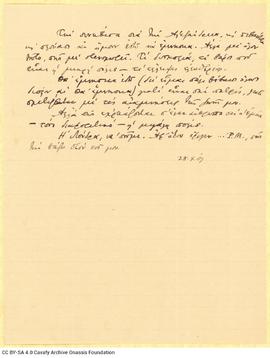
Plomer, W.Handwritten note on one side of a notepaper with the poet's thoughts on his life in Alexandria and how much different it could have been, were he living in a large city abroad. Date below the text. Blank verso.
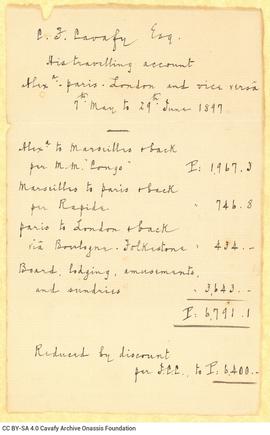
Cavafy, C. P.Handwritten note by John Cavafy with a list of his expenses during a trip he made together with C. P. Cavafy in the period May-June 1897 to Paris and London, via Marseilles. Written on one side of a piece of paper. Blank verso.
Cavafy, JohnHandwritten note by Paul Cavafy on a postcard to C. P. Cavafy, with notes on both sides. It is mentioned that Paul is leaving for London and Paris, having Alexandria as his final destination. Of note is the use of English words and phrases. The card bears a postage stamp; mail service rubber stamps (Buxton, Port Said – Alexandria); the address is written in French; handwritten notes in pencil. (Buxton)
[Cavafy], Polis [Paul]Handwritten notes by Rica Singopoulo on the recto of eight sheets. Blank versos, except for the one of the fourth sheet. All sheets are numbered 1 to 8 at top right. Biographical notes, pertaining to the life, habits and social encounters of Cavafy. Also, information about the members of his family (parents and siblings). It appears that the notes were written after the poet's death and the information comes from Singopoulo's own knowledge as well as from the remains of Cavafy's belongings. Certain inaccuracies are observed, such as the poet's date of birth (1865 instead of 1863).
[Singopoulo, Rica]Handwritten text by Rica Singopoulo on the recto of thirteen sheets from a notepad. Blank versos. Seven sheets have been torn off the notepad. Rica Singopoulo's notes pertain to the history of the poet's paternal and maternal family, for the members of which is provided all the information she collected from the poet himself as well as from his notes. Extensive reference to the life of the poet and that of his brothers. Cancellations and emendations.
[Singopoulo, Rica]Handwritten notes by Rica Singopoulo on seven sheets and three double sheet notepapers. The notes pertain to Cavafy's life and to the members of his family (mainly his mother and brothers). Some of the information recorded derives from the family correspondence as well as from the remnants of the poet's belongings.
[Singopoulo, Rica]Manuscripts of poems on both sides of a ruled sheet. The poem "Oblivion" on the recto. The initial title, "Forgetfulness", has been emended to "Oblivion". Footnote in English: excerpt from a poem by L. Smithers from a 1895 edition. Note in pencil below the poem. Number "148" at top left. On the verso, the poem "Distinguishing Marks" crossed out in pencil. Note and the title "Finished" below the poem. Number "147" at top right. The titles have been underlined and there is a line in red ink below each poem.
Cavafy, C. P.Greek passport of the poet's father, P. I. Cavafy, issued by the Greek embassy in Istanbul. The date and personal details are handwritten. Visas from Trieste, Vienna and Berlin on the verso. The passport was kept by the poet in an envelope labelled "My father's passport". Accompanied by two photographic copies of both sides from a photo studio in Alexandria. A copy of each side of the passport has been certified by the Greek Consulate of Alexandria.
Greek Embassy in IstanbulBritish passport of Cavafy's mother, Charikleia, affixed on a leather cover. It was issued in London and mentions that its owner is widow of Peter John Cavafy, who has been a naturalised British citizen since 1850 and that she may travel in Europe and Africa, accompanied by her sons, Paul, John and Constantine, aged 16, 13 and 12, respectively. The date and personal details are handwritten. Bearer's signature.
The Foreign OfficePersonal scrapbook of many sheets with attached printed and handwritten invites addressed to Paul and the Cavafy family for various social events, some newspaper publications as well as other relevant souvenirs (menus, lists with balls etc.). On some pages, handwritten notes, either of chronological indications noting the changing of the years or, rarely, clarifying notes about an invitation etc.
[Cavafy, Paul]Photographic portrait of the poet's uncle, George Cavafy. He is depicted sitting, holding a paper. The logo of the photo shop in the lower part of the recto as well as on the verso, along with handwritten notes.
Elliott & FryPhotograph of the first-born brother of the poet, George Cavafy, with a moustache and holding a cigarette in his left hand. The logo of the photo shop in the lower part of the recto as well as on the verso.
London Stereoscopic Co.Clipping from the Athenian newspaper Dimokratia. The article by Giorgos Kotzioulas "O "Kyklos" gia ton Kavafi", regarding the issue of the Athenian journal Kyklos dedicated to his poetry appears in the second page.
Dimokratia (newspaper)Part of a handwritten text by Rica Singopoulo on the verso of three sheets and on both sides of a fourth sheet. The sheets are numbered 3-6 at top left of the verso. The undated text describes political events during a period of instability and uncertainty in Egypt and, on that basis, may be dated in the 1936-1937 period. Cancellations and emendations.
[Singopoulo, Rica]Handwritten prose text by Cavafy on 14 sheets and 9 double sheet notepapers. Pages 4-38 are numbered. The upper half of page 30 is typewritten. The text narrates the history of the Cavafy family from the 18th century (1728) and Peter Cavafy to the time and family of the poet, citing all known information on every person, providing more details and placing greater emphasis on the members of his own family as well as on members of other (often related) families linked to it. Cancellations; abbreviations. Interpolated words in Greek. The date indication ("1903") is provided by the author of the text (page 19).
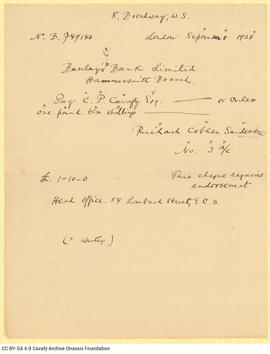
Cavafy, C. P.Handwritten copy of a payment checque on one side of a ruled sheet, by the poet's hand. Blank verso. Despatch of £1,10 from Richard Cobden Sanderson to Cavafy. (London)
Cavafy, C. P.Two handwritten copies of a receipt for £1,10 from Cavafy to the publisher of The Criterion for the publication of the poem "Ithaca" in the July issue; accompanied by two envelopes: one to the journal and one to Cavafy, with the journal's logo. The second envelope, originally sent to Τ. S. Eliot; the latter's name and address have been crossed out and replaced by hand with Cavafy's address in Alexandria. The copies of the receipts are handwritten by the poet.
Cavafy, C. P.Handwritten draft of a receipt by Cavafy for the amount of £3,3 from The Nation and The Athenaeum. Accompanied by envelope with the name and address of the journal. (Alexandria, 5/12/1923)
Handwritten draft of a receipt by Cavafy for the amount of £3,3 from The Nation and The Athenaeum. (London, 16/11/1923)
Handwritten draft of a receipt by Cavafy from The Nation and The Athenaeum with no details having been filled-in.
Empty envelope with handwritten notes and the indication 16/11/1923.
All four aforementioned documents were originally placed inside a handmade folder of wrapping paper.
Envelopes and parts of envelopes with the details of the recipient C. P. Cavafy (approximately 75). The items bear postage stamps and seals, while some also bear handwritten notes with enumeration details and information regarding the date they were received. Handwritten notes by C . P. Cavafy and his brother, John Cavafy, on one envelope; another envelope is accompanied by a short note with date indication and the signature "John" written by the poet's brother. The envelopes accompany the letters sent by Paul Cavafy to C. P. Cavafy during the former's stay abroad.
[Cavafy, Paul]