Typewritten letter by Charles Prentice (C. H. C. Prentice) to E. M. Forster on one side of two letterheads of the Chatto & Windus publishing house of London. The other sides are blank. Prentice, one of the partners of the publishing house, expresses his interest in the English publication of Cavafy's poems and details to Forster the financial terms proposed by their house. The letter is accompanied by two sheets with the handwritten addresses of Furness, of Forster and of the publishing house, by one sheet with the names of Furness and Forster as well as by two pieces of paper with the handwritten addresses of Mavrogordatos and The Hogarth Press publishing house.
Prentice, C. H. C.Cairo (Egypt)
131 Archival description results for Cairo (Egypt)
Handwritten letter by Konstantinos F. Skokos to Cavafy on the first and fourth pages of a bifolio. Reference to Pavlos Gneftos as well as to the publication of the National Diary 1898, which is to include poems by Cavafy. There is also a kind request that the poet mediates for the registration of subscribers from Egypt. (Athens)
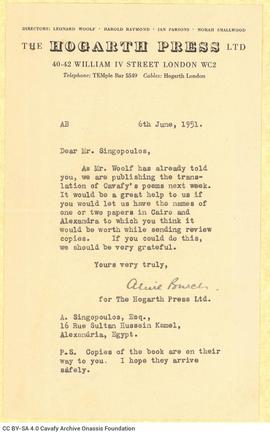
Skokos, K. F.Typewritten letter by Aline Burch to Alekos Singopoulo on one side of a letterhead of The Hogarth Press. Blank verso. The publishing house wishes to send copies of the Cavafy publication to Egyptian newspapers suggested by Singopoulo. He also informs about the despatch of copies to Singopoulo. Handwritten signature. (London)
Burch, AlineHandwritten musical score on all sides of a double sheet notepaper. Copy of a composition by George Poniridy for voice and piano, based on the poem "In Stock" by Cavafy. The verses of the poem written above the notes.
UnknownHandwritten prose text ("In Broad Daylight") on three double sheet notepapers. Pages 5-6 and 8-12 are numbered. Few cancellations and emendations in various parts. The three double sheet papers are enclosed in another one, with the handwritten title on the first page. The title has been underlined and there is a line in red ink at the end of the text.
Cavafy, C. P.Manuscript on two large-size sheets affixed to one another so as to form a double sheet paper. It contains the Cavafy family tree, going back to the generation of their father, Peter John Cavafy. The date of birth and death of the family members is recorded as well as other relevant information. There is also record of the Cavafy family crests and crowns as well as other "Notes", explanatory of the family tree.
[Unidentified]Two handwritten drafts of a letter by Cavafy to Alekos [Singopoulo] on all sides of two ruled sheets. Extensive use of abbreviations in the first sheet. Advice by the poet to Singopoulo regarding his return to Alexandria. He also kindly asks him to write to his family.
Cavafy, C. P.Handwritten draft of an untitled poem on the verso of a letter by John Cavafy to C. P. Cavafy. Brief note in ink below the draft. The letter is dated 1/4/1908 and is written on a letterhead of R. J. Moss & Co., Cairo. John informs C. P. Cavafy that he is returning him the letters of their brother, Paul.
Cavafy, C. P.Handwritten draft letter by Cavafy to Alekos [Singopoulo] on all sides of three pieces of paper as well as on both sides of a sheet. Pages 3 and 4 are numbered. Extensive reference to Malakasis. Advice to Singopoulo.
Cavafy, C. P.Handwritten draft letter to Marika Zalichi in a double sheet notepaper, one sheet and half a sheet. All pages are numbered (1-6) except for the verso of the sheet entirely crossed out (its recto is page 5), and the verso of the half sheet, which is blank (its recto is page 6). Extensive reference to the Greek language question and demoticism. Cancellations and emendations.
Cavafy, C. P.Handwritten draft letter by Cavafy to Maria (Marigo) Cavafy on a sheet, a double sheet notepaper and a piece of paper. At the top left of the recto of the first sheet, a note that the letter by Marigo was received on 24/2/1902 (the letter is dated 17/2/1902). Family news and frequent references to Marigo's stay in Athens and her impressions from the city. The poet expresses his sentiments of love as well as those of his brothers, and hopes they meet again soon. Extensive use of abbreviations. Cancellations and emendations. Marigo Cavafy departs from Athens to England, after a visit to Egypt.
Cavafy, C. P.Handwritten draft letter by Cavafy to E. M. Forster on three ruled pieces of paper. References to Christopher Scaife, Robin Furness and Nikos Kazantzakis. Authorial cancellations and emendations.
Cavafy, C. P.Handwritten draft letter by Cavafy to Alekos [Singopoulo] on both sides of a letterhead of the Cercle Mohammed Aly. The poet mentions news of common acquaintances of theirs and asks Singopoulo for his own news.
Cavafy, C. P.Handwritten draft letter by Cavafy to Alekos [Singopoulo] on the recto of a sheet. Cancellations. Blank verso. The poet thanks for the receipt of a letter from Singopoulo and refers to his health.
Cavafy, C. P.Handwritten draft letter by Cavafy to Alekos [Singopoulo] on both sides of four pieces of paper. Abbreviations and cancellations. Pages 3 to 6 are numbered. Personal and social news.
Cavafy, C. P.Handwritten draft letter by Cavafy to Alekos [Singopoulo] on two sheets and on one small piece of paper. Abbreviations and cancellations. Remarks concerning Singopoulo's spelling. News of common acquaintances of theirs and reference to a lecture on D'Annunzio.
Cavafy, C. P.Handwritten draft letter by Cavafy to Alekos [Singopoulo] in three pieces of paper and on both sides of a sheet folded in a bifolio. Two of the three pieces of paper have writing only on one of their sides. Printed details of the National Bank of Egypt on their versos. Pages 3 to 5 are numbered at top right. The poet refers to social interactions of his as well as to the professional qualifications of Singopoulo.
Cavafy, C. P.Handwritten draft letter by Cavafy to Alekos [Singopoulo] on the first page of a double sheet notepaper. The remaining pages are blank. Cancellations. Advice by the poet to Singopoulo regarding his health. Reference to his professional affairs.
Cavafy, C. P.Draft letter by Cavafy to Alekos [Singopoulo] on all sides of two sheets. Satisfaction regarding Singopoulo's professional career. Reference to the Palatine (Greek) Anthology. Fragment of a second copy on both sides of a sheet; cancellations.
Cavafy, C. P.Handwritten draft letter by Cavafy to Stamos Zervos on two bifolios; the last page of the second one is blank. This is a reply to a card he had received and is addressed to a person referred to as Stamos. Reference to the journals La Vie Nouvelle, Grammata and I Skepsi. Update on life in Alexandria, with reference to the Model School of the (Greek) Educational Association of Egypt and the "I Mana" charity institution (Union of Greek Ladies). Mention of Paris where the recipient of the letter resides. Cancellations, emendations and additions.
Cavafy, C. P.Handwritten draft letter by Cavafy on both sides of a ruled sheet and on the recto of a second sheet. The recipient (most likely the poet's brother, John) is in Cairo. Cavafy describes his everyday life and refers to the publication of three poems of his in a annual publication of Alexandria. Social news. Abbreviations, cancellations and emendations.
Cavafy, C. P.Handwritten list for the distribution of the collection of poems published after the 1910 Issue, consisting of four cut sheets of notepaper initially folded in bifolios with notes on all sides and of a broadsheet written on one side. The names of individuals are recorded in chronological order (1912-1918), and next to them the number of issues to be sent to each of them is mentioned; there are also notes by Cavafy regarding the person who mediates for the acquisition of the issue or who will be the final recipient. At the top of the list it is stated that the distribution started in April 1912. The total of issues distributed is recorded at the end of each column which is subsequently carried forward to the top of the next one.
Cavafy, C. P.Series of handwritten notes referring mostly to the poet's mother, Charikleia Cavafy, in two parts. The first includes 28 loose sheets cut in various sizes, 16 of which are written on both sides. Chronological indications (1896-1898) in the text. The second part is entitled "St[ate] of h[er] ’98 disease" and comprises 4 cut sheets of paper of various sizes. Events relating to Cavafy's mother's illness are recorded in one section. The text continues to the recto of the last sheet; all pages are numbered (1-7). Cancellations and emendations in both parts as well as abbreviations in parts of the text.
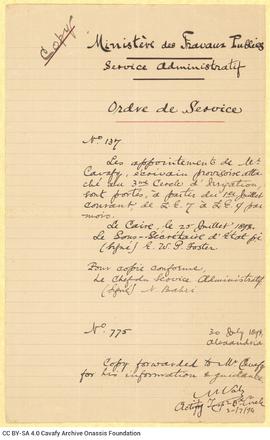
Cavafy, C. P.Handwritten copy of an official letter from the ministry of Public Works, on the first page of a double sheet notepaper, by which Cavafy is notified of the decision to raise his monthly salary from 7 to 9 pounds. The letter is signed by E.W.P. Foster. (Alexandria)
Cavafy, C. P.Handwritten copy of a letter by Cavafy to E. M. Forster on both sides of a sheet, with references to Crawford Flitch and Robert Graves. Cavafy mentions that he is enclosing his poems "Tomb of Ignatius" and "Monotony", translated by G. Valassopoulo, together with the Greek originals. (Alexandria)
Cavafy, C. P.Typewritten copy of a letter by Alekos Singopoulo to The Hogarth Press on one side of a sheet. Blank verso. Handwritten notes at bottom right of the recto. The sender asks for an update on the delay of the English publication of Cavafy's poems and expresses his satisfaction with the result. He also asks for an update on the reception of the book by the British public and the relevant critique and proposes newspapers of Egypt to which copies could be sent. The letter is accompanied by a typewritten translation thereof on the recto of a sheet. (Alexandria)
[Singopoulo, Alekos D.]Handwritten text on a homemade notepad, sewn on the spine. Travel diary and notes. The title handwritten on the cover. Mentions of non-Greek publications and bibliographical references to 1880 and 1807 editions. Some pages are blank. One page in Greek. Note on metrics below (Homeric?) verses in English. Copy of a poem by D. Solomos and its translation into English. The poet departs, together with his mother and two of his siblings, on a steamboat to Istanbul on the aftermath of the Urabi Revolt, for which young Cavafy provides a short analysis. Extensive reference to the members of the Fotiadis family. The narration covers the period 23/6-8/7/[1882].
Cavafy, C. P.Handwritten drafts of the poem "Company of Four" on both sides of a sheet; on one side of a cut printed broadsheet with fragment of a poem and the indication "Alexandria 1926" (arithmetic operation on the other side); on both sides of a piece of paper, torn on one edge; on the verso of a shares form of the National Bank of Egypt dated "21 March 1930" and Cavafy's signature in English. Handmade folder from the card of the Alexandrini Vivliothiki for an event dated "30/9/1930". The handwritten title of the poem and the note "Prov[isional] ti[tle]" on the verso of the card.
Cavafy, C. P.Handwritten musical score on all sides of a double sheet notepaper. Copy of a composition by George Poniridy for voice and piano, based on the poem "Come Back" by Cavafy. The verses the poem written above the notes.
UnknownHandwritten list for the distribution of the 1910-11 Collection consisting of a small piece of paperboard with the title of the issue and two pieces of paper initially folded in bifolios; one of these is written on both sides, while the second only on one. The names of individuals are recorded in two columns in chronological order (1917-1920); next to the names is the number of issues sent to each of them as well as notes by Cavafy regarding the person who mediates for the acquisition of the issue or who will be the final recipient. At the top of the list it is stated that the distribution started in October 1917. The total of issues distributed is recorded at the end of each column and then it is carried forward to the top of the next one.
Cavafy, C. P.Handwritten catalogue of the periodicals in Cavafy's library, comprising five sheets, the last of which is blank. The first sheet is in lieu of cover. Cancellations and notes. The dates mentioned cover the period 1883-1905.
Cavafy, C. P.