




Identity area
Reference code
Title
Date(s)
- n.d. (Creation)
Level of description
Extent and medium
22.5 x 18 cm
Context area
Name of creator
Biographical history
Repository
Archival history
Immediate source of acquisition or transfer
Content and structure area
Scope and content
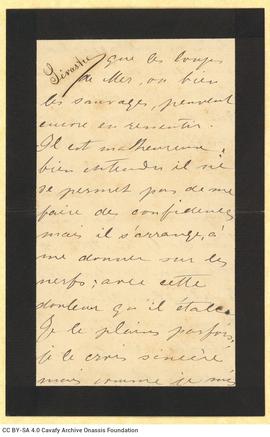
Handwritten letter by Sévastie Verhaeghe de Naeyer to her nephew, Alexandros (Alekos) Cavafy, in two bifolios with mourning border. The letter has been written onboard, after Sévastie left Egypt, en route to Colombo. She expresses her feelings and her thanks for the hospitality and love of the Cavafy brothers during her stay in Egypt; she hopes that they will visit her in the future. She kindly asks that they convey her warm greetings to the sister, Charikleia.
Appraisal, destruction and scheduling
Accruals
System of arrangement
Conditions of access and use area
Conditions governing access
Conditions governing reproduction
Language of material
Script of material
Language and script notes
French
Physical characteristics and technical requirements
Writing in ink. Physical item wear: oxidations; hole.
Finding aids
Allied materials area
Existence and location of originals
Existence and location of copies
Related units of description
Notes area
Note
Verhaeghe de Naeyer (Photiadés), Sévastie. “Letter by Sévastie Verhaeghe de Naeyer to Alexandros Cavafy”. Letter, n.d.. GR-OF CA CA-SF02-S01-SS02-F21-0004 (1128), Onassis Foundation C. P. Cavafy Fonds. From The Digital Collection of the Cavafy Archive, edited by Onassis Foundation, Athens, last modified 01.10.2025. https://doi.org/10.26256/CA-SF02-S01-SS02-F21-0004.
Alternative identifier(s)
Παλαιά ένδειξη ταξινόμησης
Access points
Subject access points
Place access points
Name access points
- Verhaeghe de Naeyer (Photiadés), Sévastie (Authority)
- Cavafy, Alexandros P. (Subject)
Genre access points
Description control area
Description identifier
Institution identifier
Rules and/or conventions used
Status
Level of detail
Dates of creation revision deletion
Language(s)
Script(s)
Sources
Archivist's note
The letter should be dated in the period 1882-1885, when Charikleia was living with some of her children in Istanbul.