Handwritten draft of the poem "Zenobia" on both sides of a ruled sheet. Paperboard with the handwritten title and date.
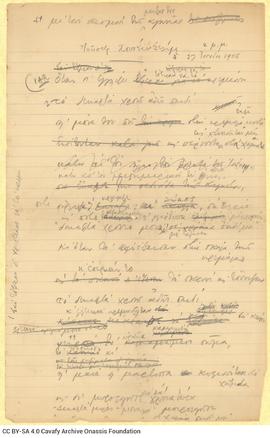
Cavafy, C. P.Manuscript of the poem "Yussef Hussein Selim, 27 June 1906 2 P.M." on one side of a ruled sheet. Cancellations and emendations. Variation of the first verse, marked "Var[iante]". Note over the title. Blank verso.
Cavafy, C. P.Typewritten English translation of the poem "Young Men of Sidon (400 A.D.)" by G. Valassopoulo on the recto of two sheets. The second sheet is numbered. Handwritten emendations in ink. Blank versos.
Valassopoulo, G.Handwritten English translation of the poem "Young Men of Sidon (400 A.D.)" by G. Valassopoulo on both sides of a sheet; handwritten cancellations, emendations and notes by Cavafy. Copy of Valassopoulo's translation by Cavafy on both sides of a sheet with entered corrections. Handwritten note with part of the same poem in English, written by Cavafy on the verso of a broadsheet with the original poem, printed in 1923. Handwritten notes by Cavafy and quotes from historical editions in English and French, on the verso of a printed broadsheet with the poem "Very Rarely" as well as on three pages of a double sheet notepaper.
Valassopoulo, G.The sub-fonds is divided into 4 series with the following subject matters: Poetic works, Prose works, Notes by the poet, Works of others on C. P. Cavafy. The first series includes the poems by C. P. Cavafy, both handwritten and printed. The second series includes Cavafy's prose works (literary texts, articles and studies, the dictionary in which he accumulates unusual and rare words of the Greek language). The third series includes the poet's handwritten notes, related to the production of his work, while the fourth series includes the translations of Cavafy's poems, studies on the work of Cavafy, poems of his set to music and sketches depicting the poet's figure.
Cavafy, C. P.Manuscript with words in Greek and French drawn from the dictionary by F. D. Dehèque Dictionnaire grec moderne-français (Paris, 1825) on both sides of a ruled sheet.
Cavafy, C. P.Printed broadsheet with the poem "Whenever They Are Aroused" on the recto. Handwritten emendation in the first verse. Handwritten note on the verso.
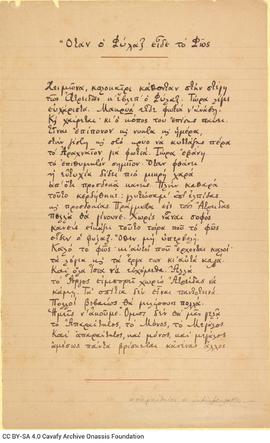
Cavafy, C. P.Manuscript of the poem "When the Watchman Saw the Light" on one side of a ruled sheet. Handwritten note in pencil, regarding the translation of a word in English, at bottom right. The title has been underlined and there is a line in red ink at the end of the poem.
Cavafy, C. P.Handwritten English translation of the poem "When Julian observed much lukewarmness" on one side of a ruled sheet. The poem is written by a hand other than Cavafy's (most likely Valassopoulo's). Cancellations and emendations by Cavafy in pencil. Blank verso.
Cavafy, C. P.Handwritten prose text (essay) on both sides of a piece of paper. Abbreviations. Brief assessment of the life and work of the jurist, scholar and poet Athanasios Christopoulos.
Cavafy, C. P.Handwritten text in English on both sides of a sheet. Notes on the translation of a poem by Cavafy ("The Satrapy"). Cancellations and emendations.
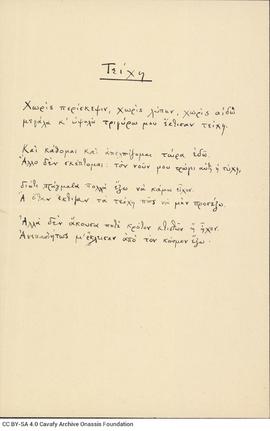
Cavafy, C. P.Manuscript of the poem "Walls" on the recto of a ruled sheet. Cancellations and emendations. Number "157" at top right and date indication ("Sept. 1896") at bottom right. The crossed out handwritten poem "The Windows" on the verso. Number "158" at top left. Underlined titles and line in red ink below each poem.
Cavafy, C. P.Four-page print with the poem "Walls" (in Greek) in the second page and its English translation by John Cavafy in the third page. Handwritten emendations by Cavafy in the Greek text. The first and last pages, in the stead of front and back cover respectively, bear typographical ornaments, as well as different date indications.
Cavafy, C. P.Manuscript of the poem "Walls" on one side of a sheet.
Cavafy, C. P.Signed manuscript of the poem "Walls". The title has been underlined and there is a line underneath the poem. Blank verso.
Cavafy, C. P.Two loose sheets with printed text on all sides. They include two printed poems by Cavafy ("Waiting for the Barbarians" and "Monotony"), as well as the title and a verse from a third poem ("The Windows"), marked in a handwriting other than the poet's. On the recto of the second sheet, affixed addition with two verses handwritten by Cavafy. On the verso, the poem "Monotony" has been striken through entirely. The printed page numbers ("21" through 24") have been striken through and another numbering has been marked ("1" through 3"). There are handwritten notes in pencil, in the margin; underlinings of words and phrases. The page numbering and the typographical features of text allude to the publication C. P. Cavafy. Poems, Kasimatis & Ionas, Alexandria 1910, from a copy of which the sheets appear to have been removed.
Cavafy, C. P.Printed eight-page pamphlet with the poem "Waiting for the Barbarians". The first page serves as a front cover. The poem title at top left; the name of the Lagoudakis printing house and the year of publication at bottom right. The text of the poem occupies pages 3 to 5. The poet's signature and the indication "December 1898" in the lower part of the fifth page. Pages 2 and 6 to 8 are blank. Accompanied by 19 copies, one of which has a front cover of paperboard.
Cavafy, C. P.Manuscript of the poem "Waiting for the Barbarians" on both sides of a ruled sheet. Notes in English in the margin. The title has been underlined and there is a line in red ink at the end of the poem.
Cavafy, C. P.Two printed sheets with the poem "Waiting for the Barbarians". The verso of the second sheet, the lower part of which has been cut off, is blank. The poem's title at top left of the recto of the first sheet. Handwritten cancellations and emendations in several verses. Added handwritten verses as well as cancellations of other verses in the second and third pages. The printed text, the font and the layout are similar to those of the eight-page 1904 publication of the poem by the Lagoudakis printing house and this should be considered a copy thereof.
Cavafy, C. P.Handwritten comments and notes on the poem "Waiting for the Barbarians" on both sides of a ruled sheet and on three pieces of paper. The title in red ink on the recto of the ruled sheet.
Cavafy, C. P.Manuscript of the poem "Waiting for the Barbarians", on one side of three ruled sheets. Page numbers indicated ("1, 2, 3") at top right of the recto of each sheet. The poet's name, crossed out, at the end of the poem. Cancellations and emendations. The versos of all sheets are blank.
Cavafy, C. P.Two printed sheets with the poem "Waiting for the Barbarians". Some verses crossed out in pencil. Handwritten emendations, verse variations and notes by Cavafy. Printed date ("December 1898") at bottom left of the recto of the second sheet. Handwritten notes by Cavafy on the verso of the second sheet.
Cavafy, C. P.Manuscript of the poem "Waiting for the Barbabrians" on a double sheet notepaper, with an addition pasted on the second page. The text continues on the verso of the first sheet; the remaining pages are blank. Cancellations and emendations. Signed: "C. P. Cavafy".
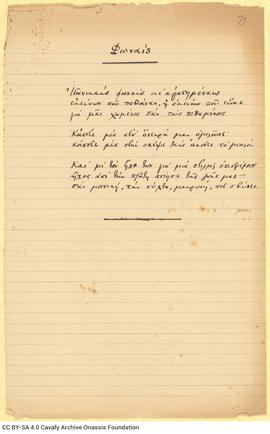
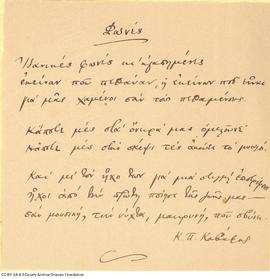
Cavafy, C. P.Manuscript of the poem "Voices" on one side of a ruled sheet. Number "79" at top right. Blank verso.
Cavafy, C. P.Autograph manuscript of the poem "Voices" on one side of a cut sheet.
Cavafy, C. P.Three visiting cards: two printed ones of Charikleia Cavafy and a handwritten one of C. P. Cavafy. One of Charikleia's cards mentions that she accepts visits every second and last Friday of the month.
[Cavafy (Fotiadi), Charikleia]Printed visiting card of Cavafy.
Cavafy, C. P.Handwritten draft of the poem "Visions" in pencil, on the first side of a double sheet graph paper. The other pages are blank, the last two of which are cut approximately in half.
Cavafy, C. P.Handwritten verses from poems by Solomos and Valaoritis as well as from folk songs, on a handmade notepad comprising six sheet, with the last one blank, and on a small piece of paper. Bibliographical references.
Cavafy, C. P.Piece of paperboard (perhaps from a handmade folder), entitled "Valassopoulo's translation work. Finished". The handwriting is probably that of Rica Singopoulo but the last word has been written by Cavafy.
[Singopoulo, Rica]Handwritten prose text on the first two pages of a double sheet notepaper. The other two pages are blank. Cavafy briefly examines the poetry of Aristotelis Valaoritis and draws parallels to that of Dionysios Solomos. A few titles of poems by Valaoritis are mentioned.
Cavafy, C. P.Manuscript of an untitled poem on both sides of a sheet. Page numbers are indicated: "39" on the recto, "40" on the verso. The note "Fragment" at the bottom of the verso. Cancellations and emendations. The central part of the sheet has been detached but is preserved.
Cavafy, C. P.Handwritten poem and introductory note with abbreviations.
Cavafy, C. P.Manuscript of an untitled poem on one side of a ruled sheet. Cancellations and emendations.
Cavafy, C. P.Manuscript of the poem "Two Young Men, 23 to 24 Years Old" on one side of two ruled sheets. Number "75" at top right of the recto of the first sheet. The signature "C. P. Cavafy" on the recto of the second sheet, at the end of the poem. Affixed clipping from a printed medium with date annotation ("14 June 1927") and the brand name of the Kasimatis and Ionas printing house. The day and year of the date have been emended in ink by the poet. The versos of both sheets are blank. Printer's copy.
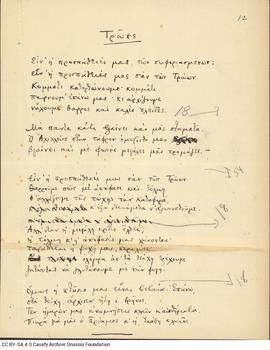
Cavafy, C. P.Manuscript of the poem "Trojans" on both sides of a ruled sheet.
Cavafy, C. P.Manuscript of the poem "Trojans". Cancellations and emendations. Sheet number marked at top right: "12". Numbers written in pencil in the text margin.
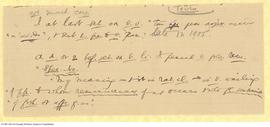
Cavafy, C. P.Handwritten notes on the poem "Trojans" in ink, on a piece of paper. The poem title, the annotation "late in 1905" and a note in pencil, at top left. Extensive use of abbreviations.
Cavafy, C. P.Manuscript containing a series of four translated poems by Cavafy into English ("Herodes Atiicus", "The Satrapy", "The Glory of the Ptolemies") on four sheets, two of which bear notes on both sides. Cancellations, emendations and abbreviations. In all poems, except for "Philhellene", John Cavafy's name is noted ("J. C. Cavafy") as the translator.
Cavafy, C. P.Handwritten text by Cavafy, including 21 poems of his translated into English ("An o[ld] man", "Candles", "Voices", etc.) by his brother, John Cavafy, on six double sheet notepapers with notes on all sides; the last page of the last notepaper is blank. The text is abbreviated and is underlined all across. The poems are numbered in pencil (1-21, omitting 11).
Cavafy, C. P.List of Cavafy's poem titles in English, in a four-page folder. Handwritten note in Greek ("Translations") on the cover; the list in the inner pages. The titles are divided in three parts, numbered accordingly (1-3), while there is an additional note on part 1.
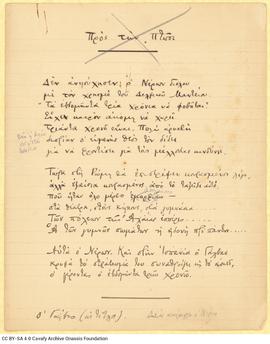
Cavafy, C. P.Handwritten poem ("Towards the Fall") on the first page of a ruled double sheet notepaper, written by Cavafy. The title has been crossed out. Notes in pencil in the left margin and at the bottom of the page; verse emendation. Note "Galva (as the title)" at bottom left. The remaining pages are blank.
Cavafy, C. P.Handwritten poem ("Tomb of Lanes") on one side of a ruled sheet, with cancellations and emendations on the body of the poem and notes at the bottom of the page.
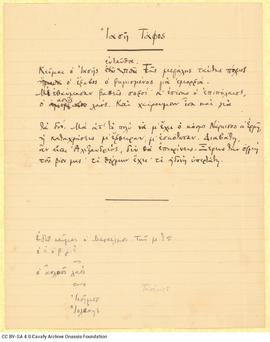
Cavafy, C. P.Handwritten poem ("Tomb of Iases") on the first page of a ruled double sheet notepaper. Cancellations, emendations and notes below the poem. Underlined title and line at the end of the poem. The remaining pages are blank.
Cavafy, C. P.Manuscript of the poem "To Stay" on both sides of a ruled sheet. Cancellation and emendation. Notes on the verso below the poem.
Cavafy, C. P.Manuscript of the poem "To Pleasure" on one side of a ruled sheet. Cancellation and emendation. Notes below the poem. Blank verso. Accompanied by two small pieces of paper with handwritten notes in English, on one side.
Cavafy, C. P.Handwritten English translation of the poem "To Antiochus Epiphanes" on both sides of a ruled sheet. Cancellations and emendations. The note "Translation by F. L." in brackets on the verso.
Cavafy, C. P.Typewritten English translation of the poem "For Antiochus Epiphanes". The poem is found twice, on a broadsheet and on the first page of a double sheet notepaper. Handwritten emendations. The note "(Translated by L.F.)" below the poem.
Cavafy, C. P.Manuscript of the poem "Timolaus the Syracusan" and note on both sides of a sheet. Line numbering in the margin. The title has been underlined and there is a line in red ink at the end of the poem. On the verso, the note: "Published in the aig. imerologion of G. V. Tsokopoulos, 1895". Cancellations and emendations. The main text has most likely been transcribed by Cavafy’s brother, Aristeidis Cavafy.
Cavafy, C. P.Handwritten draft of the poem "Tigranocerta" on two sheets. The verso of the second sheet is blank. Handmade folder with the handwritten title and date.
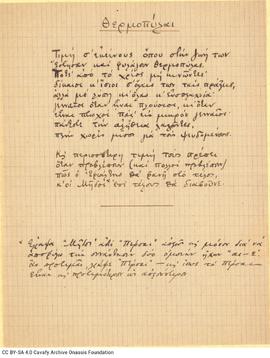
Cavafy, C. P.Manuscript of the poem "Thermopylae" on one side of a sheet. The title has been underlined and there is a line in red ink at the end of the poem. At the bottom of the page, explanatory note (instruction) regarding the choice of specific words in order to avoid hiatus.
Cavafy, C. P.Manuscript of the poem "Theophilus Palaeologus", written in pencil on one side of a sheet. Accompanied by four pieces of paper with notes (mostly short quotes from historical publications on the fall of Constantinople and bibliographical references).
Cavafy, C. P.Autograph manuscript of the poem "Theodotus" on the first page of a ruled double sheet notepaper. The remaining pages are blank. Cancellation and emendation. Handwritten notes on the same page, on the recto of a sheet and on the recto of three pieces of paper, the last two of which bear numbers (2, 3) and date at top right ("3.10.'11").
Cavafy, C. P.Handwritten text in English on both sides of a sheet. It is a translation of the poem "Theodotus". At the end of the text, John Cavafy is mentioned as the translator.
Cavafy, C. P.Manuscript of the poem "Their Beginning" in the first page of a ruled double sheet notepaper. Variations, marked "Variantes", below the poem. The remaining pages are blank.
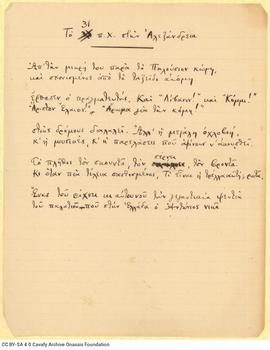
Cavafy, C. P.Manuscript of the poem "In 31 B.C. in Alexandria" on one side of a ruled sheet. Cancellations and emendations. Blank verso.
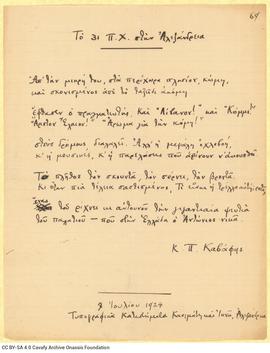
Cavafy, C. P.Manuscript of the poem "In 31 B.C. in Alexandria" on one side of a ruled sheet, signed by Cavafy. Number "69" at top right. Date ("7 July 1924") and brand name of the Kasimatis and Ionas printing house below the poem. Cancellation and emendation. Blank verso. Printer's copy.
Cavafy, C. P.Polygraphed copy of the handwritten poem "The Windows". Emendation in the beginning of verse 5, handwritten by the poet. On the verso, a sketch in pencil, depicting Cavafy in facial view, wearing glasses.
Cavafy, C. P.Polygraphed copy of a handwritten poem ("The Windows"). Signed: "C. P. Cavafy".
Cavafy, C. P.Handwritten notes on the poem "The Windows" in ink, on both sides of a sheet of paper. The title is written and underlined in red ink.
Cavafy, C. P.Handwritten English translation of the poem "The Tomb of Lysias the Grammarian" by G. Valassopoulo on one side of a sheet, with handwritten emendations by Cavafy in pencil on the text and notes of his on the verso, some crossed out. Printed broadsheet with the poem in Greek and year of publication (1919). Blank verso. Copy of Valassopoulo's translation by Cavafy on the recto of half a sheet, with the emended text. Blank verso. Three crossed out handwritten notes by Cavafy on the translation of the poem on one side of a piece of paper. Blank verso.
Valassopoulo, G.Typewritten English translation of the poem "The Tomb of Lysias the Grammarian" by G. Valassopoulo on one side of a sheet. Blank verso. Two copies.
Valassopoulo, G.Typewritten English translation of the poem "Tomb of Lanes" by G. Valassopoulo on one side of a sheet, with handwritten emendations. Blank verso. Handwritten note by Cavafy that the translation has been sent to E. M. Forster, on a piece of paper.
Valassopoulo, G.English translation of the poem "Tomb of Lanes", in five typewritten copies. One of them bears handwritten emendations and changes made by the poet, which have been incorporated in the other typewritten copies, and mentions G. Valassopoulo as translator. Another typewritten copy mentions, below the text, G. Valassopoulo and "Ε.M.F." (obviously E. M. Forster) as translators. Another typewritten copy mentions: "Translated by V. F. C." (the words, except for the first one, have been handwritten by Cavafy). They are most likely the initials of Valassopoulo, Forster and Cavafy. Clipping from a printed broadsheet with the handwritten date 1926, which contains on one side the translation of two verses of the poem and is also handwritten by Cavafy.
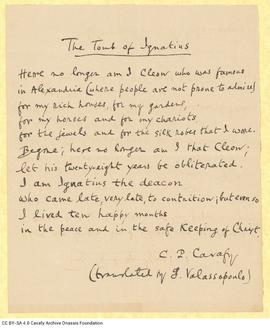
Valassopoulo, G.Manuscript by Cavafy with the English translation of the poem "Tomb of Ignatius" by G. Valassopoulo, on one side of a ruled sheet. Blank verso.
Cavafy, C. P.Two typewritten copies of the English translation of the poem "Tomb of Ignatius" by G. Valassopoulo on one side of a sheet. Blank verso.
Valassopoulo, G.Handwritten copy by Cavafy on an English translation by G. Valassopoulo of the poem "Tomb of Eurion" on one side of a ruled sheet. Emendation in ink. Blank verso.
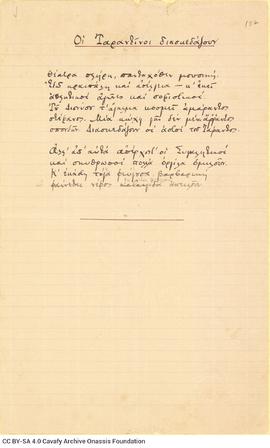
Valassopoulo, G.Manuscript of the poem "The Tarentines Have Their Fun", written in ink on one side of a ruled sheet. The title has been underlined and there is a line in red ink below the poem. Cancellation and notes in pencil. Number "132" at top right. Blank verso.
Cavafy, C. P.Manuscript of the poem "The Seven Holy Children", with cancellations and emendations on both sides of a sheet and on the recto of a second sheet. Handmade folder with handwritten title and date indication.
Cavafy, C. P.Manuscript of the poem "The Seleucid's Displeasure" in the first page of a ruled double sheet notepaper. Cancellations and emendations. crossed out notes at top and bottom of the page. Number "345" in brackets at bottom right. Pages 2 and 3 are blank. Notes on the fourth page, some of which crossed out. Notes on five pieces of paper of various sizes and on a ruled sheet. One of the papers bears fragment of a typewritten official letter on one side.
Cavafy, C. P.Handwritten text in English, on both sides of a printed broadsheet. It is a translation of a poem by Cavafy. Cancellations and emendations. The broadsheet contains the poem "Aboard the Ship", with one word crossed out and replaced by a handwritten note. The printed sheet number has been corrected by hand. Date indication ("December 1919") and the brand name "Kasimatis & Ionas Printing House - Alexandria" at the bottom of the page.
Cavafy, C. P.Manuscript of the poem "The Satrapy" on one side of a ruled sheet. crossed out notes at bottom left. "98 Bis" at top right. Cancellations and emendations. Variations of verses. Blank verso.
Cavafy, C. P.The poem "The Retinue of Dionysus" on one side of a printed broadsheet. The poet's signature ("C. P. Cavafy") below the poem. The printed numbering of the broadsheet ("13") has been crossed out in ink. Blank verso.
Cavafy, C. P.Handwritten title "The Retinue of Dionysus" on the recto of a sheet; number "11" at top right. All details have been written by Cavafy. Blank verso.
Cavafy, C. P.Handwritten notes on the poem "The Retinue of Dionysus" on the first two pages of a ruled double sheet notepaper. The other two pages are blank. The poem title on the first page; comment on the importance of punctuation in avoiding hiatus and noting metrics at top left. Bibliographical reference in the second page.
Cavafy, C. P.Manuscript of the poem "The Rest Shall I Tell in Hades to Those Below", written in ink in the first page of a ruled double sheet notepaper. The title "Morning Sea" written in pencil below the poem. The remaining pages are blank. Accompanied by a small piece of paper with verses.
Cavafy, C. P.Handwritten notes on the poem "The Rest Shall I Tell in Hades to Those Below" on both sides of a ruled paper. The title is written and underlined in red ink.
Cavafy, C. P.Handwritten draft and notes on the poem "The Rescue of Julian" on four sheets, two of which have been folded in bifolios. Handmade folder with the handwritten title and date.
Cavafy, C. P.Press clipping from the newspaper Tilegrafos of 2/14 January 1893, with an article by Cavafy on the poetry of Georgios Stratigis. The poet analyses the work of Stratigis and quotes from his poems. The article is signed "C.F.C.".
Cavafy, C. P.Handwritten prose text ("The Pleasure Brigade") in ink on both sides of a ruled sheet. Notes in pencil at the bottom of the verso. The title has been underlined and there is a line in red ink at the end of the text.
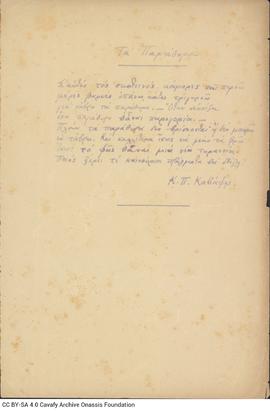
Cavafy, C. P.Handwritten draft of the poem "The Photograph" on both sides of a ruled sheet. Handmade folder with the handwritten title, the note "provisional title" and the date.
Cavafy, C. P.Manuscript of a poem and attached handwritten note. The poem "The Pawn" on both sides of a sheet. Cancellations and emendations. The verses on the verso have been crossed out. Page numbers are indicated: "31" on the recto, "32" on the verso. The handwritten note: "Not for publication. But may remain here" and the date inidcation "23.3.'11" on a separate piece of paper attached to the sheet.
Cavafy, C. P.Manuscript of the poem "The Pawn" on both sides of a sheet. Cancellations and emendations. The main text, on the recto, has been written by John Cavafy; the emendations and the text on the verso by C. P. Cavafy. The note "P.T.O." (Please Turn Over) at the end of the first page; the poet's initials ("C.P.C.") at the end of the poem.
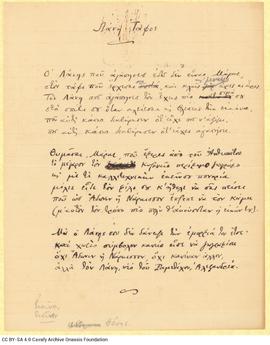
[Cavafy, John]Handwritten drafts of the poem "The Patriarch", on a sheet folded in a bifolio; on both sides of two loose sheets; on part of an envelope; on both sides of a sheet from a Collection of poems by Cavafy, with part of the poem "Caesarion" (the crossed out poem was printed in Alexandria in 1927; page number "8" at top right). Handmade folder with the handwritten title, the note "provisional title" and the date on the verso of a printed cover of a Collection of poems by Cavafy from the 1915-1924 period ("1924" is handwritten; the printed details on the recto of the cover have been crossed out in pencil).
Cavafy, C. P.Manuscript of the poem "The Next Table" on one side of a ruled sheet, signed by the poet. Blank verso.
Cavafy, C. P.Manuscript of the poems "The Naval Battle", "The Glory of the Ptolemies" and notes on both sides of a sheet. The titles have been underlined and there is a line in red ink below each poem. The notes explain parts of the poems which are indicated with numbered indicators and pertain to translation issues. Terms and phrases in English.
Cavafy, C. P.Handwritten notes on the poem "The Naval Battle" on both sides of two ruled papers. Numbers "2" and "4" at top left. Extensive use of abbreviations.
Cavafy, C. P.Handwritten prose text by Cavafy, written on the recto of four sheets numbered at top right. Blank verso. Placed inside a double sheet notepaper with handwritten title and indication of place (Alexandria) and date on the first page. The remaining pages are blank. The same poem, comprising three stanzas, is repeated at the beginning and the end of the text. Signed "Const. F. Cavafy" on the last page.
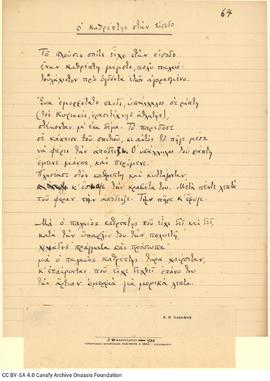
Cavafy, C. P.Manuscript of the poem "The Mirror in the Entrance" on one side of a ruled sheet. Cancellations and emendations. At the bottom, affixed piece of paper with printed details: the poet's name ("C. P. Cavafy"), the date ("3 February 1930") corrected by hand, and the brand name "Kasimatis & Ionas Printing shops – Alexandria". Sheet number marked at top right: "64".
Cavafy, C. P.Manuscripts of poems on four sheets. The item comprises a total of four ruled sheets (the last three of which had been initially pasted together so as to form a double sheet notepaper) and two pieces of paper (initially affixed on two of the sheets' pages). On one side of the first sheet, the title "The Funeral of Sarpedon", note on the publication of the poem (in Skokos' Ethnikon Imerologion), emendations and variations in some of the verses, all written by Cavafy and crossed out. At the top of the page, two crossed out verses of a poem and number "115" at right. On the other side of the sheet, part of the poem "The Mimiambs of Herodas", written by another person. Cancellations and emendations by Cavafy. Small paper with note by the poet (emendation of four verses) initially pasted on the middle of the page. On one side of the second sheet, the continuation of the previous poem with cancellations, emendations and notes by Cavafy. Number "117" at top right; the date indication "Novem. 1892" at bottom right. Initially affixed over the middle of the page, a piece of paper with a variation of the last stanza of the poem, handwritten by Cavafy. The other side of the sheet is blank. Part of a poem on one side of the third sheet, which has not been written by Cavafy. Cancellations and emendations, handwritten by Cavafy. This side of the sheet had been initially affixed on the blank side of the second sheet. On the second page of the third sheet, the poem "Azure Eyes", written by Cavafy. The blank side of the fourth sheet had been initially affixed on the second page of the previous sheet (and, consequently, covered the poem "Azure Eyes"). On the other side of the last sheet, the poem "Alexandrian Merchant", written by Cavafy. Indicated date ("Apr. 1893") and notes by the poet in pencil, below the text.

Cavafy, C. P.Handwritten prose text ("The meeting of vowels in prosody") on sixteen sheets. The sheets are numbered at the top right of the recto ("2"-"16"); from "8" onwards they are corrected in pencil. The verso of all sheets is blank, except for sheet "9". Footnotes. Interpolated words and phrases in English, French and Italian. The signature "C.P.C.", in pencil, at the end of the text. The text is enclosed in a ruled double sheet notepaper that has been torn into two sheets.
Cavafy, C. P.Handwritten prose text ("The Last Days of Odysseus") on the recto of twelve ruled sheets numbered (1 to 12) at top right. The handwritten title with place (Alexandria) and date («Apr. '94") on the first of four pages of a double sheet notepaper, which serves both as cover and as protection for the text sheets. The sheet numbered "3" is smaller in size than the rest. Quotes in English and Italian. Cancellations in red ink. Signed "Const. F. Cavafy" on the last sheet, below the text. The title has been underlined and there is a line in red ink at the end of the text.
Cavafy, C. P.Series of handwritten notes referring mostly to the poet's mother, Charikleia (Fotiadi) Cavafy, in two parts. The first includes three loose sheets folded in bifolios; they are written on both sides and enclosed in a folded sheet entitled "T. Last D. 1899". Pages 2-7 are numbered. The notes pertain to the last days of Charikleia Cavafy – the narration starts on 15 January 1899. The second part includes seven loose sheets of various sizes, written both on the recto and the verso, with one page number (4) marked. The content has the same subject, however it follows an inverse narrative sequence, starting on 3 February and ending on 27 January 1899. Both texts abbreviated. Cancellations and emendations.
Cavafy, C. P.Handwritten draft of the poem "The Item in the Paper" on both sides of three loose sheets and of one ruled sheet. The title of the poem at the bottom of the verso of the last sheet. Handmade folder with the handwritten title and date.
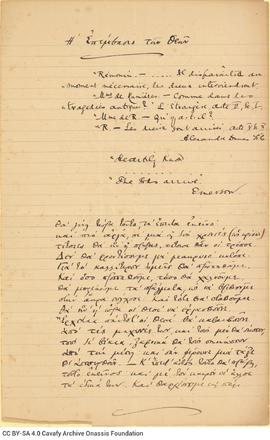
Cavafy, C. P.Manuscript of the poem "The Intervention of the Gods" on both sides of a ruled sheet. The title has been underlined and there is a line in red ink at the end of the poem. Notes in pencil. Quotes by R. W. Emerson and Alexandre Dumas fils in English and French. Accompanied by a piece of paper with a handwritten note in English.
Cavafy, C. P.Manuscript of the poem "The Intervention of the Gods".
Cavafy, C. P.Manuscript of the poem "The Inkwell" and explanatory notes on the first and third pages of a double sheet notepaper. The title has been underlined and there is a line in red ink below the poem. The notes relate to translation issues. Terms and phrases in English.
Cavafy, C. P.Manuscript of an English translation of a poem by Cavafy ("The Hall Mirror") on one side of a blank sheet. The poet's signature in English and the note "translation adapted by C.H.O.S." below the text. Blank verso.
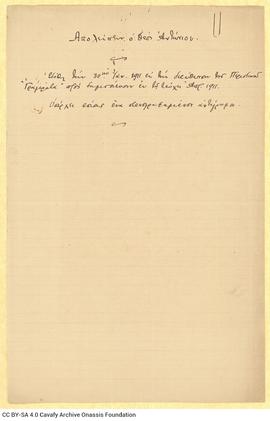
Cavafy, C. P.Handwritten note on one side of a ruled sheet, regarding the publication of the poem "The God Abandons Antony" in the issue of April 1911 of the journal Grammata. Blank verso.
Cavafy, C. P.Handwritten notes on the poem "The God Abandons Antony" on both sides of a ruled sheet and on the verso of a piece of a letterhead with fragment of a crossed out typewritten letter. They are accompanied by a small piece of paper with the handwritten title.
Cavafy, C. P.