Series of handwritten notes referring mostly to the poet's mother, Charikleia (Fotiadi) Cavafy, in two parts. The first includes three loose sheets folded in bifolios; they are written on both sides and enclosed in a folded sheet entitled "T. Last D. 1899". Pages 2-7 are numbered. The notes pertain to the last days of Charikleia Cavafy – the narration starts on 15 January 1899. The second part includes seven loose sheets of various sizes, written both on the recto and the verso, with one page number (4) marked. The content has the same subject, however it follows an inverse narrative sequence, starting on 3 February and ending on 27 January 1899. Both texts abbreviated. Cancellations and emendations.
Cavafy, C. P.Handwritten notes on the first side of a handmade folder made of paperboard, inside which documents were placed originally. The names of individuals (Dragoumis, Nomikos, Delta, Charikleia A. Cavafy, Stefanopoulos, Stratigis) from which letters have been received are recorded. Cancellations. The handwriting is that of Rica Singopoulo.
[Singopoulo, Rica]Handwritten note by Charikleia Cavafy, Cavafy's niece, in the first page of a bifolio. The remaining pages are blank. She announces her engagement to Geronymo Valieri and, on the occasion, invites her uncle to a meal. [Alexandria]
[Cavafy (Valieri)], CharikleiaHandwritten French translations of the poems "Chandelier", "Days of 1903", "Morning Sea" and "Far Off" on both sides of a small-size sheet.
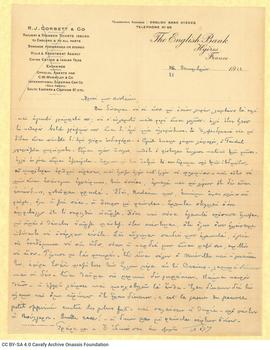
[Cavafy (Valieri), Hariclia]Handwritten diary-type letter by Paul Cavafy to C. P. Cavafy from Hyères, France, on both sides of two sheets. The letter is written on three different days, marked separately. In the first part, Paul expresses his nostalgia for his family and, on the occasion of the news from Alexandria he reads in the Press sent by the poet, he refers to various individuals (Zervoudakis, etc.) expressing his opinion either on their overall activities or on current events. In the rest of the letter he describes the state of general De Horsey's health, gives information on his family in England and describes his way of living. Of note is the frequent use of English and French words and phrases in the flow of written discourse. (Hyères)
[Cavafy], Polis [Paul]Handwritten letter by Paul Cavafy to C. P. Cavafy from Hyères, France, according to the letterhead. Paul comments on his health, expressing his concern, while he refers nostalgically to members of their family. (Hyères)
[Cavafy], Polis [Paul]Handwritten letter by Paul Cavafy to C. P. Cavafy from Hyères, France, according to the letterhead. Paul refers to members of family and to friends, and comments on his recent visit to Paris. Of note is the use of French words and phrases in the flow of written discourse. (Hyères)
[Cavafy], Polis [Paul]Handwritten letter by Paul Cavafy to C. P. Cavafy from Hyères, France, on all sides of a bifolio. It is a reply to a letter by the poet, dated 24 July. Paul comments on issues apparently mentioned by C. P. Cavafy, such as his absence from his work and his health problems, and describes his own situation in detail. He also refers to people they both know in Alexandria and informs him of a book he published as well as of his intention to broaden his journalistic activity. Of note is the use of English words and phrases in the flow of written discourse. (Hyères)
[Cavafy], Polis [Paul]Handwritten letter by Paul Cavafy to C. P. Cavafy from Hyères, France, according to the letterhead. Paul refers to members of the family and wants to learn their news; he briefly describes what he did in the time since his last letter and repeats his request for the despatch of his personal notes (diaries). Of note is the use of English words and phrases in the flow of written discourse. (Hyères)
[Cavafy], Polis [Paul]Handwritten letter by Paul Cavafy to C. P. Cavafy from Hyères, France, on both sides of a sheet. Reference to Paul's change of residence after the death of general De Horsey as well as to his short trip to Marseilles. Commentary on his health. Of note is the frequent use of English words and phrases in the flow of written discourse. (Hyères)
[Cavafy], Polis [Paul]Handwritten letter by Paul Cavafy to C. P. Cavafy from Hyères, France. He expresses his worry about the interruption of the correspondence between the two brothers as well as his concern about securing his pension, on the occasion of events in Egypt.
[Cavafy], Polis [Paul]Handwritten letter by Paul Cavafy to C. P. Cavafy from Hyères, France, on both sides of a cut sheet. Update on his health and expression of gratitude to his brother, Constantine. According to the text, C. P. Cavafy sent a letter to Paul (14 January 1918), which had not been received.
[Cavafy], Polis [Paul]Handwritten letter by Paul Cavafy to C. P. Cavafy from Hyères, France, on all sides of a bifolio. It is a reply to a letter by the poet. He informs him of his plans to stay in L'Almanarre as escort to general De Horsey for a few more months and extensively comments on developments regarding his former service with the Municipality of Alexandria, referring to individuals. He expresses his strong interest in the issue, urging C. P. Cavafy to send him newspapers, so that he may receive information. Of note is the use of English and French words and phrases in the flow of written discourse. (Hyères)
[Cavafy], Polis [Paul]Handwritten letter by Paul Cavafy to C. P. Cavafy from Hyères, France, according to the letterhead. Paul refers to members of family and to friends. Of note is the use of French words and phrases in the flow of written discourse. (Hyères)
[Cavafy], Polis [Paul]Handwritten letter by Paul Cavafy to C. P. Cavafy from Hyères, France, on both sides of a letterhead. It is a reply to a letter by the poet. Paul conveys his strong impressions from his experience of observing an airplane (biplane) flight; he comments extensively on issues relating to their family and to their social circle - mostly individuals from his prior service with the Municipality of Alexandria. He refers to his personal diaries, which apparently are gradually sent by C. P. Cavafy, and informs him on his trips and his stay at a seaside place in the area. Of note is the use of English and French words and phrases in the flow of written discourse. (Hyères)
[Cavafy], Polis [Paul]Handwritten letter by Paul Cavafy to C. P. Cavafy from Hyères, France, according to the letterhead, on both sides of two sheets. It is a reply to a letter by the poet, dated 30 September. Arguments raised by Paul in favour of his stay in France, contrary to the suggestion of John Cavafy to return to Alexandria. Comments on World War I events, which is still in progress, and are linked to the previous subject. Reference to members of their family; Paul thanks C. P. Cavafy for intervening in a matter regarding Paul's pension. Of note is the use of English and French words and phrases in the flow of written discourse. (Hyères)
[Cavafy], Polis [Paul]Handwritten diary-type letter by Paul Cavafy to C. P. Cavafy from Hyères, France, written over three days, in a bifolio with notes on all sides. It is a reply to a letter by C. P. Cavafy, dated 26 March. Commentary on subjects and individuals apparently mentioned in the letter by C. P. Cavafy. Account of Paul's everyday life after the death of general De Horsey, with references to his financial situation and to his plan to publish a newspaper, which was postponed due to the war. He informs his brother about his membership in a club (Circle d’agriculture) and the opportunity he has to use the library - he is presently reading the comedies The Wasps and The Clouds by Aristophanes, as well as Les Caractères by La Bruyère. Finally, on the occasion of a trip he made to Nice and Monte Carlo, he provides information on the common acquaintances he met there. Of note is the frequent use of English and French words and phrases in the flow of written discourse.
[Cavafy], Polis [Paul]Handwritten letter by Paul Cavafy to C. P. Cavafy from Hyères, France, on both sides of a letterhead. In the largest part of the letter he comments on the death of Thelxiopi Cavafy and expresses his concern on the future of her daughter, Eleni. Of note is the use of English and French words and expressions in the flow of written discourse. (Hyères)
[Cavafy], Polis [Paul]Handwritten letter by Paul Cavafy to C. P. Cavafy from Hyères, France, on both sides of a cut sheet. It is a reply to a letter by the poet, dated 20 December. Reference to Paul's journalistic activity with the The Riviera News newspaper and to the privileges stemming thereof (admittance to the casino and the theatre); comments on their common friends and family. Of note is the use of English and French words and phrases in the flow of written discourse. (Hyères)
[Cavafy], Polis [Paul]Handwritten letter by Paul Cavafy to C. P. Cavafy from Hyères, France, on two sheets. The letter is written in parts, given that –as the author clarifies– the second part is added on the same date, but after the composition of the first was completed. Paul expresses his concern about the interruption of the correspondence between the two brothers -there are details regarding the dates of the last letters– which is restored in the second part of the letter. Paul finally receives a letter by C. P. Cavafy on the same day. Reference to individuals from their family circle, and mention of his acquaintance with a man of Greek origin in Hyères, who had served in Egypt. Extensive comments on writers and works, including: Letters by Madame de Sevigné; Agamemnon by Aeschylus; Stello by De Vigny; Crime and Punishment by Dostoevsky. Of note is the use of English and French words and phrases in the flow of written discourse.
[Cavafy], Polis [Paul]Handwritten letter by Paul Cavafy to C. P. Cavafy from France, dated "16 March 1912", in the first three pages of a bifolio. It is a reply to a letter he had received from Cavafy. Update on his health, his plans to stay at Hyères as well as on other current matters. He also comments on theatrical events, as he went to the play by Henry Kistemaeckers, La flambée. Of note is the frequent use of English and French words and phrases in the flow of written discourse.
[Cavafy], Polis [Paul]Handwritten letter by Paul Cavafy to C. P. Cavafy from Hyères, France, according to the letterhead. Paul comments on his health, his life at Hyères as well as on news from Alexandria. He also refers to the First Balkan War in response to a remark apparently made by C. P. Cavafy in a previous letter. Of note is the use of English and French words and phrases in the flow of written discourse. (Hyères)
[Cavafy], Polis [Paul]Handwritten letter by Paul Cavafy to C. P. Cavafy from Hyères, France, on both sides of a letterhead. It is a reply to a letter by the poet, dated 21 September. Paul expresses his concern for his health and informs his brother on the details of the publication on Hyères, a copy of which he has already sent him. He refers to his readings, such as The History of Tom Jones by Henry Fielding. Finally, he states his interest in the armed conflict in the Balkans as well as in the apparent pro-German attitude of the King of Greece, Constantine I. Of note is the use of English words and phrases in the flow of written discourse. (Hyères)
[Cavafy], Polis [Paul]Handwritten letter by Paul Cavafy to C. P. Cavafy from Hyères, France, on both sides of a sheet. It is a reply to a letter by the poet, dated 29 January. Paul refers to World War I and expresses his admiration for the French, the English and the Russians. On the occasion of a letter he received from his niece, Charikleia, he recalls memories of her. He describes in detail the dental problems he is facing. Of note is the use of English and French words and phrases in the flow of written discourse. (Hyères)
[Cavafy], Polis [Paul]Handwritten letter by Paul Cavafy to C. P. Cavafy from Hyères, France, on both sides of a sheet. It is a reply to a letter by the poet, dated 4 May. Paul refers in detail to everything that transpired after the death of general De Horsey (obligations he undertook, communication with the family), reminisces about Alexandria and mentions several individuals from their social and family circle. He expresses his interest in the health of his brother, C. P. Cavafy, and asks information regarding his place of residence. Incidentally, he comments on the novel Bruge-la-morte by Georges Rodenbach. Of note is the use of English and French words and phrases in the flow of written discourse. (Hyères)
[Cavafy], PaulHandwritten letter by Paul Cavafy to C. P. Cavafy, on all sides of a bifolio. It is a reply to a letter by the poet, dated 17 July. Detailed account of his health and expression of interest in his brother, C. P. Cavafy, and his niece, Charikleia. Reference to Tata and Le père Lebonnard by J. Aicard, Sedan ou les charniers by C. Lemmonier and Sketches by Boz by Ch. Dickens. Of note is the use of English and French words and phrases in the flow of written discourse.
[Cavafy], Polis [Paul]Handwritten letter by Paul Cavafy to C. P. Cavafy from Hyères, France. Concern for the developments in Greece, considering they will affect him due to his nationality; concern also for his potential return to Alexandria. Of note is the use of English and French words and phrases in the flow of written discourse.
[Cavafy], Polis [Paul]Handwritten letter by Paul Cavafy to C. P. Cavafy from Hyères, France, on a bifolio with notes to the recto of the second sheet. It is a reply to a letter by C. P. Cavafy, dated 22 November - the date is noted in different ink. Comments on individuals related to their family and social circle as well as other matters set forth in the previous letter by C. P. Cavafy. He describes his place of residence, mentions the collection of letters of P. Mérimée Lettres à une inconnue, and informs about his health, mentioning events of the past. Of note is the use of French words and phrases in the flow of written discourse.
[Cavafy], Polis [Paul]Handwritten letter by John Cavafy to C. P. Cavafy in the first three pages of a bifolio. The last page is blank. Comments on the Italian translation by Atanasio Catraro of poems by C. P. Cavafy. Reference to his health and his bad mood. (Heluan)
Cavafy, JohnHandwritten letter by Charikleia A. Cavafy, niece of C. P. Cavafy, in the first page of a bifolio. It is a reply to a letter she had received from Cavafy. The author refers to John Cavafy and the condition of his health, expresses her concern and urges C. P. Cavafy to visit them. Accompanied by envelope.
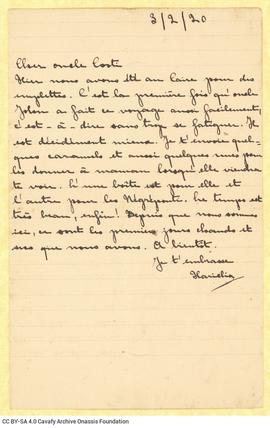
[Cavafy (Valieri)], HaricliaHandwritten letter by Charikleia Cavafy to her son, George, in the first three pages of a bifolio. The last page is blank. Reference to health-related issues and the weather as well as to the family of her son, Aristeidis. Also, references to the social life in Cairo. Interpolated words in French. [Alexandria]
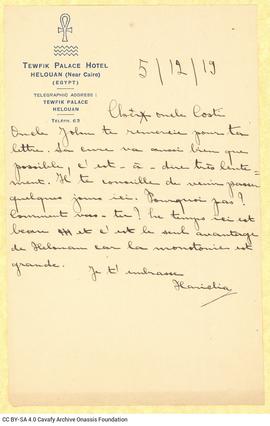
K., X. [Cavafy (Fotiadi), Charikleia]Handwritten letter by Charikleia Cavafy (Valieri) to C. P. Cavafy, on one side of a letterhead of the Tewfik Palace Hotel in Heluan. Blank verso. Update on John's health and his bad mood; thanks for the despatch of a letter and a poem. Accompanied by a paperboard notebook cover; on the label, the note "Letters of John Cavafy & Charikleia A. Cavafy", most probably by Rica Singopoulo. (Heluan)
[Cavafy (Valieri)], HaricliaHandwritten letter by Charikleia Cavafy (Valieri) to Cavafy on one side of a letterhead of the Tewfik Palace Hotel. Update on John's health. (Heluan)
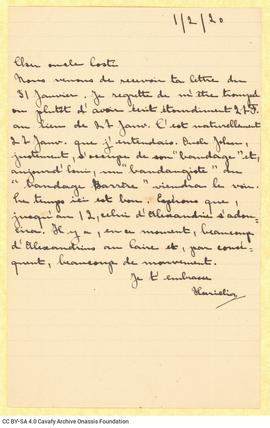
[Cavafy (Valieri)], HaricliaHandwritten letter by Charikleia Cavafy (Valiery) to Cavafy on the first page of a bifolio. The remaining pages are blank. Update on John's health. (Heluan)
[Cavafy (Valieri)], HaricliaHandwritten letter by Charikleia Cavafy (Valiery) to Cavafy on the first page of a bifolio. The remaining pages are blank. Reference to the improvement of John's health. [Cairo]
[Cavafy (Valieri)], HaricliaHandwritten letter by Charikleia Cavafy (Valieri) to Cavafy on the first three pages of a bifolio. The last page is blank. Announcement of the death of Paul in Hyères, France, and reference to various procedural matters. [Cairo]
[Cavafy (Valieri)], HaricliaHandwritten letter by Charikleia Cavafy (Valieri) to Cavafy on both sides of a letterhead of the Tewfik Palace Hotel. She invites the poet to visit her and John at Heluan. Update on John's health and reference to his relation to a certain Madame D. (Heluan)
[Cavafy (Valieri)], HaricliaHandwritten letter by Charikleia Cavafy (Valieri) to Cavafy on one side of a letterhead of the Tewfik Palace Hotel. She invites the poet to visit her and John at Heluan. (Heluan)
[Cavafy (Valieri)], HaricliaHandwritten letter by Charikleia Cavafy (Valiery) to Cavafy on the first page of a bifolio. The remaining pages are blank. Update on John's health. (Heluan)
[Cavafy (Valieri)], HaricliaTypewritten copy of decision No. 126 of the Greek Consular Court of Alexandria, by virtue of which Cavafy's will is probated, in the first three pages of a double sheet notepaper. Two copies of a French translation of the previous decision, in the first two pages of double sheet notepapers with the embossed seal of the Roussos & Pandelidis law firm. Certificates from the Greek Consulate of Alexandria confirming the death of Cavafy, the absence of any descendants and other heirs as well as the absence of any contestations against the will. They are accompanied by French translations. Typewritten French translation of Cavafy's will.
Greek Consular Court (Alexandria)Two typewritten documents by virtue of which the two nieces of Cavafy, Eleni Coletti and Charikleia Valieri, accept their inheritance and the payment of the respective tax and waive any further claims on the Cavafy estate. Bank receipt for the payment of money by Singopoulo to Charikleia Valieri. Correspondence between the law firms that dealt with Valieri's inheritance (four typewritten letters).
Koletti, Eleni Max.Handwritten list of the 1910 Issue distribution, comprising three parts: a small piece of paperboard with the title of the issue and two pieces of ruled paper initially folded in bifolios, with notes on all sides. Two columns in chronological order (1910-1915) with the names of individuals, next to which is the number of issues sent to each of them, as well as notes by Cavafy regarding the person who mediates for the acquisition of the issue or the person who is the final recipient. At the top of the list it is stated that the issue distribution started in April 1910; the phrase "1910 printout distribution" in the stead of a title. At the end of each column the total of issues distributed is noted, which is then carried forward to the top of the next one.
Cavafy, C. P.Three typewritten tax returns and inheritance fees of Constantine P. Cavafy. The first two (Α’ and Β’) were written by the lawyer Anastasios Stylianoudis and are signed by Alekos Singopoulo. They were filed with the Greek Consulate of Alexandria. They are accompanied by the typewritten service acknowledgment documents. The third return (Γ’) is signed by Singopoulo's attorney-at-law; it was filed with the 7th Tax Office of Athens. It is accompanied by a filing acknowledgment document, an additional tax notice, as well as four receipt duplicates for the taxes due. The documents also include a typewritten French translation of a certificate by the Financial Inspector of Athens that Singopoulo had filed the required inheritance returns.
Stylianoudis, AnastasiosHandwritten draft letter by Cavafy, probably to his brother John, in two double sheet notepapers. The last two pages are blank. Reference to the journal Grammata and to persons supporting Cavafy's poetic work as well as to members of his family. Number "3" in one of the pages. Cancellations and emendations; abbreviations.
Cavafy, C. P.Handwritten draft letter by C. P. Cavafy to his brother, Paul, in five parts (three sheets, one bifolio and one small-size sheet) with notes on all sides. The date is noted in the margin of the text of the first page, in pencil. Comments on matters discussed by Paul in a letter of his, dated 14 August 1916; news regarding various individuals related to their family or extended social circle in Alexandria as well as changes to the city. The poet describes the apartment in which he resides and refers to the matter of lighting, explaining why he does not use electricity. He also expresses his satisfaction about the progress of his poetic work, which appears to be of great concern to him. Cancellations and emendations in many parts of the text. All pages but two are numbered (1-10).
Cavafy, C. P.Handwritten draft letter by Cavafy to his brothers Alekos (Alexandros) and Poli (Paul) in a letterhead of the Shepheard's Hotel. The poet visits Cairo and conveys news about the weather there as well as about his social encounters. Reference to their brother Aristeidis and his family as well as to their other brother, John. Cancellations.
Cavafy, C. P.Handwritten list for the distribution of the collection of poems published after the 1910 Issue, consisting of four cut sheets of notepaper initially folded in bifolios with notes on all sides and of a broadsheet written on one side. The names of individuals are recorded in chronological order (1912-1918), and next to them the number of issues to be sent to each of them is mentioned; there are also notes by Cavafy regarding the person who mediates for the acquisition of the issue or who will be the final recipient. At the top of the list it is stated that the distribution started in April 1912. The total of issues distributed is recorded at the end of each column which is subsequently carried forward to the top of the next one.
Cavafy, C. P.Series of handwritten notes referring mostly to the poet's mother, Charikleia Cavafy, in two parts. The first includes 28 loose sheets cut in various sizes, 16 of which are written on both sides. Chronological indications (1896-1898) in the text. The second part is entitled "St[ate] of h[er] ’98 disease" and comprises 4 cut sheets of paper of various sizes. Events relating to Cavafy's mother's illness are recorded in one section. The text continues to the recto of the last sheet; all pages are numbered (1-7). Cancellations and emendations in both parts as well as abbreviations in parts of the text.
Cavafy, C. P.Handwritten list for the distribution of the 1912 onwards Collection consisting of a small piece of paperboard with the title of the issue, a piece of paper initially folded in a bifolio, and two small-sized sheets, one of which bears notes on both sides of the sheet, while the second only on one. The names of individuals are recorded in chronological order (1918-1920); next to the names is the number of issues to be sent to each of them as well as notes by Cavafy regarding the person who mediates for the acquisition of the issue or who will be the final recipient. At the top of the list it is stated that the distribution started in March 1918. The total of issues distributed is recorded at the end of each page and then it is carried forward to the top of the next one.
Cavafy, C. P.