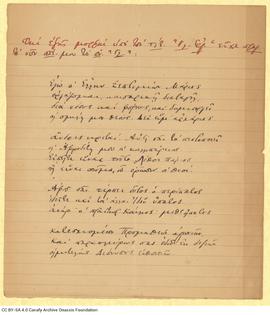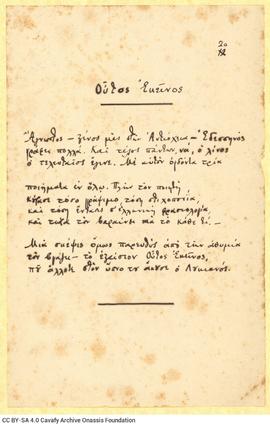
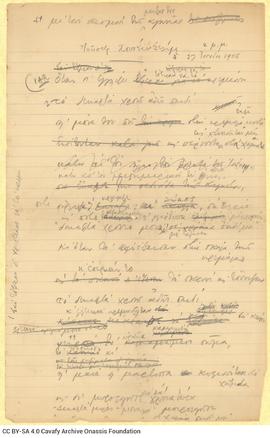
Manuscript of the poem "Yussef Hussein Selim, 27 June 1906 2 P.M." on one side of a ruled sheet. Cancellations and emendations. Variation of the first verse, marked "Var[iante]". Note over the title. Blank verso.
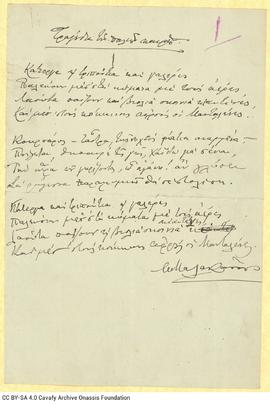
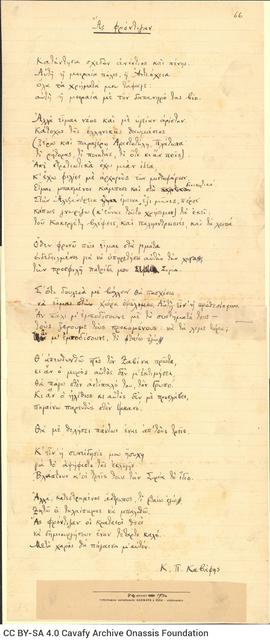
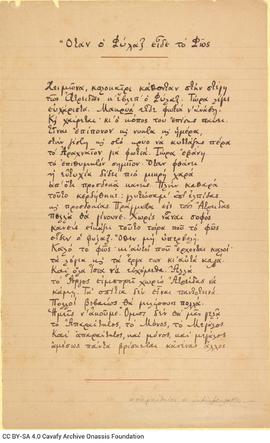
Cavafy, C. P.Manuscript of the poem "When the Watchman Saw the Light" on one side of a ruled sheet. Handwritten note in pencil, regarding the translation of a word in English, at bottom right. The title has been underlined and there is a line in red ink at the end of the poem.
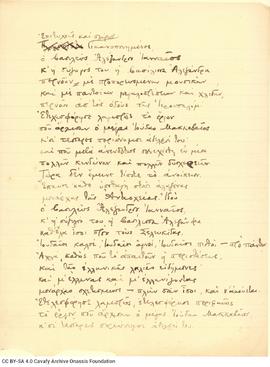
Cavafy, C. P.Handwritten English translation of the poem "When Julian observed much lukewarmness" on one side of a ruled sheet. The poem is written by a hand other than Cavafy's (most likely Valassopoulo's). Cancellations and emendations by Cavafy in pencil. Blank verso.
Cavafy, C. P.Handwritten English translation of Cavafy's poem "Walls", made and written down by John Cavafy on one side of a piece of paper. Blank verso.
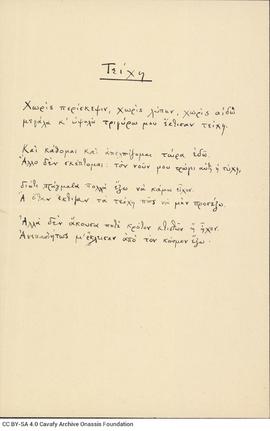
Cavafy, JohnManuscript of the poem "Walls" on one side of a sheet.
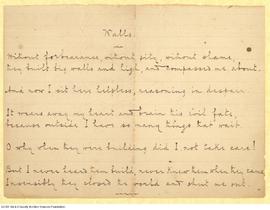
Cavafy, C. P.Signed manuscript of the poem "Walls". The title has been underlined and there is a line underneath the poem. Blank verso.
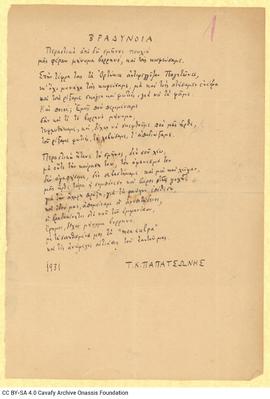
Cavafy, C. P.Manuscript of the poem "Vradynoia". The name "T. C. Papatzoni" as well as date indication ("1931") below the poem. Number "1" is marked.
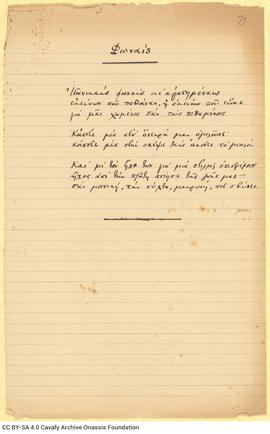
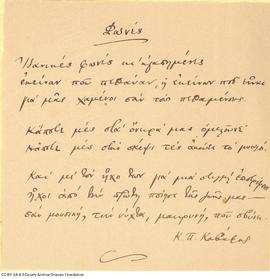
Papatsonis, T. K.Manuscript of the poem "Voices" on one side of a ruled sheet. Number "79" at top right. Blank verso.
Cavafy, C. P.Autograph manuscript of the poem "Voices" on one side of a cut sheet.
Cavafy, C. P.Handwritten note of thanks by Grigorios Xenopoulos to Cavafy on a printed visiting card.
Xenopoulos, GrigoriosPrinted visitng card of the Grand Logothete of the Ecumenical Patriarchate, Stavrakis Aristarchis.
[Stavrakis, Aristarchis]Printed visiting card of N. D. Pappos. It is most probably the son of D. Pappos and Amalia Pitaridi Pappou, Cavafy's cousin and godmother.
[Pappos, N. D. ]Printed visiting card of Cavafy.
Cavafy, C. P.Printed visiting card of Ch. Callinus, second husband of Cavafy's aunt, Amalia (Fotiadi Psylliari), who was working with the Belgian diplomatic delegation as interpreter.
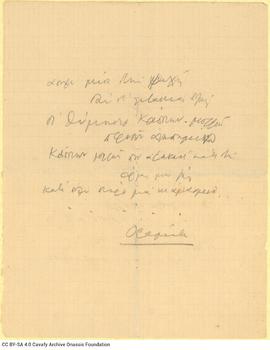
[Callinus, Ch.]Handwritten draft of the poem "Visions" in pencil, on the first side of a double sheet graph paper. The other pages are blank, the last two of which are cut approximately in half.
Cavafy, C. P.Piece of paperboard (perhaps from a handmade folder), entitled "Valassopoulo's translation work. Finished". The handwriting is probably that of Rica Singopoulo but the last word has been written by Cavafy.
[Singopoulo, Rica]Handwritten poem and introductory note with abbreviations.
Cavafy, C. P.Manuscript of an untitled poem on one side of a ruled sheet. Cancellations and emendations.
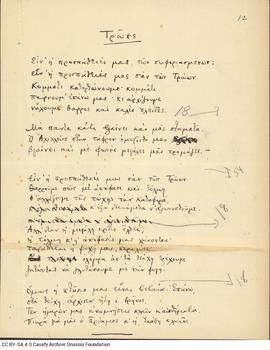
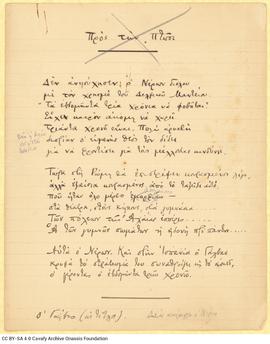
Cavafy, C. P.Manuscript of the poem "Trojans". Cancellations and emendations. Sheet number marked at top right: "12". Numbers written in pencil in the text margin.
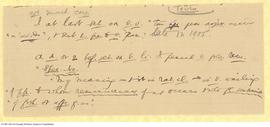
Cavafy, C. P.Handwritten notes on the poem "Trojans" in ink, on a piece of paper. The poem title, the annotation "late in 1905" and a note in pencil, at top left. Extensive use of abbreviations.
Cavafy, C. P.Manuscript of the poem "Tragoudia tou paliou kairou". The title is followed by the mark "I"and number "1" is written in pencil. Cancellation in the last stanza.
Malakasis, M.Handwritten poem ("Towards the Fall") on the first page of a ruled double sheet notepaper, written by Cavafy. The title has been crossed out. Notes in pencil in the left margin and at the bottom of the page; verse emendation. Note "Galva (as the title)" at bottom left. The remaining pages are blank.
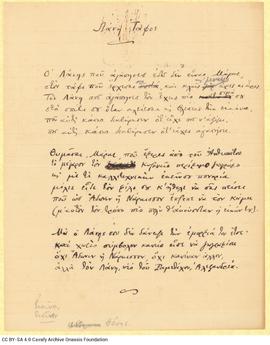
Cavafy, C. P.Handwritten poem ("Tomb of Lanes") on one side of a ruled sheet, with cancellations and emendations on the body of the poem and notes at the bottom of the page.
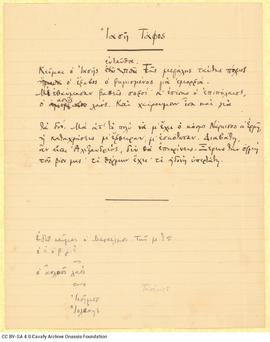
Cavafy, C. P.Handwritten poem ("Tomb of Iases") on the first page of a ruled double sheet notepaper. Cancellations, emendations and notes below the poem. Underlined title and line at the end of the poem. The remaining pages are blank.
Cavafy, C. P.Typewritten poem by M. B. Davies in English; handwritten emendation.
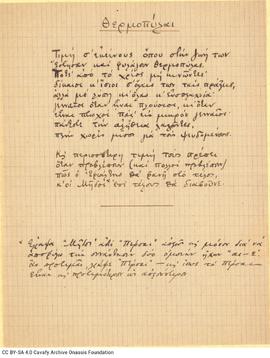
Davies, M. B.Manuscript of the poem "Thermopylae" on one side of a sheet. The title has been underlined and there is a line in red ink at the end of the poem. At the bottom of the page, explanatory note (instruction) regarding the choice of specific words in order to avoid hiatus.
Cavafy, C. P.Manuscript of the poem "Their Beginning" in the first page of a ruled double sheet notepaper. Variations, marked "Variantes", below the poem. The remaining pages are blank.
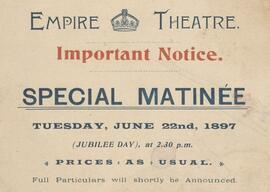
Cavafy, C. P.Advertisement card of the Empire Theatre in London. Information about a morning performance.
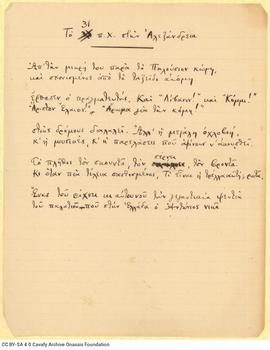
The Empire Theatre (London)Manuscript of the poem "In 31 B.C. in Alexandria" on one side of a ruled sheet. Cancellations and emendations. Blank verso.
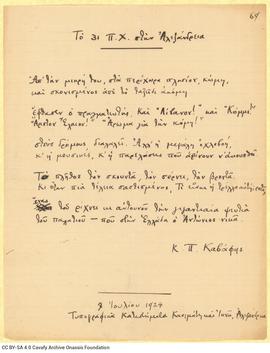
Cavafy, C. P.Manuscript of the poem "In 31 B.C. in Alexandria" on one side of a ruled sheet, signed by Cavafy. Number "69" at top right. Date ("7 July 1924") and brand name of the Kasimatis and Ionas printing house below the poem. Cancellation and emendation. Blank verso. Printer's copy.
Cavafy, C. P.Polygraphed copy of a handwritten poem ("The Windows"). Signed: "C. P. Cavafy".
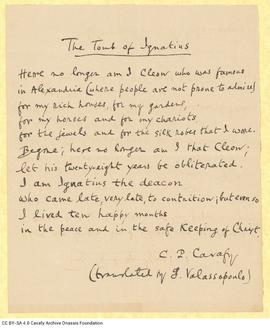
Cavafy, C. P.Manuscript by Cavafy with the English translation of the poem "Tomb of Ignatius" by G. Valassopoulo, on one side of a ruled sheet. Blank verso.
Cavafy, C. P.Handwritten copy by Cavafy on an English translation by G. Valassopoulo of the poem "Tomb of Eurion" on one side of a ruled sheet. Emendation in ink. Blank verso.
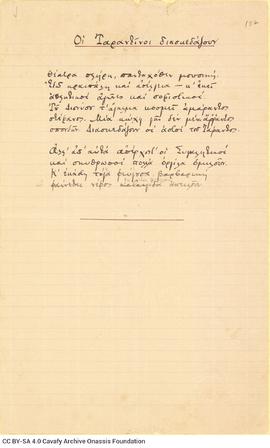
Valassopoulo, G.Manuscript of the poem "The Tarentines Have Their Fun", written in ink on one side of a ruled sheet. The title has been underlined and there is a line in red ink below the poem. Cancellation and notes in pencil. Number "132" at top right. Blank verso.
Cavafy, C. P.Manuscript of the poem "The Satrapy" on one side of a ruled sheet. crossed out notes at bottom left. "98 Bis" at top right. Cancellations and emendations. Variations of verses. Blank verso.
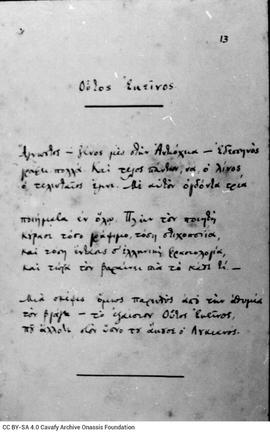
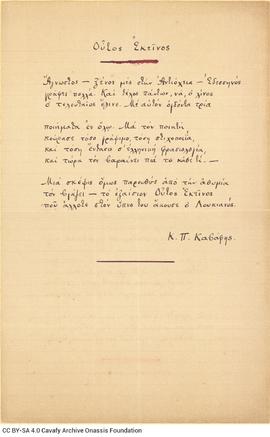
Cavafy, C. P.The poem "The Retinue of Dionysus" on one side of a printed broadsheet. The poet's signature ("C. P. Cavafy") below the poem. The printed numbering of the broadsheet ("13") has been crossed out in ink. Blank verso.
Cavafy, C. P.Handwritten title "The Retinue of Dionysus" on the recto of a sheet; number "11" at top right. All details have been written by Cavafy. Blank verso.
Cavafy, C. P.Manuscript of the poem "The Next Table" on one side of a ruled sheet, signed by the poet. Blank verso.
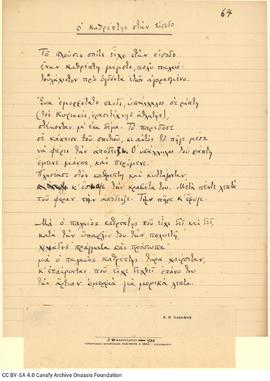
Cavafy, C. P.Manuscript of the poem "The Mirror in the Entrance" on one side of a ruled sheet. Cancellations and emendations. At the bottom, affixed piece of paper with printed details: the poet's name ("C. P. Cavafy"), the date ("3 February 1930") corrected by hand, and the brand name "Kasimatis & Ionas Printing shops – Alexandria". Sheet number marked at top right: "64".
Cavafy, C. P.Manuscript of the poem "The Intervention of the Gods".
Cavafy, C. P.Manuscript of an English translation of a poem by Cavafy ("The Hall Mirror") on one side of a blank sheet. The poet's signature in English and the note "translation adapted by C.H.O.S." below the text. Blank verso.
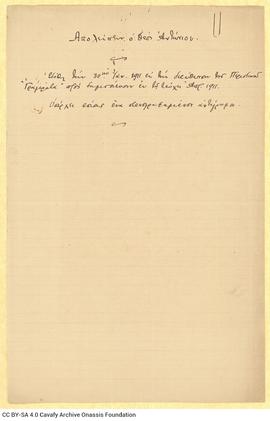
Cavafy, C. P.Handwritten note on one side of a ruled sheet, regarding the publication of the poem "The God Abandons Antony" in the issue of April 1911 of the journal Grammata. Blank verso.
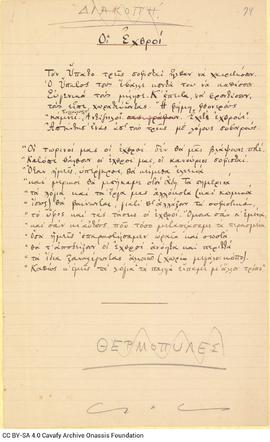
Cavafy, C. P.Manuscript of the poem "The Enemies", written in ink on one side of a ruled sheet. The title has been underlined; cancellation and line in red ink below the poem. Number "74" at top right. At the top, the crossed out title "Interruption" and the crossed out title "Thermopylae" below the poem. The number and the titles are written in pencil. Blank verso.
Cavafy, C. P.Manuscript of the poem "The End of Antony" written in ink on one side of a ruled sheet. Notes in pencil below the poem.
Cavafy, C. P.Typewritten English translation of the poem "Finished" by G. Valassopoulo on one side of a sheet; handwritten emendations. Blank verso.
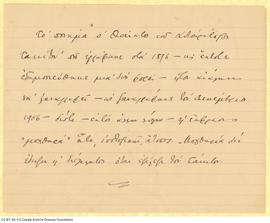
Valassopoulo, G.Handwritten notes on the poem "The Death of the Emperor Tacitus" on the recto of a ruled sheet. There are two versions of the poem, the original of 1896 and the subsequent of 1906 as well as the reasons of historical accuracy that urged Cavafy to revise the text.
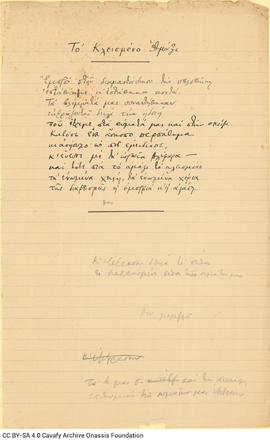
Cavafy, C. P.Manuscript of the poem "The Closed Carriage" and notes in the margin.
Cavafy, C. P.Manuscript of the poem "That's How" with additions and notes.
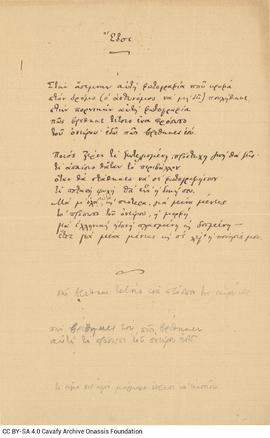
Cavafy, C. P.Manuscript of the poem "That Is He" on one side of a sheet. Number "20" at top right and the crossed out number "12" below. Blank verso.
Cavafy, C. P.Manuscript of the poem "That Is He" on one side of a sheet. Blank verso. Number "13" at top right. The title has been underlined and there is a line below the poem.
Cavafy, C. P.Autograph manuscript of the poem "That Is He" on one side of a ruled sheet. The title has been underlined and there is a line in red ink at the end of the poem.
Cavafy, C. P.Handwritten text on the first page of a double sheet notepaper. The remaining pages are blank. Sale of the house on 10 Lepsius street.
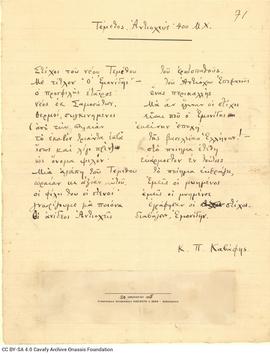
Cavafy, C. P.Manuscript of the poem "Temethus, an Antiochene: 400 A.D." on one side of a ruled sheet, signed by the poet. Blank verso.
Cavafy, C. P.Autograph manuscript of the poem "Temethus, an Antiochene: 400 A.D." on one side of a ruled sheet. Cancellations and emendations. Signed: "C. P. Cavafy". At the bottom, affixed piece of paper with printed details: date, corrected by hand to read "20 January 1925", and the brand name "Kasimatis & Ionas Printing shops – Alexandria". Sheet number marked at top right: "71".
Cavafy, C. P.Telegram by Leonard Woolf to Alekos Singopoulo, in which he asks to be informed whether the latter has received the preliminary agreement and whether he agrees with the terms set forth therein.
Woolf, [Leonard]Telegram from the Benakis family to the Singopoulos, expressing the family's condolences for the death of Cavafy. (Athens)
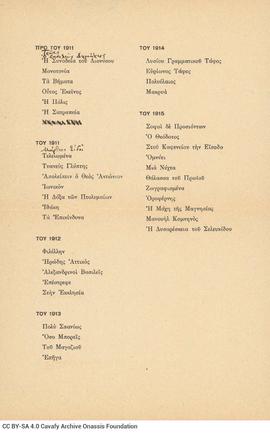
BenakiPrinted table of contents from a poetry collection by Cavafy (Γ10) in two columns. It contains poems before 1911 as well as of the 1911-1915 period. Three titles have been added in the poet's handwriting and one has been crossed out.
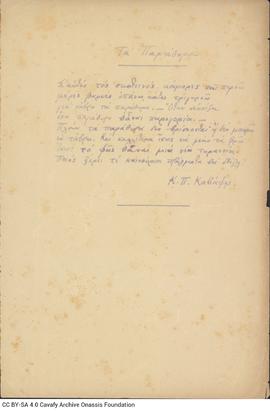
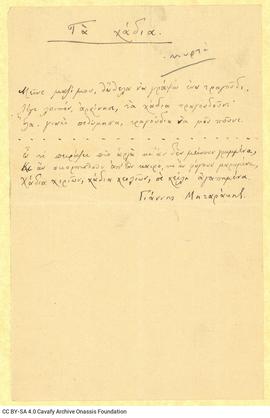
Cavafy, C. P.Handwritten poem ("Ta hadia"). Note in pencil in the margin (possibly addressed to the publisher).
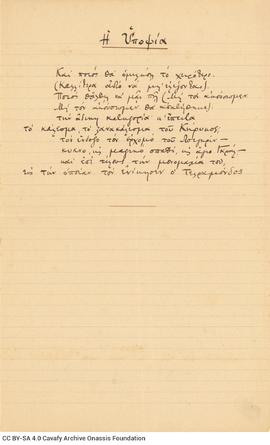
Mitarakis, GiannisManuscript of the poem "Suspicion" on one side of a ruled sheet. Cancellations and additions. Number "38" at top right.
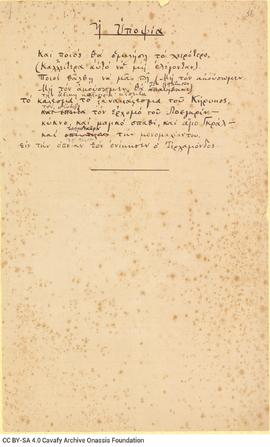
Cavafy, C. P.Manuscript of the poem "Suspicion". The title has been underlined and there is a line in red ink below the poem.
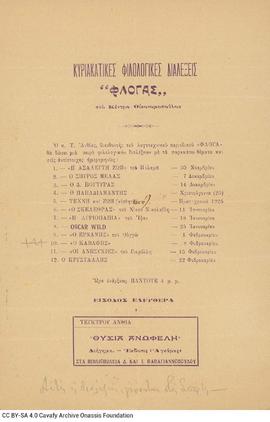
Cavafy, C. P.Programme of Sunday lectures by Tefkros Anthias (pen name of Andreas Pavlou), organised by the literary journal Floga, which he directed. The lectures were given in the period 30/11/1924-22/2/1925. One of the lectures is about Cavafy. Handwritten note by the poet in pencil, that the lectures were taking place in Sparta (Anthias was working there as a teacher during the 1924-1925 period). Advertisement of the novel "Thysia anofeli" by Tefkros Anthias below the programme. Handwritten emendation in ink. Blank verso.
Floga (magazine)Solemn declaration by Paul Cavafy on one side of a ruled sheet. He declares that part of the furniture and items contained in the house on 17 Rosetta street, which he rented and in which he lived together with C. P. Cavafy, belong to his brother, Constantine. The text is written by the poet and signed by Paul. Blank verso.
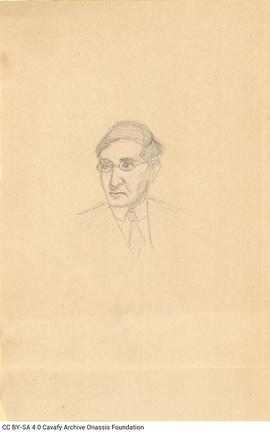
Cavafy, C. P.Sketch in ink by Sofo (Sofoklis Antoniadis) on rice paper. It depicts Cavafy in frontal view, wearing glasses, in a suit and necktie. Signed by the artist. The handwritten title of the sketch ("The poet C. P. Cavafy") at bottom right.
SofoPainting drawing in charcoal. It depicts Cavafy in three-quarter view, wearing glasses, looking slightly to the right. Blank verso. The sketch is placed inside a handmade folder of particularly thin paper, on which the poet has marked the date.
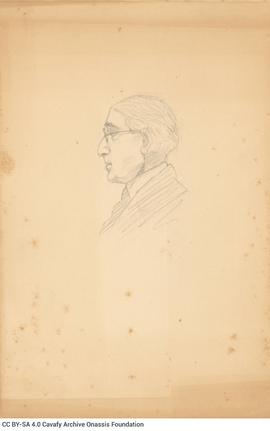
UnknownSketch by an unknown person on one side of a sheet. Blank verso. It depicts Cavafy in profile view, wearing glasses and looking to the right.
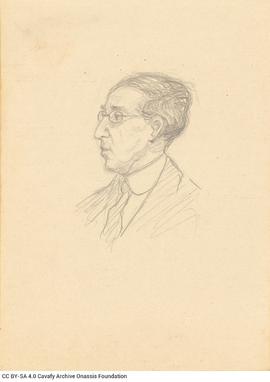
UnknownSketch in pencil on one side of a piece of paper. Blank verso. It depicts a bust of Cavafy in three-quarter view, looking to the left.
UnknownSketch by an unknown person on one side of a sheet. Blank verso. It depicts Cavafy wearing glasses and looking to the left.
UnknownSketch on one side of a paperboard. Blank verso. It depicts a bust of Cavafy in profile view, looking to the left.
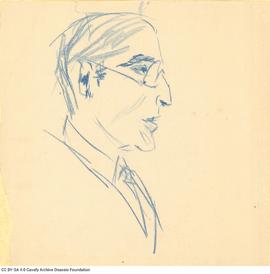
UnknownSketch by an unknown person, in sky blue pencil on one side of a sheet. Blank verso. It depicts Cavafy in profile view, wearing glasses and looking to the right.
UnknownSketch by an unknown person on one side of a sheet. Blank verso. It depicts Cavafy seated, in frontal view, wearing glasses, in a suit and necktie.
UnknownSketch in pencil on one side of a piece of paper. Blank verso. It depicts a bust of Cavafy in profile view, looking to the left.
UnknownSketch in ink, by way of a cartoon, on one side of a sheet. To the left, a Pharaoh sitting in a throne and at his feet, a subject kneeling before him. Below, the note "The scribe Fri-a implores King Ka-fafi to eat bread at his house". Judging from the handwriting, the sketch could be attributed to the poet's brother, John.
[Cavafy, John]Sketch by Nikolaos Gogos in pencil on one side of a sheet. Blank verso. It depicts Cavafy in profile view, wearing glasses and looking to the right. Signed by the artist and dated.
Gogos, NikolaosSketch in pencil on one side of a piece of paper. Blank verso. It depicts a bust of Cavafy in three-quarter view, looking slightly to the left.
UnknownAutograph manuscript of the poem "Should Have Taken the Trouble". Cancellations and emendations. At the bottom, affixed piece of paper with printed details: date, corrected by hand to read "8 July 1930", and the brand name "Kasimatis & Ionas Printing shops – Alexandria". Sheet number marked at top right: "66".
Cavafy, C. P.Handwritten French translation of the poem "He Swears". Cancellations and note in pencil in the margin, where a word used in the translation is repeated. Below the poem, handwritten note in which Alexandros Empeirikos is mentioned as translator.
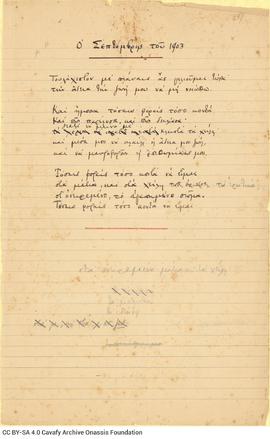
[Cavafy, C. P.]Manuscript of the poem "September of 1903" and notes in the margin. The title has been underlined and there is a line in red ink below the poem. The sheet number is marked ("207"). The note "A.M." on the border. Cancellations and emendations.
Cavafy, C. P.Two small-sized copies (most probably lithographs) of a portrait of Cavafy by Efthymis Papadimitriou (Mim Pap). The poet is depicted in profile, wearing a suit, a nectie and glasses, looking to the left. Blank verso. The two small pieces of paperboard are placed in an envelope.
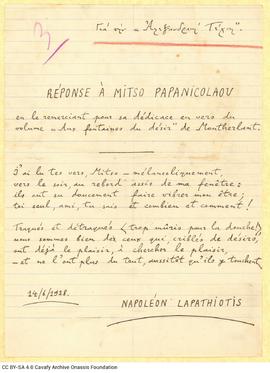
Mim Pap [Papadimitriou, Efthymis]Handwritten poem by Napoleon Lapathiotis in French. According to the handwritten introductory note, this is an expression of thanks to Mitsos Papanikolaou for verses he had devoted to him previously. Reference to Aux fontaines du désir by Henry de Montherlant. Note in Greek that the text is to be sent to the journal Alexandrini Techni; number "3" written in pencil.
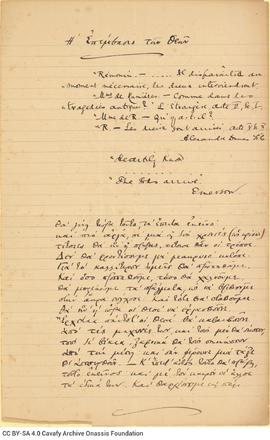
Lapathiotis, NapoléonManuscript of the poem "Remember, Body....." on one side of a ruled sheet. Blank verso.
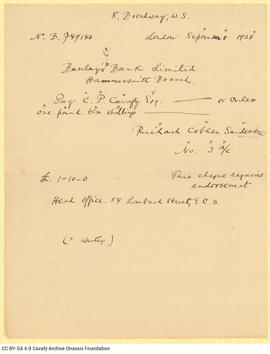
Cavafy, C. P.Handwritten copy of a payment checque on one side of a ruled sheet, by the poet's hand. Blank verso. Despatch of £1,10 from Richard Cobden Sanderson to Cavafy. (London)
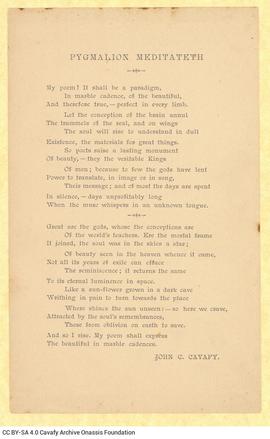
Cavafy, C. P.Printed poem by John Cavafy ("Pygmalion Meditateth"), on one side of a sheet.
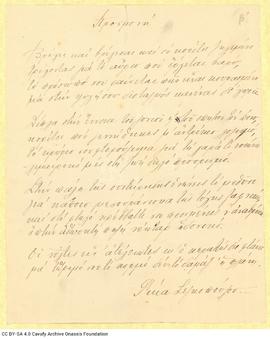
Cavafy, John C.Handwritten poem by Rica Singopoulo ("Prosmoni"). "β'"noted in pencil in the margin.
Segkopoulou, RikaHandwritten text by Cavafy on the first page of a double sheet notepaper. The other three pages are blank. The text is a draft of an official report regarding the poet's birth and christening certificates. The dates mentioned cover the period 1864-1915.
Cavafy, C. P.Handwritten promissory note of the Patriarchate of Jerusalem to John Cavafy, in the first page of a double-sheet. The remaining pages are blank. It is mentioned that the Patriarchate borrowed an amount of money from John Cavafy (who is most probably the poet's grandfather) in order to restore the Holy Sepulchre. The name of the Patriarch of Jeruslaem, Polycarpus, at top centre of the page; his signature below the text of the promissory note. Stamped seal representing the resurrection of Jesus and the year 1808 to the left of the signature.
Patriarchate of JerusalemAdvertising event programme for the Olympia music hall in Paris. Information and ticket prices are stated.
Olympia (Paris)Printed (lithograph) encyclical [apantachousa] by the Patriarch of Alexandria Nikanor (1866-1869) to the faithful and the clergy. The letter pertains to a dispute between the Patriarchate of Constantinople and the Patriarchate of Alexandria (the former is accused of interfering in the internal affairs of the latter).
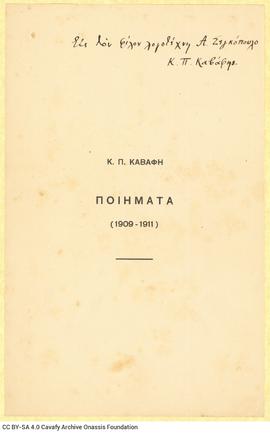
UnknownPrinted cover of Cavafy's Collection of poems 1909-1911. Handwritten dedication by the poet to Alekos Singopoulo at the top. Blank verso.
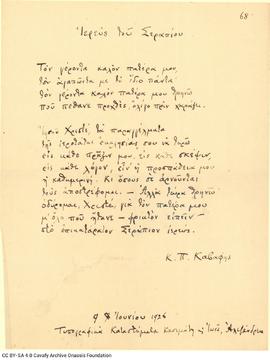
Cavafy, C. P.Autograph manuscript of the poem "Priest of the Serapeum" on one side of a sheet. At the bottom of the page, handwritten date ("9 June 1926"), and the brand name "Kasimatis & Ionas Printing shops, Alexandria". Sheet number marked at top right: "68".
Cavafy, C. P.Cartoon-type sketch by Kem (Kimon E. Maragkos), cut off from a French newspaper. It depicts Cavafy in profile view, walking to the left. He is wearing a suit, hat and glasses. His right hand is raised. In the left hand, behind his back, he is holding worry beads. Signature of the artist and date indication.
KemClipping from the newspaper Neon Asty. Poem on the verso.
Neon Asty (newspaper)Clipping from the newspaper Tachydromos of Alexandria, with a short interview of Cavafy, including a sketch of him by Edmond Soussa.
Tachydromos (Alexandria), newspaperClipping from the Athenian newspaper Politeia. Short note entitled "Mia mimisis Kavafeios"; and poem entitled "Keravnos", imitating the poet's style.
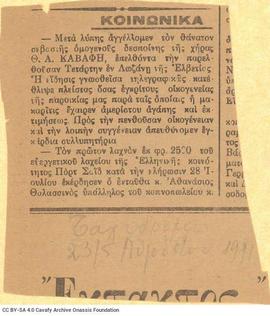
Politeia (newspaper)Clipping from the newspaper Tachydromos of Alexandria. Announcement of the death of Thelxiopi Cavafy (widow of the poet's brother, Alexandros) in Lausanne, Switzerland, published in the "Social News" column. Newspaper title and date handwritten by Cavafy.
Tachydromos (Alexandria), newspaperClipping from the Athenian newspaper Dimokratia. The article by Giorgos Kotzioulas "O "Kyklos" gia ton Kavafi", regarding the issue of the Athenian journal Kyklos dedicated to his poetry appears in the second page.
Dimokratia (newspaper)Clipping from the Neon Asty with the poem "Notes", signed by Attikos. The newspaper title is noted by Cavafy.
Neon Asty (newspaper)Clipping from a printed medium with the poem "I mana tou nafti", written by the student of the Averoff Secondary School and subsequently poet, Konstantinos N. Konstantinidis.
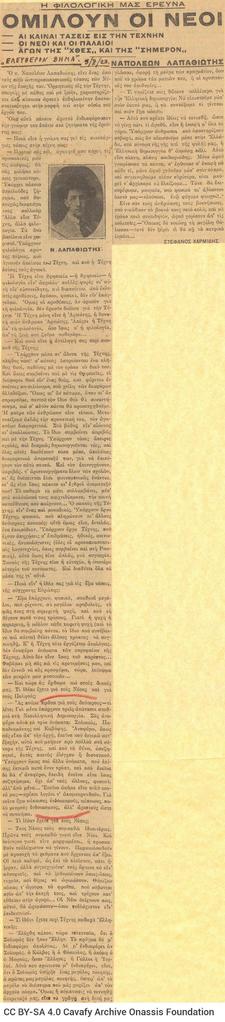
UnknownClipping from the Athenian newspaper Eleftheron Vima. It contains an interview of Napoleon Lapathiotis to Stefanos Charmides. The paragraph that refers to Cavafy has been marked in red pencil. Newspaper title and date handwritten.
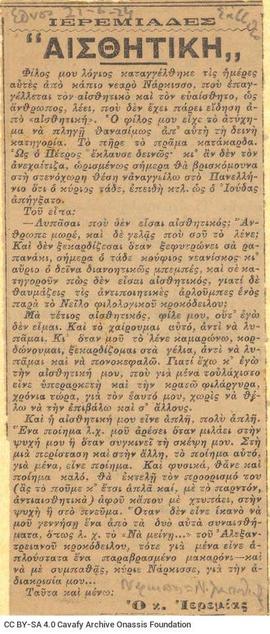
Eleftheron Vima (newspaper)Clipping from the Athenian newspaper Ethnos. It contains the column "Ieremiades", with a note that reads "Aesthetics" and negative comments on the poetry of Cavafy, who is alluded to but not named. Moreover, reference to "Narcissus", who as explained by a handwritten note, is Napoleon Lapathiotis. Newspaper title and date handwritten.
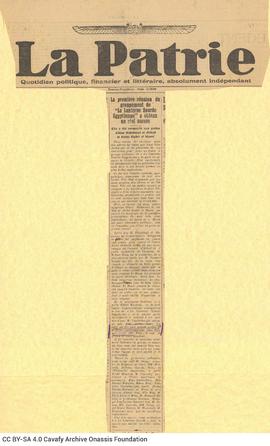
Ethnos (newspaper)Clipping from the French-language newspaper La Patrie. An unsigned article on the first page refers to the first meeting of the literary and artistic group "La Lanterne Sourde Egyptienne" of Paul Vanderborght in Cairo. Reference to an impending event in honour of Cavafy, "one of the greatest poets of contemporary Greece, alongside Palamas". The relevant lines are marked and underlined. Vanderborght had informed Cavafy by letter about this event, so the article may be dated to 1929.
La Patrie (newspaper)