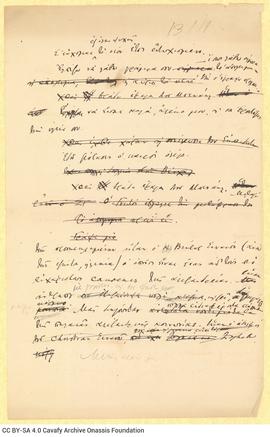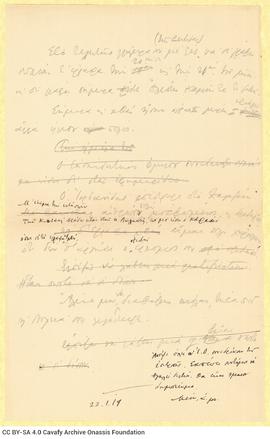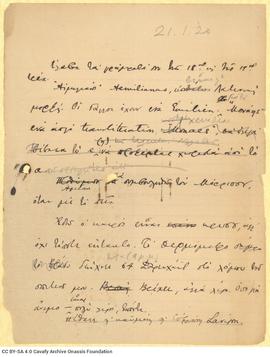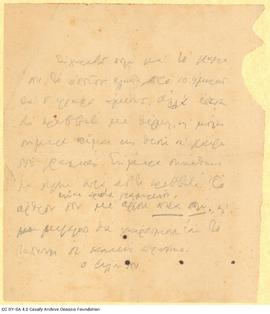
Handwritten text regarding the Delphic Festival on one side of two sheets. There arithmetic notes in pencil on the first sheet. Number "2" on the recto of the second sheet and the name of M. Vaianos on its verso. Cancellations and emendations.
Nirvanas, PavlosHandwritten text regarding the Delphic Festival on one side of two sheets. The author expresses his admiration for the event; reference to the performance of the tragedy Prometheus Bound by Aeschylus. Handwritten numerical notes on the first sheet.
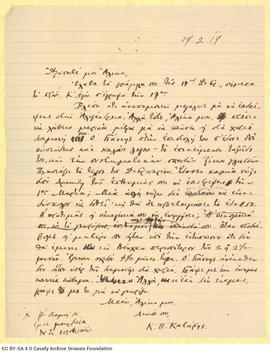
Malakasis, M.Handwritten text on the first page of a double sheet notepaper. The remaining pages are blank. Sale of the house on 10 Lepsius street.
Cavafy, C. P.Manuscript of the poem "Temethus, an Antiochene: 400 A.D." on one side of a ruled sheet, signed by the poet. Blank verso.
Cavafy, C. P.Autograph manuscript of the poem "Temethus, an Antiochene: 400 A.D." on one side of a ruled sheet. Cancellations and emendations. Signed: "C. P. Cavafy". At the bottom, affixed piece of paper with printed details: date, corrected by hand to read "20 January 1925", and the brand name "Kasimatis & Ionas Printing shops – Alexandria". Sheet number marked at top right: "71".
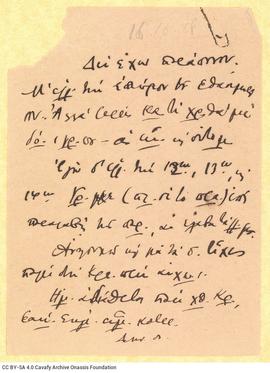
Cavafy, C. P.Telegram by The Listener to Alekos Singopoulo, requesting his permission to publish four poems by Cavafy, translated by Mavrogordatos, in the weekly magazine of the BBC. Handwritten notes on the verso, with Singopoulo's new address in Alexandria and the titles of the four poems (quite probably handwritten by Rica Singopoulo).
The Listener (journal)Telegram by The Listener to Alekos Singopoulo, asking his permission to publish two poems by Cavafy, translated by Mavrogordatos, in the weekly journal of the BBC. Blank verso. Accompanied by a small-size piece of paper of the BBC referring to the rights of the translator, Ioannis Mavrogordatos, as well as by a telegram delivery receipt to Singopoulo, dated 26/4/1939.
The Listener (journal)Copy of a telegram by Alekos Singopoulo to Leonard Woolf, in which he informs him about the despatch of a letter.
Singopoulo, Alex.Telegram by Leonard Woolf to Alekos Singopoulo, in which he asks to be informed whether the latter has received the preliminary agreement and whether he agrees with the terms set forth therein.
Woolf, [Leonard]Telegram from the Benakis family to the Singopoulos, expressing the family's condolences for the death of Cavafy. (Athens)
BenakiPrinted four-page pamphlet with the poem "Walls" and its English translation by the poet's brother, John Cavafy. The first page bears the poem title and the poet's name, a brief quote from Aeschylus as well as place (Alexandria) and date indication (1 September 1896). Two typographic ornaments, one at top left and another at bottom right. Border.
On the second page, the poem in Greek inside a border, and the initials "C.C.". On the third page, in the same layout, the indication "Translation" and the initials "J.C.C.". The layout of the fourth page is similar to that of the first one, but the date (1897) is written in Roman numerals. Accompanied by another copy torn in two places.
Handwritten list of books and periodicals, entitled "Taken by Peridis" and written on twelve sheets; they are all numbered at top right of the recto. Among them, a volume with translations by John Cavafy and a large number of issues of Greek and foreign newspapers and journals. It is obviously material borrowed by Michalis Peridis from the remnants of Cavafy's belongings.
[Singopoulo, Alekos D.]Printed table of contents from a poetry collection by Cavafy (Γ10) in two columns. It contains poems before 1911 as well as of the 1911-1915 period. Three titles have been added in the poet's handwriting and one has been crossed out.
Cavafy, C. P.Handwritten poem ("Ta hadia"). Note in pencil in the margin (possibly addressed to the publisher).
Mitarakis, GiannisHandwritten English translation of the poem "T[he] Fun[eral] of Sar[pedon]" by the poet on both sides of a ruled sheet. Extensive use of abbreviations. The translation was made by John Cavafy.
Cavafy, C. P.Manuscript of the poem "Suspicion" on one side of a ruled sheet. Cancellations and additions. Number "38" at top right.
Cavafy, C. P.Manuscript of the poem "Suspicion". The title has been underlined and there is a line in red ink below the poem.
Cavafy, C. P.Clipping from the newspaper L'Echo de Paris. Article by Georges Bonnamour entitled "Sur la terrace". The name, date and issue number of the newspaper are handwritten by Cavafy.
L'Écho de Paris (newspaper)Programme of Sunday lectures by Tefkros Anthias (pen name of Andreas Pavlou), organised by the literary journal Floga, which he directed. The lectures were given in the period 30/11/1924-22/2/1925. One of the lectures is about Cavafy. Handwritten note by the poet in pencil, that the lectures were taking place in Sparta (Anthias was working there as a teacher during the 1924-1925 period). Advertisement of the novel "Thysia anofeli" by Tefkros Anthias below the programme. Handwritten emendation in ink. Blank verso.
Floga (magazine)Manuscript of a poem and attached handwritten note. On a ruled sheet, the poem "Strengthening" and notes in the margin. The title has been underlined and there is a line in red ink below the poem. Sheet number marked: "78". The handwritten note "Not for publication. But may remain here" on a separate piece of paper.
Cavafy, C. P.Four-page menu of the Star & Carter Hotel & Restaurant in London. It contains a bound map of Paris. Photograph of the hotel on back cover.
Star & Carter Hotel & RestaurantHandwritten copy by Cavafy of the poem "Srahmandazi" by Henry Newbolt, on the first three pages of a double sheet notepaper. Footnote on the first page. Bibliographical reference to the The Monthly Review (June 1902), below the text on the third page (June 1902). The last page is blank.
Cavafy, C. P.Solemn declaration by Paul Cavafy on one side of a ruled sheet. He declares that part of the furniture and items contained in the house on 17 Rosetta street, which he rented and in which he lived together with C. P. Cavafy, belong to his brother, Constantine. The text is written by the poet and signed by Paul. Blank verso.
Cavafy, C. P.Three sketches on small-size pieces of paper, depicting a helmet, a cross and a bird. Also, clipping from an envelope with the printed motto "For Christ and the Land of the Romans" in Greek. All the above is placed inside a folder of ricepaper with a note by Cavafy referring to a certain part of his family tree.
UnknownTwo sketches in pencil on one side of pieces of paper. They both depict Cavafy in profile view, looking to the left. They are placed inside a handmade folder marked "Raptarchis" and "1925", handwritten by Cavafy. One of the two sketches bears an illegible signature.
UnknownSketches by various artists (K. Maleas, P. Radovich, N. Gogos, Efth. Papadimitriou, J. Kefalinos, etc.), the majority of which depict Cavafy's figure. Two of them are printed and some are polygraphed; there is also a photograph of a drawing as well as a sketch published in a French printed medium. Most of the works have been made in pencil. Some of the drawings are signed. Seven of the items are dated.
Small-size sketch by N. Gogos depicting Cavafy; copy of a sketch of Cavafy; photographic, printed and lithography reproductions of portraits and sketches depicting the poet.
Sketch in pencil made by Gerasimos Grigoris. It depicts Cavafy's face. Another sketch on the verso of the sheet, also in pencil.
Grig[oris], G[erasimos]Sketch in ink by Takis Kalmouchos on one side of a sheet. It depicts Cavafy in profile, looking to the left. The artist's signature below the figure. Handwritten notes in red pencil ("2/3", "Should come to the office") at bottom left. Handwritten dedication by Kalmouchos to Marios Vaianos on the verso.
Kalmouchos, T.Sketch in ink by Sofo (Sofoklis Antoniadis) on rice paper. It depicts Cavafy in frontal view, wearing glasses, in a suit and necktie. Signed by the artist. The handwritten title of the sketch ("The poet C. P. Cavafy") at bottom right.
SofoPainting drawing in charcoal. It depicts Cavafy in three-quarter view, wearing glasses, looking slightly to the right. Blank verso. The sketch is placed inside a handmade folder of particularly thin paper, on which the poet has marked the date.
UnknownSketch by an unknown person on one side of a sheet. Blank verso. It depicts Cavafy in profile view, wearing glasses and looking to the right.
UnknownSketch in pencil on one side of a piece of paper. Blank verso. It depicts a bust of Cavafy in three-quarter view, looking to the left.
UnknownSketch by an unknown person on one side of a sheet. Blank verso. It depicts Cavafy wearing glasses and looking to the left.
UnknownSketch on one side of a paperboard. Blank verso. It depicts a bust of Cavafy in profile view, looking to the left.
UnknownSketch by an unknown person, in sky blue pencil on one side of a sheet. Blank verso. It depicts Cavafy in profile view, wearing glasses and looking to the right.
UnknownSketch by an unknown person on one side of a sheet. Blank verso. It depicts Cavafy seated, in frontal view, wearing glasses, in a suit and necktie.
UnknownSketch in pencil on one side of a piece of paper. Blank verso. It depicts a bust of Cavafy in profile view, looking to the left.
UnknownSketch in ink, by way of a cartoon, on one side of a sheet. To the left, a Pharaoh sitting in a throne and at his feet, a subject kneeling before him. Below, the note "The scribe Fri-a implores King Ka-fafi to eat bread at his house". Judging from the handwriting, the sketch could be attributed to the poet's brother, John.
[Cavafy, John]Sketch by Nikolaos Gogos in pencil on one side of a sheet. Blank verso. It depicts Cavafy in profile view, wearing glasses and looking to the right. Signed by the artist and dated.
Gogos, NikolaosSketch in pencil on one side of a piece of paper. Blank verso. It depicts a bust of Cavafy in three-quarter view, looking slightly to the left.
UnknownThe fonds includes the archival remnants of Alekos Singopoulo, heir of C. P. Cavafy, and of his wife, Rica Singopoulo, first editor of the Cavafy archive (from 1926 to 1939).
More specifically, the files of the fonds include texts by Alekos and Rica Singopoulo that shed light on Cavafy’s personality and poetic work, the correspondence between the Singopoulos and the poet as well as with others, and Singopoulo’s correspondence with a British publisher (The Hogarth Press) relating to the first collective publication of Cavafy’s work in English. It also includes items related to other activities of the Singopoulos as well as personal documents. The fonds is complemented by a collection of photographs in the possession of Alekos and Rica Singopoulo as well as by a file of sketches (or reproductions of sketches) depicting Cavafy, originally in the possession of Alekos Singopoulo.
Lastly, the Alexandrini Techni archive consists almost exclusively of manuscripts (prose works and poems) that had been sent to the journal for publication, of letters of authors and scholars addressed to the editors of the journal and of handwritten lists with the names of authors and publishers in Athens.
Singopoulo, Alekos D.Manuscript poem and notes. Τhe poem "Simeon" and notes in the margin in the first two pages of a double sheet notepaper. The title "Safe Haven" in the last page. Handwritten notes with cancellations and emendations in a small-size piece of paper.
Cavafy, C. P.Envelope of the General Consulate of Greece ("Consulat Général de Grèce") in Alexandria, addressed to C. P. Cavafy. Printed recipient details in French and handwritten details. It contains two separate documents: The certificate of the Silver Medal of the Order of the Phoenix that was awarded to the poet by the Presidency of the Hellenic Republic, dated 12/7/1926. It is printed on two sheets of thick paper; printed and handwritten details on the recto of the first sheet. Typewritten accompanying letter by the Consul General of Greece in Alexandria, Marinos Sigouros, on the award of the certificate to C. P. Cavafy, dated 8/9/1926.
UnknownAutograph manuscript of the poem "Should Have Taken the Trouble". Cancellations and emendations. At the bottom, affixed piece of paper with printed details: date, corrected by hand to read "8 July 1930", and the brand name "Kasimatis & Ionas Printing shops – Alexandria". Sheet number marked at top right: "66".
Cavafy, C. P.Handwritten notes and short letters by Cavafy to Nikos and Eftychia Zelita, on seventeen parts of sheets of various sizes, cards and small pieces of paper. One side of some is blank. Date indications ("13/8/28", "26 Feb. 926" and illegible note) on three of the sheets. Reference to the Grammata publishing house of Alexandria, to Cavafy's collection (the Collection 1907-1915 is referred to by name) as well as the newspaper I Laiki Foni newspaper of Volos. The messages usually pertain to a meeting among them or some other sort of favour.
Cavafy, C. P.Press clipping from the newspaper Kleio of Leipzig with an article by Cavafy entitled "Shakespeare on Life". Two sections of the print are affixed on the two sides of a sheet, which is numbered by hand "11" and "12 at top right of the recto and at top left of the verso respectively. The publication details written by Cavafy in the upper part of the recto. Commentary on Shakespeare's view on life as seen through his work Measure for Measure. The article is signed "Constantine F. Cavafy".
Cavafy, C. P.Envelopes and parts of envelopes with the details of the recipient C. P. Cavafy (approximately 75). The items bear postage stamps and seals, while some also bear handwritten notes with enumeration details and information regarding the date they were received. Handwritten notes by C . P. Cavafy and his brother, John Cavafy, on one envelope; another envelope is accompanied by a short note with date indication and the signature "John" written by the poet's brother. The envelopes accompany the letters sent by Paul Cavafy to C. P. Cavafy during the former's stay abroad.
[Cavafy, Paul]Handwritten French translation of the poem "He Swears". Cancellations and note in pencil in the margin, where a word used in the translation is repeated. Below the poem, handwritten note in which Alexandros Empeirikos is mentioned as translator.
[Cavafy, C. P.]Manuscript of the poem "September of 1903" and notes in the margin. The title has been underlined and there is a line in red ink below the poem. The sheet number is marked ("207"). The note "A.M." on the border. Cancellations and emendations.
Cavafy, C. P.Handwritten notes on the poem "Sculptor from Tyana" on three pieces of paper, two of which bear date indications. They are accompanied by a small piece of paper with the handwritten title. Extensive use of abbreviations.
Cavafy, C. P.Two copies (perhaps lithographs) of a portrait of Cavafy by Charikleia Alexandridou Stefanopoulou. Third reproduction of the portrait in slightly smaller size and in the form of a postcard. Βlank versos.
UnknownTwo small-sized copies (most probably lithographs) of a portrait of Cavafy by Efthymis Papadimitriou (Mim Pap). The poet is depicted in profile, wearing a suit, a nectie and glasses, looking to the left. Blank verso. The two small pieces of paperboard are placed in an envelope.
Mim Pap [Papadimitriou, Efthymis]Eleven copies of a portrait of Cavafy by Konstantinos Maleas. The poet is depicted in profile, smiling, looking to the left. Three copies on paperboard; eight copies, particularly faded, on very thin paper. The copies on paper are negative prints.
UnknownHandwritten prose text by Cavafy, written on the recto of three sheets numbered at top right. Blank versos. Comments on four verses of the English translation of the poem "Absence". The number of three of the verses is corrected in pencil. Use of English words. Footnotes on the last two pages.
Cavafy, C. P.Handwritten poem by Napoleon Lapathiotis in French. According to the handwritten introductory note, this is an expression of thanks to Mitsos Papanikolaou for verses he had devoted to him previously. Reference to Aux fontaines du désir by Henry de Montherlant. Note in Greek that the text is to be sent to the journal Alexandrini Techni; number "3" written in pencil.
Lapathiotis, NapoléonHandwritten notes by Cavafy on three pieces of paper regarding the payment of rents. References to addresses in Alexandria and amounts in pounds. The dates mentioned cover the period 1908-1915.
Cavafy, C. P.Handwritten draft of the poem "Remorse", written in pencil and ink on both sides of a broadsheet of the poem "Anna Comnena". The broadsheet was printed in December 1920, in Alexandria. Handmade folder with the handwritten title, the note "provisional title" and the date.
Cavafy, C. P.Manuscript of the poem "Remember, Body....." on one side of a ruled sheet. Blank verso.
Cavafy, C. P.Hardcover notebook. It contains handwritten cooking recipes by Charikleia Cavafy. It also includes three pieces of paper with recipes, in another handwriting. The sheets after the 16th are blank, except for three which contain lists of household expenses in different handwriting. The last list pertains to the 1867-1868 period. On the inside of the cover the names of two housekeepers who worked in Charikleia's house in the years 1888 and 1892 are mentioned.
[Cavafy (Fotiadi), Charikleia]Receipts and invoices regarding the funeral of Charikleia Cavafy. Printed invoice from the Greek Community of Alexandria for funeral and burial expenses. Handwritten receipt for the payment of the priests who accompanied the funeral, on the first page of a bifolio; the second and third pages are blank; arithmetic operations and notes by Cavafy in the last page. Handwritten receipt for the payment of funeral expenses. Printed invoice from the funeral home ("Société des Pompes Funèbres d'Alexandrie"). Printed invoice from a marble scuplting workshop and printed invoice from a lithography house. Printed invoice from the newspaper La Réforme.
Greek Community in AlexandriaReceipts and invoices regarding the memorial services for Charikleia Cavafy. Handwritten invoice for the expenses of the priests who officiated at the forty-day memorial service at the church of the Annunciation, in the first page of a double sheet notepaper. The remaining pages are blank. Printed invoice of the Greek Community of Alexandria for Charikleia's memorial service. Handwritten invoice of expenses for the priests who officiated at the annual memorial service, on the first page of a double sheet notepaper. Printed invoice of the Greek Community of Alexandria for the same service.
Greek Community in AlexandriaTwo handwritten copies of a receipt for £1,10 from Cavafy to the publisher of The Criterion for the publication of the poem "Ithaca" in the July issue; accompanied by two envelopes: one to the journal and one to Cavafy, with the journal's logo. The second envelope, originally sent to Τ. S. Eliot; the latter's name and address have been crossed out and replaced by hand with Cavafy's address in Alexandria. The copies of the receipts are handwritten by the poet.
Cavafy, C. P.Handwritten draft of a receipt by Cavafy for the amount of £3,3 from The Nation and The Athenaeum. Accompanied by envelope with the name and address of the journal. (Alexandria, 5/12/1923)
Handwritten draft of a receipt by Cavafy for the amount of £3,3 from The Nation and The Athenaeum. (London, 16/11/1923)
Handwritten draft of a receipt by Cavafy from The Nation and The Athenaeum with no details having been filled-in.
Empty envelope with handwritten notes and the indication 16/11/1923.
All four aforementioned documents were originally placed inside a handmade folder of wrapping paper.
Handwritten copy of a payment checque on one side of a ruled sheet, by the poet's hand. Blank verso. Despatch of £1,10 from Richard Cobden Sanderson to Cavafy. (London)
Cavafy, C. P.Printed poem by John Cavafy ("Pygmalion Meditateth"), on one side of a sheet.
Cavafy, John C.Notes on two sheets, numbered "Ι" and "ΙΙ". References to book titles, authors and purchase prices.
[Singopoulo, Alekos D.]Handwritten drafts of the poem "Ptolemy the Benefactor (or Malefactor)" on all pages of a double sheet notepaper; on three loose sheets; on both sides of a printed broadsheet with fragment of the poem "Ides of March" bearing an emendation in the eighth verse; on both sides of a small piece of paper; on the recto of a note to Cavafy in English dated "2.2.22". Handmade folder with the handwritten title and the date "Febr. '22" on the verso of a cut printed medium entitled "Seventeenth Annual Report, The Egyptian Salt & Soda Company Limited".
Cavafy, C. P.Handwritten poem by Rica Singopoulo ("Prosmoni"). "β'"noted in pencil in the margin.
Segkopoulou, RikaHandwritten prose and poetry works sent to Alexandrini Techni for publication. The sub-file includes, inter alia, texts by Napoleon Lapathiotis (prose texts and a translation of a poem by H. de Régnier), Jean Psichari ("I kainourgia mou agapi"), Rica Singopoulo ("Optasia", "Irthes arga!", etc.), Miltiadis Malakasis (text on the Delphic Festival and poems), Pavlos Nirvanas (note on the Delphic Festival), Angelos Sikelianos ("To tragoudi ton Argonafton", "Ymnos tou megalou nostou"), Evangelos Papanoutsos ("On morality") etc. There is also a text fragment with comments on the translations of poems by Cavafy as well as a journal offprint with a text by Sikelianos on the Delphic Festival. Seven items are dated. The rest may be dated on the basis of their publication in the journal.
The series is arranged in three files (4-6), which contain the prose works of C. P. Cavafy. File 4 contains handwritten literary texts. File 5 includes texts of critique and essay-type texts (articles, studies, etc.), some of which are incomplete or in the form of notes. File 6 contains Cavafy's handwritten notes on a dictionary of unusual words and neologisms compiled by himself.
Fragment of a handwritten text on lycanthropy and the also handwritten unfinished text "Woman and the Ancients" (on men's views on women in ancient times, with references to Euripides and Solomon), written in English on both sides of two sheets. Footnotes and bibliographical references. The texts seem to not have been written by Cavafy.
UnknownHandwritten text in two ruled double sheet notepapers, with linguistic comments on Emmanuel Rhoides' work Ta eidola. The first two pages of the first notepaper are blank. Interpolated words in French. The signature "C.P.C." at the bottom of the last page. Comments and views by the poet on the use of katharevousa (purist Modern Greek) and the demotic language.
Cavafy, C. P.Handwritten prose text written on one sheet, with linguistic remarks and comments on specific words; endnotes in four pieces of paper. Signed "C.P.C." below the main text and "C. P. Cavafy" at the bottom of the piece of paper containing endnote 4. The text refers to a publication by [Ioulia] Dragoumi and seems to be missing its beginning. Cancellations and emendations. Use of English and French words and expressions.
Cavafy, C. P.Handwritten text on a ruled double sheet notepaper. The signature "C.P.C." at bottom right of the last sheet. Cavafy describes the process of acquiring and financially utilising shares from the Stock Exchange and the role of banks in this procedure, on the basis of information he had received from the Ottoman Bank. Cancellations.
Cavafy, C. P.Handwritten prose text by Cavafy on a double sheet notepaper, on both sides of two sheets and on the recto of a third sheet. Three date indications, all from 1903 (July, August, November). Extensive use of abbreviations throughout the text. Very few titles of poems are mentioned ("Walls", "The Windows", etc.). Few cancellations, emendations and notes in pencil.
Cavafy, C. P.Handwritten prose text by Cavafy on both sides of two ruled sheets and on both sides of a third sheet, of smaller size, folded in a bifolio. All pages are numbered (1-8). crossed out verses in Greek on page 1. Few interpolated Greek words and phrases in the English text. Extensive use of abbreviations. They are likely (interpretative?) comments by Cavafy on one of his poems or on poems of his or general thoughts on his on poetry.
Cavafy, C. P.Handwritten prose text on both sides of a ruled sheet. Use of English words. The poet comments on an English translation of his poem "Addition" and provides comments on the poem.
Cavafy, C. P.Handwritten text by Cavafy on the first two pages of a double sheet notepaper. Use of English words and phrases. Comments on the English translation of the poem "In the House of the Soul", addressed to the poet's brother, John. The signature "C." and date indication below the text.
Cavafy, C. P.Handwritten text on all sides of two sheets and on the recto of a third sheet, the verso of which is blank. Use of English and French words. All three sheets are torn in half. Diary-type text, describing the illness and the last days of the poet's friend Mike Th. Ralli. Date indications (15, 27, 28 September 1889). Accompanied by folder with brief description of the content (probably written by G. A. Papoutsakis).
Cavafy, C. P.Handwritten text by Rica Singopoulo on both sides of a ruled sheet. Cancellations. Comments on the work of Cavafy and the criticism it received. It is probable that the beginning of the text is missing.
[Singopoulo, Rica]Handwritten untitled text on the recto of two ruled sheets, taken from a notepad. Blank versos. The text is most likely written by Rica Singopoulo. Pages "2" to "12" are numbered at top centre. The text analyses and presents Cavafy's poetic work, with references to poets, writers and critics.
[Singopoulo, Rica]Part of a handwritten text by Rica Singopoulo on the verso of three sheets and on both sides of a fourth sheet. The sheets are numbered 3-6 at top left of the verso. The undated text describes political events during a period of instability and uncertainty in Egypt and, on that basis, may be dated in the 1936-1937 period. Cancellations and emendations.
[Singopoulo, Rica]Fragment of a handwritten prose text by Cavafy on the life and work of the sophists, on both sides of six ruled sheets (pages 5-15). The odd pages are numbered at top right in pencil. The text includes footnotes. The beginning and the end of the text are missing.
Cavafy, C. P.Handwritten prose text by Cavafy on 14 sheets and 9 double sheet notepapers. Pages 4-38 are numbered. The upper half of page 30 is typewritten. The text narrates the history of the Cavafy family from the 18th century (1728) and Peter Cavafy to the time and family of the poet, citing all known information on every person, providing more details and placing greater emphasis on the members of his own family as well as on members of other (often related) families linked to it. Cancellations; abbreviations. Interpolated words in Greek. The date indication ("1903") is provided by the author of the text (page 19).
Cavafy, C. P.Handwritten texts by Alekos Singopoulo on the rectos of twenty ruled sheets with repeated numbering at top right. Blank versos. Comments by Singopoulo on seven poems by Cavafy ("Sculptor from Tyana", "The Retinue of Dionysus", "That Is He", "In Stock", "Orophernes", "Very Rarely", "Chandelier"). Cancellations and emendations; short quotes from poems by Cavafy. The ensemble of sheets is enclosed in a handmade, particularly oxidated, folder with crossed out numbers on one side.
[Singopoulo, Alekos D.]Handwritten text by Cavafy on the first page of a double sheet notepaper. The other three pages are blank. The text is a draft of an official report regarding the poet's birth and christening certificates. The dates mentioned cover the period 1864-1915.
Cavafy, C. P.Handwritten text by Cavafy on both sides of a sheet. Abbreviations, cancellations and emendations. The poet refers to locations where he had coffee or dined or attended performances in France. He also refers to a person which cannot be identified.
Cavafy, C. P.Handwritten prose translation of the poem "The Satrapy" in English. The text is handwritten by Cavafy on both sides of a ruled sheet.
Cavafy, C. P.Handwritten text on all sides of two ruled double sheet notepapers. Pages 2 to 4 are numbered. Remarks on the pronunciation and use of the final "n" in the Greek language and literature. The text contains the date indication 29/6/1904 (on the 4th page) and could, on the basis of the context, be dated in this year.
Cavafy, C. P.Handwritten text by Cavafy on both sides of a ruled sheet. Use of English words. Extensive footnote on the first page. The poet comments on the English translation of the poem "Absence" by his brother, John. Date indication on the verso, below the text.
Cavafy, C. P.Handwritten promissory note of the Patriarchate of Jerusalem to John Cavafy, in the first page of a double-sheet. The remaining pages are blank. It is mentioned that the Patriarchate borrowed an amount of money from John Cavafy (who is most probably the poet's grandfather) in order to restore the Holy Sepulchre. The name of the Patriarch of Jeruslaem, Polycarpus, at top centre of the page; his signature below the text of the promissory note. Stamped seal representing the resurrection of Jesus and the year 1808 to the left of the signature.
Patriarchate of JerusalemFour-page programme with the events at the cafe chantant Concert des Ambassadeurs. The illustrator of the poster, Adolphe Willette, is mentioned on the front cover. The programme is an insert in the French journal Le Courrier français; its details are mentioned on the back cover. An inserted musical score of the song “Mon pauvre Grégoire” is found inside the programme, stating the composers, Louis Michaud and P. Bourgès. The price of the programme is on the front cover: “Quinze Centimes”.
Le Courrier français (journal)Four-page programme with the events at the cafe chantant Concert des Ambassadeurs. The illustrator of the poster, Adolphe Willette, is mentioned on the front cover. The programme is an insert in the French journal Le Courrier français; its details are mentioned on the back cover. The price of the programme is on the front cover: “Quinze Centimes”.
Le Courrier français (journal)Advertising event programme for the Olympia music hall in Paris. Information and ticket prices are stated.
Olympia (Paris)Two copies of the four-page event programme of the cafe chantant Concert des Ambassadeurs in Paris. The illustrator of the poster, Adolphe Willette, is mentioned on the front cover. The programme is an insert in the French journal Le Courrier français; its details are mentioned on the back cover. The price of the programme is on the front cover: “Quinze Centimes”.
Le Courrier français (journal)Typewritten proceedings of two meetings of the "Friends of Cavafy". The proceedings of the first meeting, which took place in the poet's flat, on one side of three numbered sheets. The other sides are blank. Reference to the names of the founding members, the purposes of the group and its executive committee. The proceedings of the second meeting, held in the same place, also on one side of three sheets. Draft of the letter the "Friends" would send to intellectuals who would wish to become members of the group; draft Press release.
"Oi Filoi tou Cavafy"Printer's copies of individual poems; handwritten tables of contents for poetry collections; handwritten notes; instructions for the typographer. 28 of the items are dated.
Printed (lithograph) encyclical [apantachousa] by the Patriarch of Alexandria Nikanor (1866-1869) to the faithful and the clergy. The letter pertains to a dispute between the Patriarchate of Constantinople and the Patriarchate of Alexandria (the former is accused of interfering in the internal affairs of the latter).
UnknownPrinted bifolio entitled "C. P. Cavafy Poems". It is a table of contents of a poetry collection by Cavafy from the 1910-1918 period ("8" in the last date has been corrected in ink at the bottom right of the first page). On the third page, printed list of poems in chronological order until the first title of 1916. From the second poem of 1916 until the poems of 1918, the titles and page numbers are handwritten by Cavafy and continue on to the fourth page. The second page is blank. On the third and fourth pages, handwritten notes by Singopoulo. Accompanied by seven broadsheets with poems by Cavafy, with handwritten comments by Singopoulo as well as manuscript cancellations and emendations by Cavafy. All broadsheets were printed in 1916. Copy of the poem "That Is He", written by Singopoulo on one side of a sheet. All prints are placed in a handmade folder of paperboard.
Cavafy, C. P.