
!["Le Banquet" [by Jules Tellier]](/uploads/r/onassis-foundation/c/a/1/ca1eec699a256a785a375109e0fff5c5509f2f1c5cdc7e5077f57fd7b33bdee6/00040001_142.jpg)
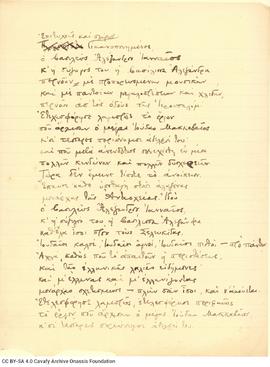
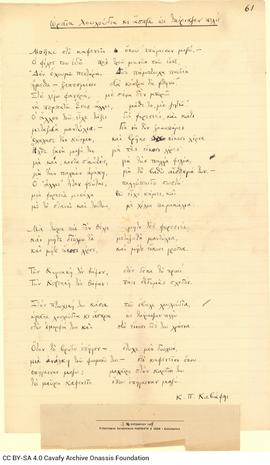
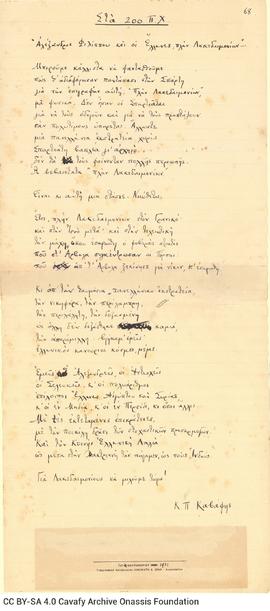
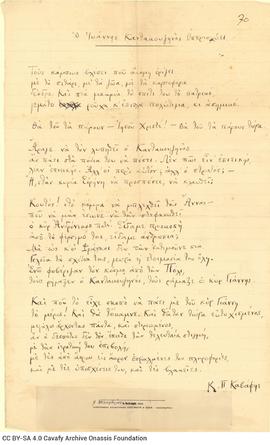
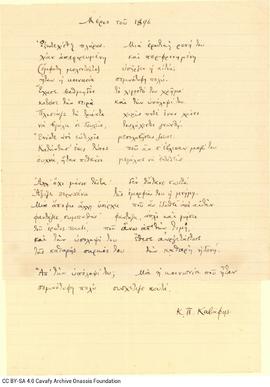
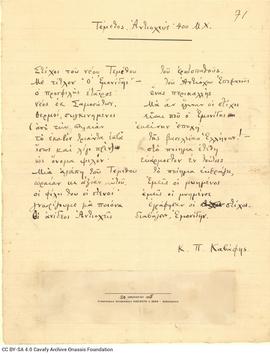
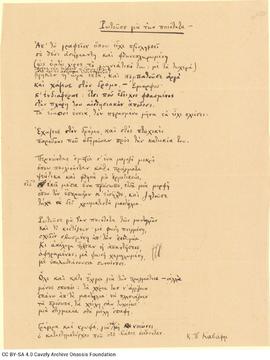
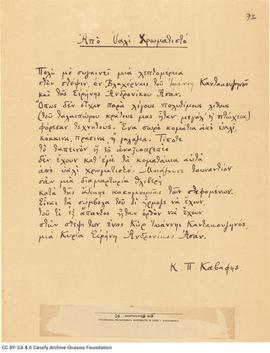
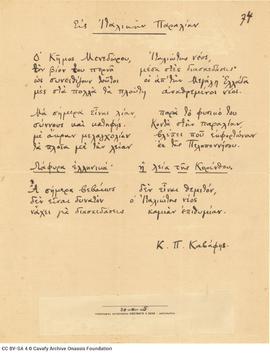
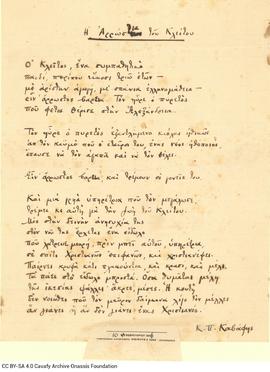
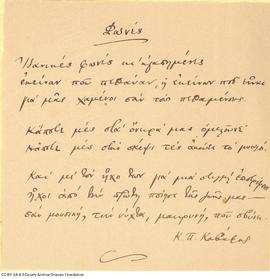
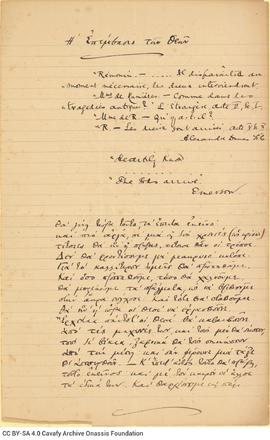
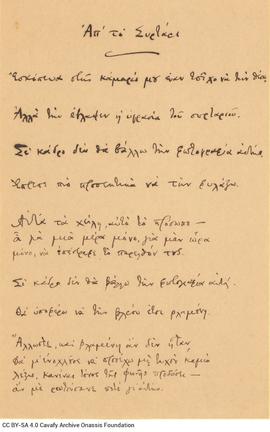
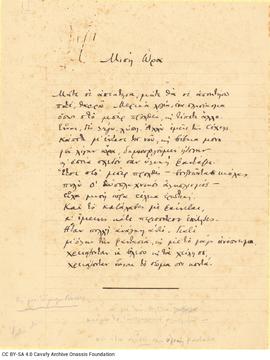
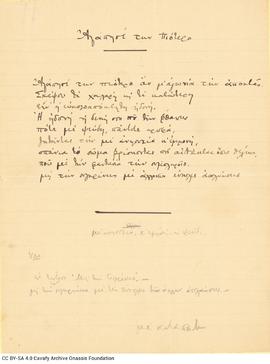
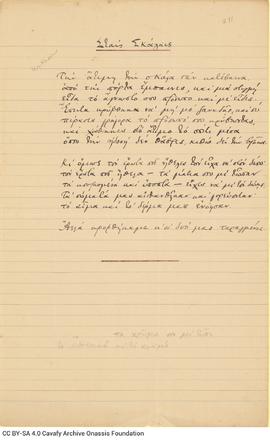
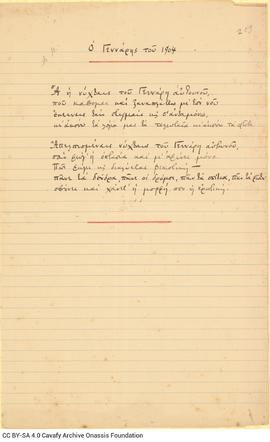
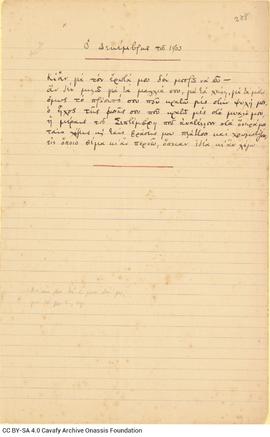
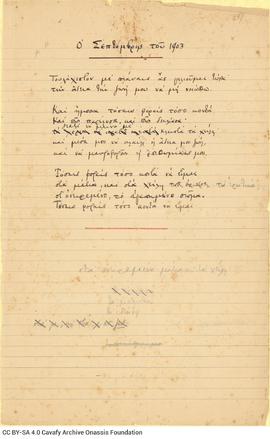
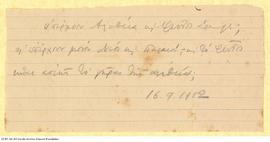
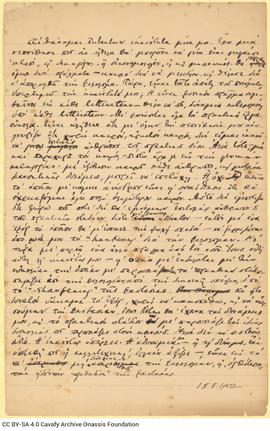
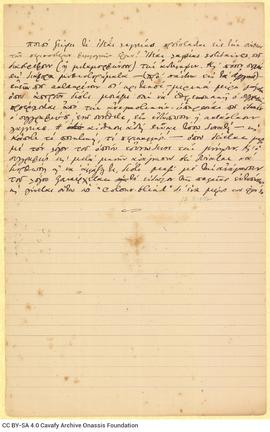
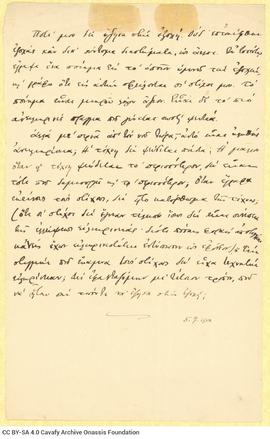
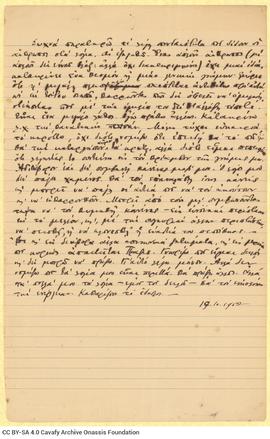
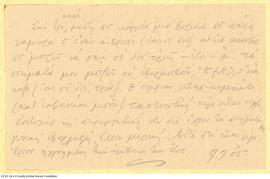
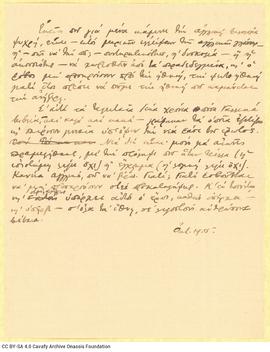
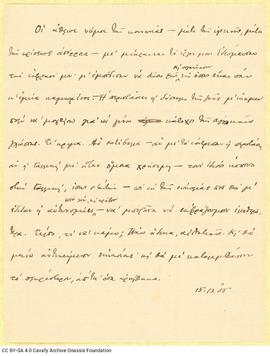
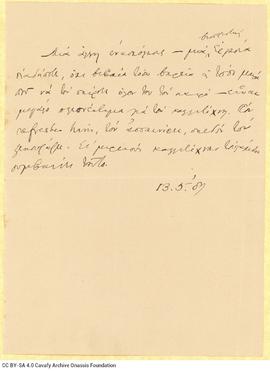
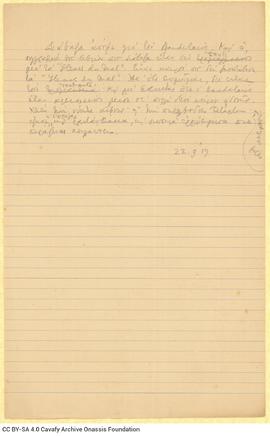
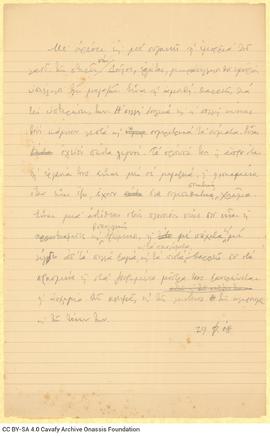
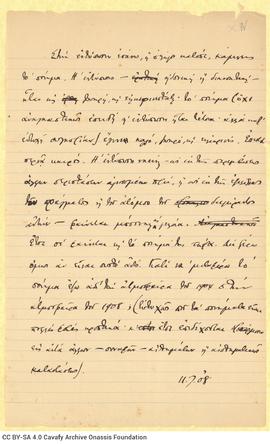
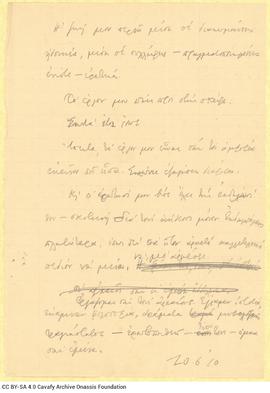
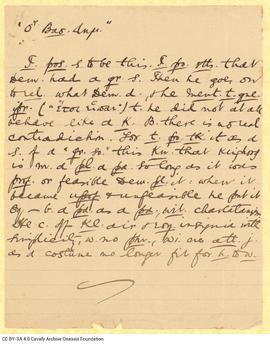
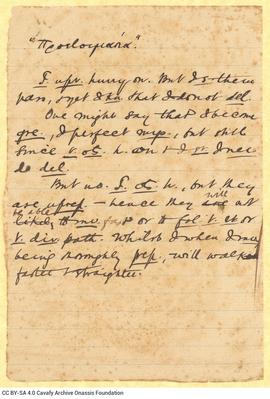
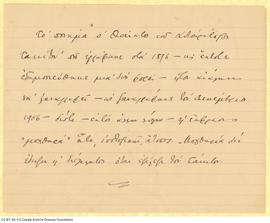
Identity area
Reference code
Title
Date(s)
- 1811-1933 (Creation)
Level of description
Extent and medium
45 files (1,914 items)
Context area
Name of creator
Biographical history
The poet Constantine Cavafy was born in Alexandria, Egypt, on April 17, 1863. When the new calendar came into effect, the date changed to April 29, so the latter is customarily cited as the poet’s date of birth. Moreover, it coincides with April 29, 1933, the date of his death, creating a notable coincidence in the registry. During the 19th to mid-20th century, Greek communities flourished in many Egyptian cities; the largest was that of Alexandria. The poet’s parents, Petros Ioannis Cavafy and Charikleia, daughter of Georgakis Fotiadis, had a total of nine children, two of whom died in infancy; one of these was the only girl. Constantine was the ninth and last child. Together with his brother Georgios, who had settled in London, Petros Ioannis Cavafy managed a flourishing trading company, “Cavafy & Co.” which traded wheat and cotton.
The family’s prosperity was to be short-lived. Petros Ioannis’s premature death in 1870 forced Charikleia to leave Alexandria and seek support, for herself and her children, from her husband’s brother in England. The family resided first in Liverpool and afterward in London. We have very little information regarding the poet’s roughly five-year stay in England (1872-1877). Naturally he would have attended school and learned English. In 1877, Charikleia and the children returned to Alexandria; Constantine was enrolled in the Hermes Lyceum of Constantine A. Papazis, where his friends included Mikes Rallis and Stephanos Skylitsis, both of whom died young. Constantine composed one of his first poems (“For Stephanos Skylitsis,” 1886) to commemorate his friend’s death, while he kept a journal of sorts regarding the illness and final days of Mikes Rallis (1889).
1882 saw a military uprising in Egypt; the British navy intervened (the British would rule over Egypt for the following seventy years); Alexandria was bombarded and foreign residents began to abandon the city. Among them was Charikleia, who this time hurried to her family home in Constantinople. The poet described the journey in a journal written in English, which he titled “Constantinopoliad – an epic.” We have only tentative information regarding his three-year stay in Constantinople. During that same year he composed his first verses in both Greek and English, as well as prose in the style of encyclopedia entries. Around the end of 1885 the family returned to Alexandria, and Constantine assumed various jobs. Over the next several years, the family would experience the successive deaths of numerous family members. Cavafy’s brother Petros Ioannis (named after their father) died in 1891, their mother Charikleia in 1899, followed by Georgios (1900), Aristeidis (1902), and Alexandros (1905). His remaining two brothers would die in the 1920s, Paul (1920) and John (1923), leaving Cavafy the last surviving sibling. He had obtained steady employment in 1892, when he was hired by the Third Circle of Irrigation, under British control, where he worked for the next 30 years. From 1908 until the end of his life, he lived alone in the apartment at what was then 10 rue Lepsius 10, in October 1964 renamed rue Sharm el Sheikhj and later renamed rue Cavafy.
During his years in Alexandria Cavafy traveled only infrequently, be it to the Egyptian interior (Cairo) or abroad. In 1897 he and his brother John embarked on a two-month journey to Paris and London. In the summer of 1901 he visited Athens for the first time, in the company of his brother Alexander, and kept a journal in English regarding the trip, with detailed accounts of what he saw and whom he met, including Kimon Michaelides, publisher of the journal Panathenaia, the poet Ioannis Polemis, the painter Georgios Roilos, and Gregorios Xenopoulos. Cavafy went on to exchange letters with Xenopoulos, who in 1903 wrote “A poet,” historically significant as the first extensive piece about Cavafy’s work to be published in Athens, in Panathenaia. The poet will again visit the Greek capital in 1905, to visit his brother Alexander, who is being treated in a hospital there and will eventually die later that same year. Cavafy’s third and last trip to Athens comes in 1932, for reasons of his own health.
Cavafy’s apartment on the second floor of what was then 10 rue Lepsius would, over time, become his customary place for meeting with Alexandrian intellectuals, as well as visitors from Greece. His unusual publication method, certain personal idiosyncrasies, as described by his associates, and his always pointed references to literary figures and books began to create an aura of legend around his person. His public image acquired strong (sometimes distorting) features from the descriptions of the well-known writers and poets, Greek and foreign alike, who visited him, including Filippo Tommaso Marinetti and E. M. Forster. Friends (and sometimes enemies) of his work gave accounts of their conversations with Cavafy either orally or in writing. This sharing of private conversations, as well as excerpts from interviews, also gave rise to the public exchange of mutually negative comments between Cavafy and Kostis Palamas, in an era in which Cavafy’s poetry had begun to threaten Palamas’s omnipotence. The recognition of Cavafy’s importance was often accompanied by parodies (sometimes vicious) that took aim either at the poet himself or at particular poems. After the poet’s death, this trend continued with the parodic mockery of a range of themes, thereby confirming the robust and continual permeation of his lines into everyday life, which continues to this day.
During the early decades of the 20th century, alongside the commercial and financial activities of the Greeks of Egypt, significant cultural and artistic movements had developed in both Alexandria and Cairo, most notably the appearance of a range of periodicals and books (even by Athenian writers), satiric yearbooks, and literary journals (Serapion, Grammata, Nea Zoi, Propylaia, Panegyptia, Argo, Foinikas), which in time found distribution throughout the Greek-speaking world. Poems by Cavafy, as well as studies or commentaries on his work, not always positive or well-intentioned, appear in all of these journals. The peculiarities of his poetry, his own personal idiosyncrasies, and his solitary life in the apartment on rue Lepsius without a telephone or electricity comprised an exceptional case that departed from the usual models. Slowly but steadily, his poetry began to spread both in the Egyptian communities and in Greece, acquiring faithful fans, as well as fanatic opponents.
1886 saw Cavafy’s very first publications: the prose piece “Coral from a mythological perspective” in the newspaper Constantinople, and the poem “Bacchic” in the journal Esperos in Leipzig. Both, like many other poems and prose pieces of his early years, were signed Constantinos F. Cavafis, and were later silently repudiated. It has been suggested that the F in his signature stood for a second baptismal name (Fotios), yet the official baptismal register contradicts this view, referring to a single Christian name. Most likely, it was a gesture of respect and honor toward Cavafy’s maternal grandfather, Georgakis Fotiadis. For the remainder of his life, he continued to publish prose and poetry in newspapers, yearbooks, and journals in Alexandria, Leipzig, Constantinople, Cairo, and Athens, though he never published a book. Several of these issues contain responses to the poet regarding the fate of the poems which from time to time he submitted for publication, primarily during the early years of his public presence.
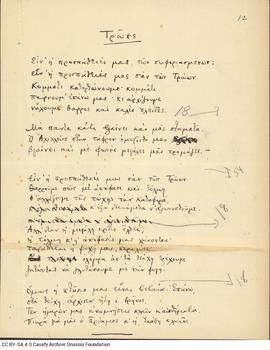
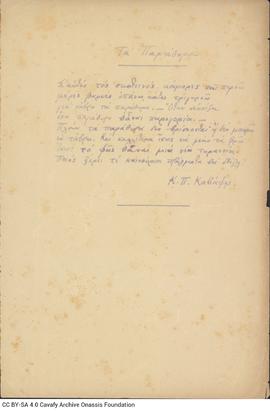
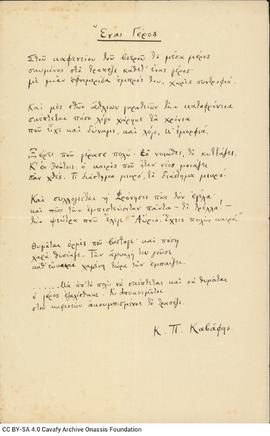
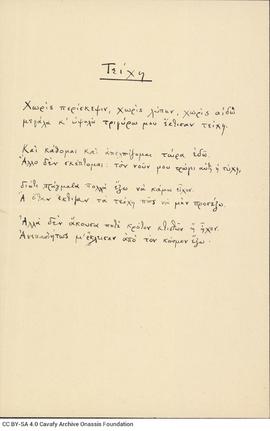
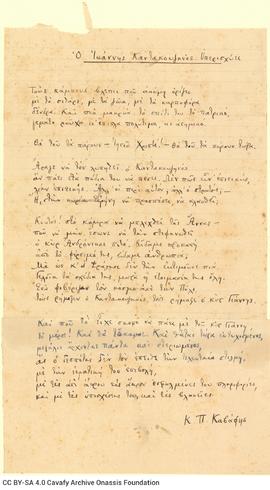
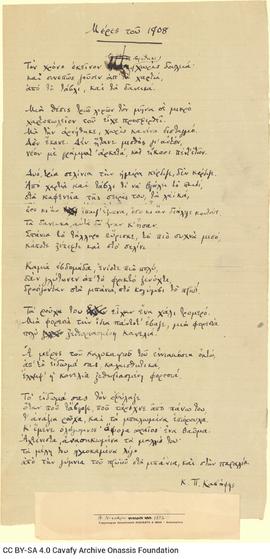
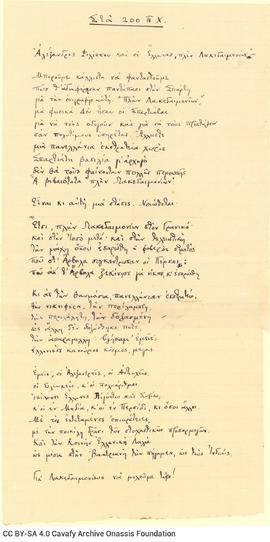
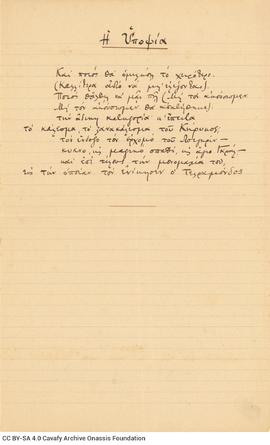
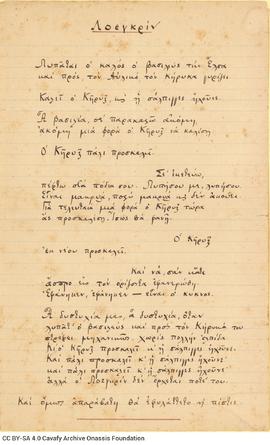
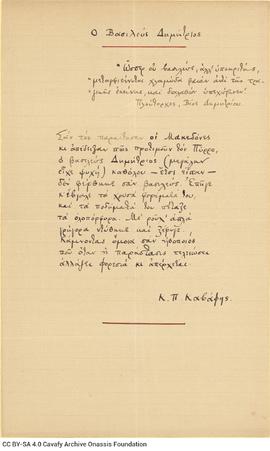
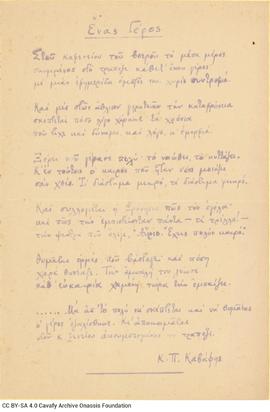
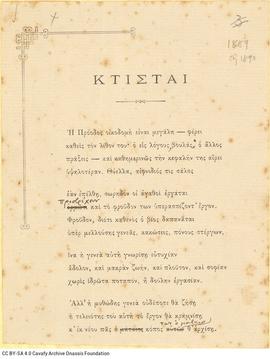
We first meet with the idiosyncratic editorial method Cavafy followed throughout the remainder of his life in 1892, when he printed a broadside containing the poem “Κτίσται” (Builders), followed a few years later by the four-page leaflet “Τείχη/My Walls” (bilingual edition, 1897); “Δέησις” (Prayer, 1898); “Τα Δάκρυα των Αδελφών του Φαέθοντος” (The Tears of Phaeton’s Sisters) and “Ο Θάνατος του Αυτοκράτορος Τακίτου” (The Death of Emperor Tacitus), under the joint title “Αρχαίαι Ημέραι” (Ancient Days, 1898); and, lastly, an eight-page leaflet containing the poem “Περιμένοντας τους βαρβάρους” (Waiting for the Barbarians, 1904). In subsequent years, he collected offprints of poems that had appeared in various journals, or had individual poems printed, and formed packets of poems, which scholars retrospectively organized into two categories: two “volumes” (1904 and 1910) and ten “collections,” which contained poems from the years 1910-1932. These quasi-books never circulated commercially; rather, the poet himself sent or gave them to friends and admirers of his work, maintaining fastidious distribution lists. This novel publication method rendered his equally novel poetry elusive and highly sought after. His entire poetic production was later grouped by G. P. Savvidis into four categories: the 154 poems of the “canon,” comprising the poems Cavafy himself put into circulation in his two “volumes” and ten “collections” plus one that was unpublished, but assumed to be ready for printing on his death; the “Repudiated” poems of his early period; the “Hidden” (which Savvidis originally called the “Unpublished”), which were not published in Cavafy’s lifetime; and the “Unfinished,” drafts of poems which the poet never completed.
By the 1920s, many young readers in Athens had turned their attention to Cavafy’s poetry; some wrote to ask for collections of his printed poems, or composed commentaries on his work. A first public, official example of the Athenian reception of his work was the rather hodge-podge tribute in the journal Nea Techni (1924), in which a plethora of writers expressed their largely positive opinions about the poet being honored. The tribute was conceived by Marios Vaianos, who corresponded with the poet but never met him, and had of taken it upon himself to act as Cavafy’s agent in Athens, offering important help in facilitating Athenian intellectuals’ communication and contact with the Alexandrian poet. In 1926, the dictatorship of Pangalos awarded the poet the Order of the Phoenix, the only distinction he received during his lifetime. The same year, when most of the important Alexandrian journals had ceased their publication, a new literary and artistic journal, Alexandrini Techni (1926-1932), appeared in Alexandria, which Cavafy not only directed from behind the scenes, but supported financially, in order to promote his work and to refute any negative comments his work might attract. The relevant news columns also note sporadic, isolated translations of his poems into foreign languages.
The earliest English translations of poems by Cavafy were attempted by John Cavafy, the poet’s brother (responsible for the translation in the bilingual edition “Τείχη/My Walls,” 1897), and Georgios Valassopoulo, who translated several poems by Cavafy that were included in E. M. Forster’s books about Alexandria, and also published in T. S. Eliot’s journal The Criterion. During Cavafy’s lifetime, translations of his poems into European languages were rare, appearing most often in foreign-language anthologies of modern Greek poetry. A true translation explosion took place after the second World War and continues to this day, with frequent new editions, even in languages that already boast several prior translations.
Beginning in the late 1920s the poet was troubled by a discomfort in his throat. “That is what made him quit smoking entirely, become more and more quiet when in company, and be overcome at times by a sudden melancholy,” as Stratis Tsirkas writes. He was diagnosed with throat cancer and encouraged by his doctors to travel to Athens for further treatment; he was accompanied on the journey by his heirs, Alekos and Rica Singopoulo. His presence in the Greek capital met with a great deal of publicity in the Athenian press. He remained for four months (July-October 1932), was treated at the Hellenic Red Cross Hospital, and underwent a tracheotomy, which caused him to permanently lose his ability to speak. His visitors at the hospital communicated with him by way of written notes. On his final trip he met many Athenian writers in person, who recorded their—not always positive—impressions. Before his departure for Alexandria, the couple Kostas and Eleni Ouranis threw a party in his honor, where the composer and maestro Dimitris Mitropoulos performed his work 10 Inventions, a piece for piano based on 10 poems by Cavafy.
Near the end of 1932, after the poet had returned to Alexandria, a tribute to Cavafy appeared in the Athenian journal Kyklos. Meanwhile, the state of his health worsened. In April 1933 he was admitted to the Greek Hospital of Alexandria, where he breathed his last on April 29; he was buried in the Cavafy family grave in the Greek cemetery in Shatby. The simple plaque reads: Constantine P. Cavafy / Poet / Died in Alexandria on April 29, 1933.
According to criticism, Cavafy’s early poetry showed the influence of romanticism; he subsequently passed through periods of Parnassianism and symbolism, to culminate, in the longest and most mature phase of his work, in poetic realism. His ironic language is immediate and powerful, far removed from the obsessions of demoticism; his erotic themes are unapologetic; and the treatment of contemporary events by means of history is perceptible throughout his work. With his lifelong, unfailing devotion to the Art of Poetry, Cavafy spoke of love and death, of the violence and intoxication of power, of political opportunism and the failure of great ideals. Today he is internationally recognized as one of the greatest poets of the 20th century.
Repository
Archival history
In 1963 Alekos Singopoulo, heir of the poet, entrusted the editing and publication of Cavafy’s entire fonds to G. P. Savvidis. The transfers of the fonds’ rights, up until it came permanently in the possession of G. P. Savvidis in 1969, have been recorded by Savvidis himself in an article in Nea Estia (see: G.P. Savvidis, «To archeio C. P. Cavafy. Mia proti enimerotiki ekthesi», Nea Estia, 74 (1963), p. 1539-1547). The fonds had been managed in succession by Rica Singopoulo (1926-1939), Alekos Singopoulo (1926-1966) and G. A. Papoutsakis (as can be deduced from the examination of the items in the fonds), Kiveli Singopoulo (1966-1969), G. P. Savvidis (1969-1995) and Manuel Savvidis (1995-2012) (see: Katerina Ghika, «Simeioma gia to Archeio Cavafy», October 2012). Both G. P. Savvidis and his heir, Manuel Savvidis, safeguarded the integrity of the Cavafy fonds and restored it to a large extent, by retrieving manuscripts and other material that had been previously separated from the fonds.
Immediate source of acquisition or transfer
The Cavafy fonds was acquired by the Onassis Foundation in 2012. The eight subsequent additions of relevant archival material were successively made by the Foundation, through purchases, from 2013 to 2018.
Content and structure area
Scope and content
The Cavafy fonds is a fairly complete fonds, free from physical decay and inconsistencies - these are traits ensuring the chronological continuity of the items contained therein, in terms of both order and frequency of appearance. These traits make the Cavafy fonds a unique literary archive.
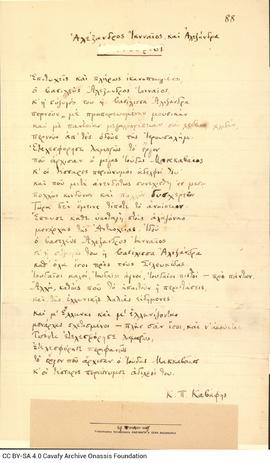
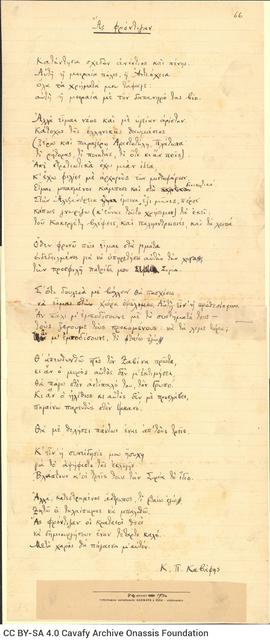
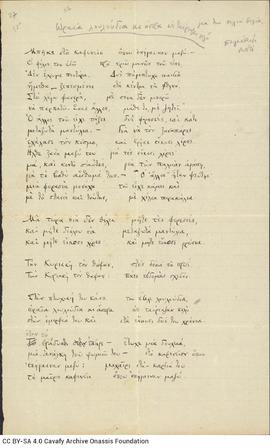
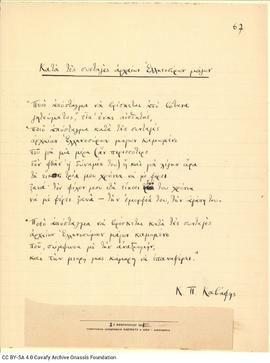
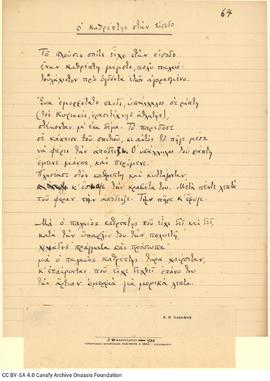
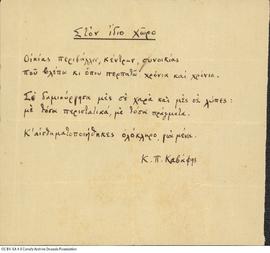
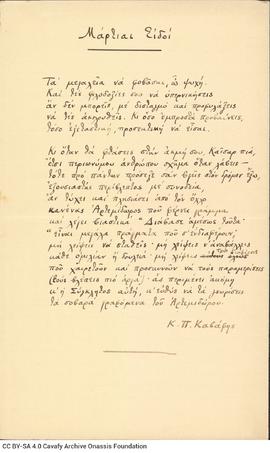
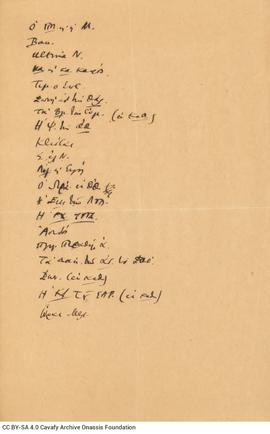
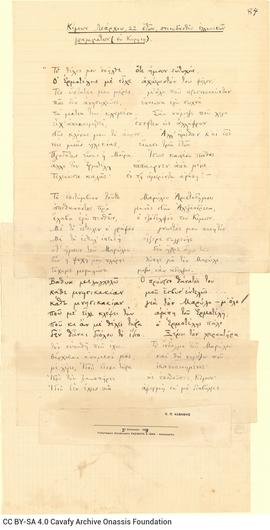
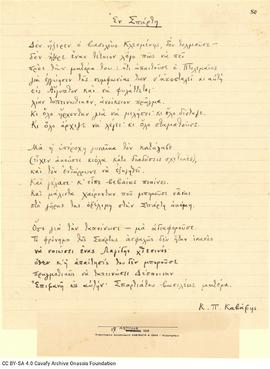
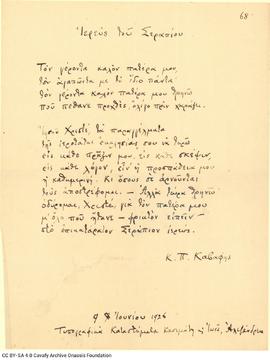
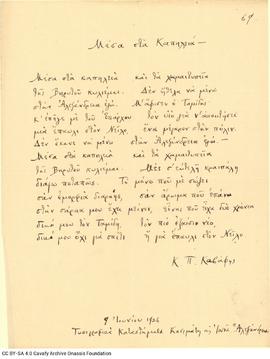
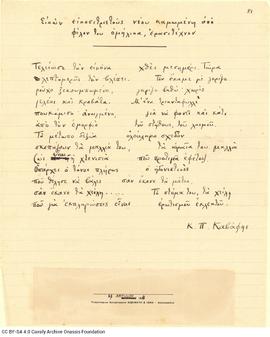
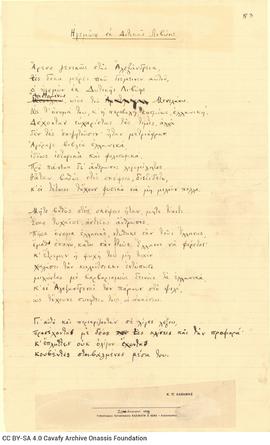
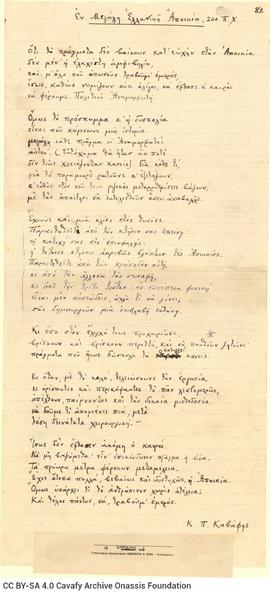
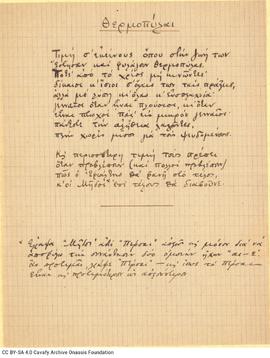
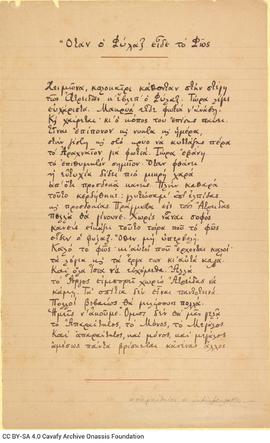
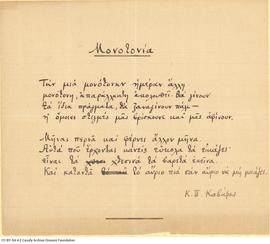
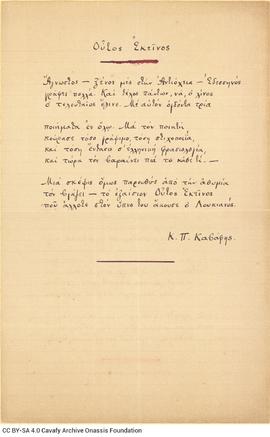
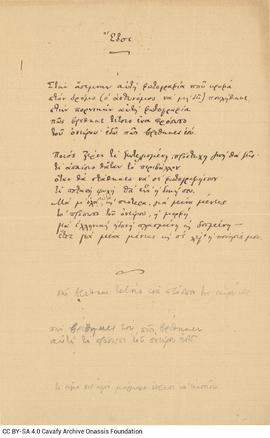
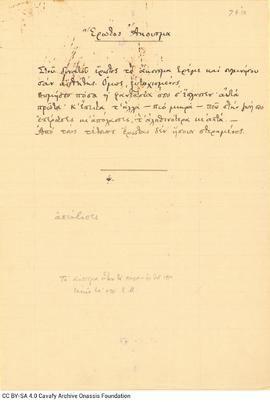
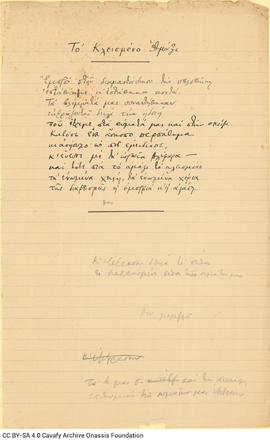
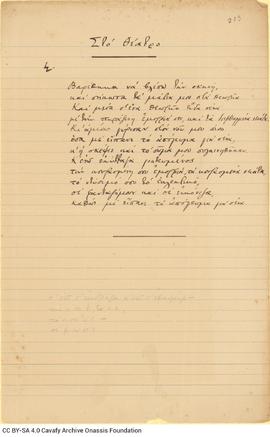
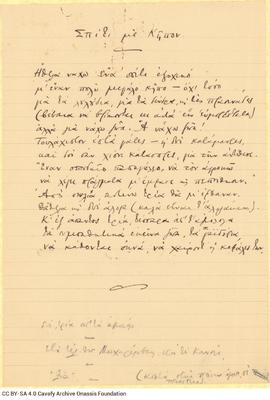
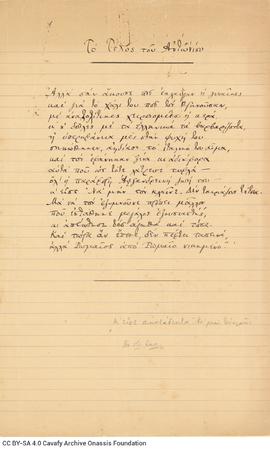
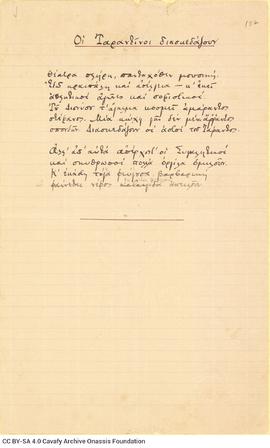
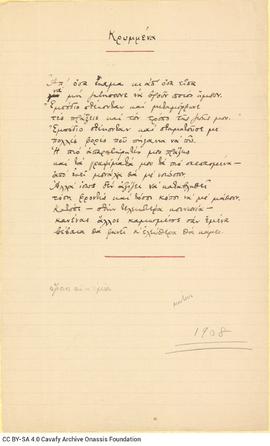
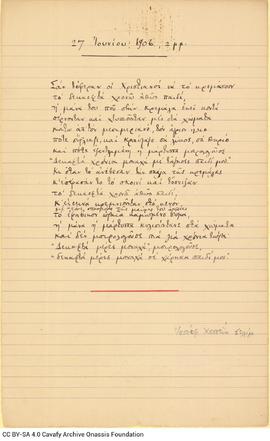
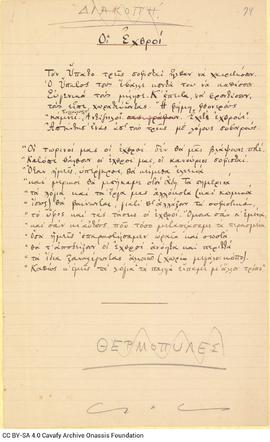
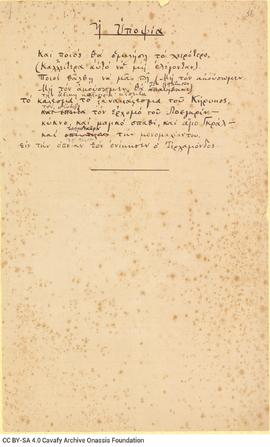
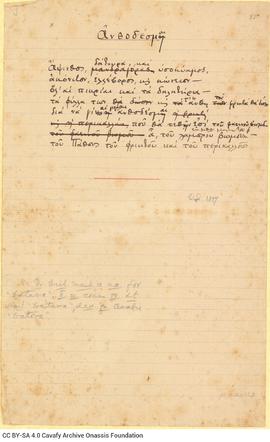
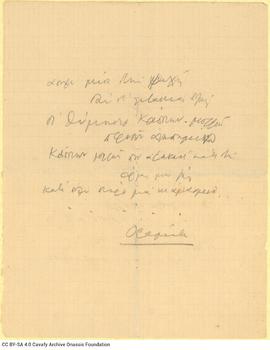
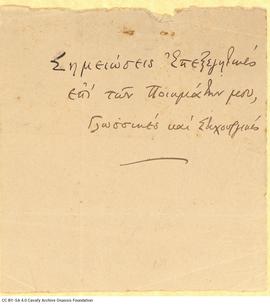
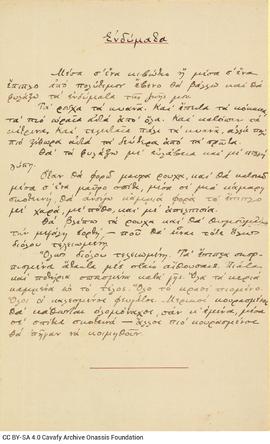
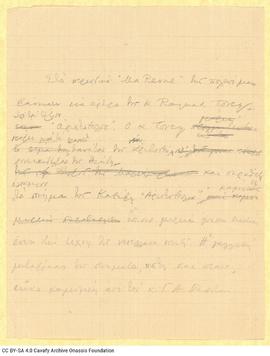
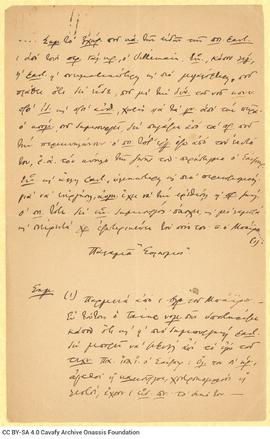
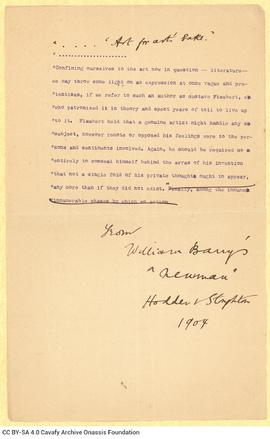
Besides, the poet himself collected and archived his work on a systematic basis. His poems, both manuscripts and in print, in the form of homemade books or printer’s copies, the distribution lists of volumes and collections, the prose texts and the poet’s personal and literary notes, together with translations, texts and studies of the poet’s work by others, make up the section of the fonds that relates to Cavafy’s intellectual activity.
The poet’s private life is outlined in the rich collection of his personal and family letters, of diary-type texts, of the various family items and, finally, in the important collection of personal and family photographs.
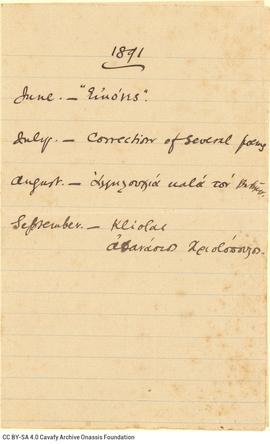
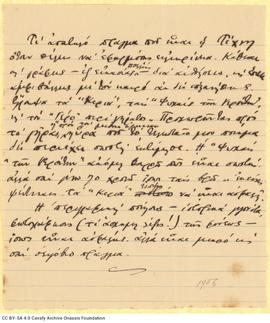
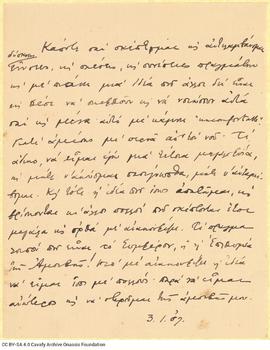
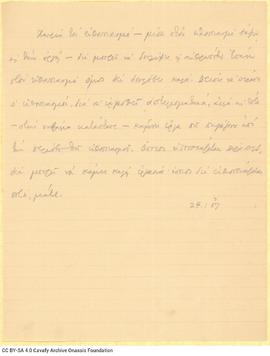
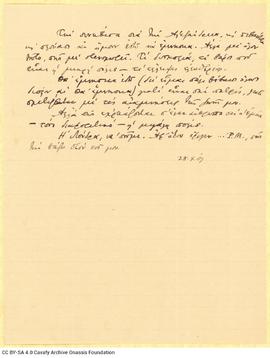
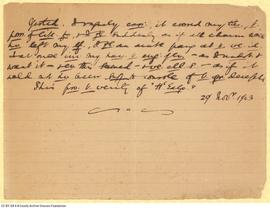
In his personal notes Cavafy records his thoughts about his work, poetry and art in general, as well as his everyday life, as for example his activities in gambling or his personal and love life. During the last years of his life, when he could no longer speak as a result of his illness, such notes were the poet’s only means of communication.
Personal relations and journeys, contacts with prominent figures and intellectuals are all included in the items of the fonds and complement Cavafy’s physiognomy by integrating it in the context of the poet’s era.
Appraisal, destruction and scheduling
The entire fonds has been retained. Bifolios and plain files of later dates that had been previously used as item separators were replaced and collected in a separate file during the arrangement process.
Accruals
Future acquisitions may occur.
System of arrangement
Α. Archival documentation
According to the G. P. Savvidis Historical Catalogue, the Cavafy fonds, as delivered to the Onassis Foundation, consists of 85 files (including manuscripts and other loose printed media); the Peridis file; the Papoutsakis file; the Alexandrini Techni archive and the Alekos and Rica Singopoulo fonds. It is noted that this Catalogue forms part of the Cavafy fonds.
The cataloguing and description of the material preceded the arrangement of the fonds, in the order of its acquisition by the Foundation. A detailed index on item level has been compiled. Further processing of the fonds dictated the arrangement of the material into three distinct sub-fonds:
A. Work (of C. P. Cavafy); B. Personal Papers (of C. P. Cavafy) and C. Post-2012 acquisitions.
The arrangement of items was organised in thematic files, the contents of which have been placed in chronological order. The files have been numbered uniformly in an ascending order and have been included in series and sub-series on the basis of thematic criteria, with the exception of the third collection, the contents of which have been arranged chronologically.
In order to facilitate item content searches, access points have been created for all fields of the archival description. These access points are grouped as follows: persons, corporate bodies, families, places, and subjects. Subjects have been further subdivided into categories.
The items of the files entitled “Peridis” and “Papoutsakis” have been placed in their files of origin, according to their content. Relevant information has been included in the “Former Reference Code” field.
Moreover, the files of the Alekos and Rica Singopoulo fonds, together with those of the Alexandrini Techni archive, were separated and now constitute a distinct fonds.
Taking into account that the fonds has been extensively used as a source of information for publications and in order to facilitate researchers, the description field entitled “Former Reference Code” includes a link between the new documentation and the indications of the G. P. Savvidis Historical Catalogue, based on the serial number of the microfilm and of the photo shoots.
Finally, the third sub-fonds is a distinct part of the Cavafy fonds, comprising additional, post-2012 acquisitions by the Onassis Foundation. Future acquisitions will be included in this sub-fonds.
In detail, the classification scheme of the fonds is articulated as follows:
CAVAFY, C. P. FONDS
Sub-fonds 01: WORK
Series: Poems
file: Poems (manuscript)
sub-file: Poems
sub-file: Printer’s copies and miscellanea
file: Poems (printed)
sub-file: Pamphlets – broadsheets
sub-file: Issues
sub-file: Collections
file: Lists
sub-file: Title lists
sub-file: Distribution lists of issues and collections
Series: Prose works
file: Literary texts
file: Articles - studies - drafts
file: “Dictionary of quotations”
Series: Notes
file: Literary notes
file: Notes on linguistic matters
file: Personal notes
file: Notes on historical matters
file: Working notes
Series: Translations and works of others on C. P. Cavafy
file: English translations
sub-file: Translations by John Cavafy
sub-file: Translations by G. A. Valassopoulo
sub-file: Translations by others
file: Translations into other languages
sub-file: French translations
sub-file: Italian translations
sub-file: Dutch translations
file: Texts and studies on C. P. Cavafy
file: Works of C. P. Cavafy set to music
file: Sketches
Sub-fonds 02: PERSONAL PAPERS
Series: Correspondence of C. P. Cavafy
Sub-series: Personal correspondence
file: Drafts and copies of C. P. Cavafy’s letters
sub-file: Drafts and copies of letters addressed to Alekos and Rica Singopoulo
sub-file: Drafts and copies of letters addressed to Ε. Μ. Forster
sub-file: Drafts and copies of letters addressed to various recipients
sub-file: Correspondence relating to C. P. Cavafy’s publication activity in England
file: Incoming correspondence
sub-file: Incoming correspondence by Ε. Μ. Forster
sub-file: Incoming correspondence by Mike Ralli, John Rodocanachi, Stephen Schilizzi
sub-file: Incoming correspondence by various authors
Sub-series: Family correspondence
file: Drafts and copies of C. P. Cavafy’s letters
file: Incoming correspondence of C. P. Cavafy
sub-file: Incoming correspondence by John Cavafy
sub-file: Incoming correspondence by Paul Cavafy
sub-file: Incoming correspondence by various senders
file: Correspondence exchanged among members of the Cavafy family, and correspondence of members of the family with third parties
Sub-series: General correspondence
file: Official correspondence
sub-file: Incoming official correspondence
sub-file: Outgoing official correspondence
file: Correspondence among third parties
Series: Miscellanea
file: Diary-type texts
file: Various personal documents
sub-file: Legal documents
sub-file: Genealogical data
sub-file: Notes on financial matters
sub-file: Personal notes
sub-file: Various family documents
sub-file: Ephemera
sub-file: Press and printed documents
sub-file: Works by others
Series: Photographic archive
file: Collection of photographs
sub-file: Personal photographs
sub-file: Family photographs
sub-file: Photographs of various persons
Sub-fonds 03: POST-2012 ACQUISITIONS
file: Acquisitions 01 (2013)
file: Acquisitions 02 (2013)
file: Acquisitions 03 (2015)
file: Acquisitions 04 (2016)
file: Acquisitions 05 (2017)
file: Acquisitions 06 (2017)
file: Acquisitions 07 (2018)
file: Acquisitions 08 (2018)
B. Literary documentation
The contribution of the literary scholars to the documentation of the Cavafy fonds consisted in adding literary and critical annotation to the archival description of individual items.
After having familiarised themselves with the entirety of the fonds, they collaborated with the archivists and decided to create two additional fields and to expand the category entitled “Subjects” of the “Access points” field. The literary scholars developed the following fields:
Ι. Related works by C. P. Cavafy
ΙΙ. Additional comments
ΙΙΙ. Access points (complementing the archival annotation)
Ι. The field entitled “Related works by C. P. Cavafy” correlates the individual archival items with one or more of Cavafy’s works and facilitates the users who wish to find archival material related to these works. Taking into account the intricacies of the publication of Cavafy’s works and the various headings under which Cavafy’s poems have reached the reader (unpublished, unfinished, hidden, repudiated etc.), the following method has been adopted: the field entitled “Related works by C. P. Cavafy” mentions the title(s) of Cavafy’s works (poems, prose texts, articles); it is followed by the number of entry in the Bibliography on C. P. Cavafy by D. Daskalopoulos (Dimitris Daskalopoulos, Vivliografia C. P. Cavafy (1886-2000), Centre for the Greek Language, Thessaloniki, 2003), that denotes the first publication of the relevant work. The “>” symbol is included between the title and the entry number, always followed by the entry number (e.g., “Alexandrian kings”>129). 1
Only in cases where the correlation between one of C. P. Cavafy’s works is obvious and explicit in an archival item has a reference been included in the relevant records; this correlation is a result of the text itself and not of a hypothesis based on secondary sources. No reference is made to a poem when the textual information included in the archival item is not intended to be related to this poem, even if it accidentally happens to be so related. For example, Cavafy used the empty back page of printed broadsheets as paper material in order to take notes or write up his poems. In such cases, the literary scholars do not refer to the printed poems included on the verso, because the issue is the item itself.
II. The field entitled “Additional comments” comprises the necessary clarifications which facilitate researchers and users. For example, it comprises:
- References to data of literary or critical interest, e.g., “References to Friedrich Schiller and to Molière as well as to ‘The Arab Conquest of Egypt’. The title ‘Siwa’ is also mentioned, probably referring to the work by Charles Dalrymple Belgrave under the same title”.
- References to drafts and to variations of Cavafy’s works, only in case the said drafts or variations are explicitly mentioned in the item or are identical.
- The secondary bibliography mentioned in the archival items themselves and the necessary explanatory comments (books, periodicals and newspapers used by Cavafy), e.g. “Reference to: Ilias Oikonomopoulos Mythologia tis Archaias Ellados, Athens, Fexis, 1896”.
- Publication data of the literary or critical work appended to or commented upon in the archival item, e.g. “Poems by Giorgos Vrisimitzakis published in the first issue of the journal Alexandrini Techni (Alexandrini Techni, year I, no. 1, December 1926, p. 3-4)”.
Concerning the field “Αdditional comments”, the literary scholars did not interpret the archival information, and only used the secondary sources in order to identify a text and to cross-check the literary and critical annotation.
The so-called “G. P. Savvidis Historical Catalogue” has been an important factor to this effort. The literary scholars consulted the catalogue in every stage of the project, without, however, always adopting its literary and critical remarks (e.g., they did not necessarily presume that notes written by the poet are linked to specific poems, etc.). It was decided, in order to highlight the contribution of the Savvidis catalogue, to include references, in the form of hyperlinks, of the archival items to the corresponding entries in the said catalogue. In this manner, the historical continuity of the fonds becomes apparent, and the users can compare the different versions or take into account remarks of the G. P. Savvidis historical catalogue which have not been included in the present documentation.
III. In order to locate the relevant material in the fonds a number of keywords are used that are called “access points”. The literary scholars, taking into account the needs of the users and the technical specifications of the electronic tool adopted for this project (“ArchiveMax”) decided, in addition to the categories “Persons”, “Corporate Bodies”, “Places”, and “Families”, which were filled in by both the archivists and the group, to subdivide the “Subjects” category of the access points that were of literary interest into further categories, as follows:
Literary and other character
Works by C. P. Cavafy (titles)
Works by other authors (titles)
Newspapers
Journals
Works by C. P. Cavafy in translation
The “Literary and other characters” category includes annotations concerning the characters encountered in poems and prose texts by Cavafy. The members of the literary scholars group adopted the methodology of Kyriakos Delopoulos as derived from his work Cavafy istorika kai alla prosopa. Istoriki, filologiki kai vivliografiki erevna, ELIA, Athens, 1978, in order to indicate the attributes of the “Literary and other characters” category.
The “^” symbol has been placed next to each character and the following data have been included in parentheses, as appropriate:
H: Historical characters
L: Literary characters [The literary scholars changed the abbreviation “ΦΙ” (‘Philological figure’) used by Delopoulos,].
I: Invented characters
M: Mythological characters
E.g. “Ioannis Kantakouzinos^(Ι)
Concerning the “non-literary” archival items, while the mythological, literary and imaginary figures carry the same annotation (L, I, M), historical figures (H) were included in the “persons” category.
Finally, in the thematic category “Places” only geographical designations that match actual locations are included, while mythical or fictional designations are excluded.
<p>In the case of the poem “Che fece… il gran rifiuto”, which has, by error, two different classification numbers, the one in the Index of Bibliography Titles (A66) and the other in the main corpus of the bibliography (A67), the latter has been adopted. <a href="#fnref1:1" rev="footnote" class="footnote-backref">↩</a></p>
Conditions of access and use area
Conditions governing access
The digital reproduction of the fonds (including description metadata) has been posted in its entirety on the website of the Onassis Foundation and is made available on the basis of the reproduction terms. Access to the original items is permitted only in special cases, following submission of a request for this purpose, so as to ensure the protection and preservation of the physical integrity of the original archival material.
Conditions governing reproduction
The Onassis Foundation Cavafy Archive is made available in its entirety subject to the Creative Commons Attribution - Share alike license (CC BY-SA 4.0), international, v. 4.0 or later. References to the Cavafy Archive should be made as follows: © 2016-2018 Cavafy Archive, Onassis Foundation. In case that a work included in the Cavafy Archive is the property of a third person, the beneficiary of the intellectual property rights shall be specified, together with the license subject to which that work is made available. Requests for additional rights or licenses, other than the ones permitted by the CC license, should be emailed to the Cavafy Archive (cavafyarchive@onassis.org).
Language of material
Script of material
Language and script notes
Mainly Greek, and, secondarily, French and English. Very few texts are written in Italian, and three texts are in Dutch.
Physical characteristics and technical requirements
The fonds consists of loose manuscripts, notebooks, prints, clippings or newspaper sheets and photographs. There are some volumes of poetry collections with homemade binding by the author, as well as handmade folders.
The writing medium is plain paper (ruled or not) or sheets of paper or paperboard cut or folded in bifolios. Scrap paper in various sizes has also been extensively used. In many cases and for practical reasons the main body of the paper has been extended with the use of affixed additions.
The writing inks used are black, red and blue; pencil has also been frequently used. The watermarks found on sheets of paper used by Cavafy have also been recorded. These are of various origins and are found on the paper of letters addressed to and sent by Cavafy which have been preserved in the fonds. Such watermarks include: English Commercial Post, Southern Cross Fine Quality, The New Mill Super Fine, Extra Strong, Navarre, Spartan Bond, Boar’s Head English Bond, Conqueror London, R. J. Moss & Co Alexandria, Marchant Singer & Co London, Velo Mill, Alex Pirie & Sons Royal Super Fine, Delta Mill Fine, Original Renage’s Mill, Original Australasian, Baskerville Vellum Wove, Au Louvre Paris, G. Pulman & Sons Air Dried London, Gurney Ivory Laid, POF, W. T. & Co, Lenvale Hollingworth Kent, Mercury Mill GB, Urania Ban, Egypte 1899, Tamvaco Choremi & Co. Alexandrie-Egypte, Aero Bank J.R., Extra Strong 1902 J.R.F., Abondance, F. Guerimand & Cie, Imperial Treasury De La Rue, Ultra Per Fecta Type Writer, Harrods Hans Script, Oceana Ledge, United Service Air-Dried Vellum, Excelsior Super Fine, Imperial Air Mail, Johannot & Cie Extra Strong, Basildon Bond, Green Spring Bond Rag Content, Air Mail 693, Titan Bond, Marmaty Mill J.C.A, Original Ledger Air Dried, Britannia, L. J. & Cie Basseau, Registre Superieure P. P. & Co., Union Bond, Velo Mill Depose. Some of them are illegible.
The correspondence series includes letterheads from hotels in France (Paris, Toulon, Hyères) as well as from various banks.
The fonds is preserved in fairly good state. Light or moderate oxidation has in cases caused discolouration and erosion of the paper. Discolourations are mainly due to the type of paper or ink used (the latter has in some cases eroded the paper to such an extent as to form holes) and to the extensive use of metal paperclips or pins. Mechanical stresses and wear are usually observed, such as loss of small parts in some items as well as tears and wears attributable to biological factors. Some items bear visible traces of glue as a result of the use of self-adhesive tape for the temporary repair of tears.
The material was subjected to preventive restoration in the course of its classification. That is, metal staples and paperclips were removed and replaced by special ones that have no impact on the archival material. Wherever possible, items that were previously folded are now kept open; protective paper has been also used.
The physical condition of all items has been recorded in the relevant description field.
Finding aids
A detailed index of the fonds has been compiled on item level.
Allied materials area
Existence and location of originals
Existence and location of copies
The Cavafy fonds was microphotographed in 1963, with the support of the historian Vasilis P. Panagiotopoulos and with financial support from Ikaros publications (see: G. P. Savvidis, «To archeio C. P. Cavafy. Mia proti enimerotiki ekthesi», Nea Estia, 74/872 (1 November 1963), p. 1539-1547).
All 158 microfilms were delivered to the Onassis Foundation in 2017. 145 of these microfilms bear the numbering F1 to F146. Microfilm no. 73 is missing. The remaining 13 microfilms contain repeat takes.
The digital reproduction of the original archival material was completed in 2017 (11,086 takes). The 158 microfilms were digitised the same year (4,741 takes). On the basis of the shots that were produced from the digitization of the microfilms and following the comparison carried out making use of an older cataloguing of the fonds (the G. P. Savvidis Historical Catalogue), it was possible to identify the original archival items which were never delivered to the Onassis Foundation although they were part of the microphotographing session that took place in 1963. In the interest of the greatest possible access to archival information, as far as the specific assets are concerned, it was decided that the digital reproduction of the attendant microfilm shots from 1963 should be made available.
Related units of description
Archival sources related to the Cavafy fonds are kept at:
A. ONASSIS FOUNDATION, CAVAFY ARCHIVE
Alekos and Rica Singopoulo fonds
B. BENAKI MUSEUM, HISTORICAL ARCHIVES
1) Manuscripts of Constantine Cavafy (1884-1897), entry no: 201
Origin: “Benaki Museum Friends” association (https://www.benaki.gr)
2) Manuscripts of Constantine Cavafy (1915-1958), entry no: 231
Origin: Erietta Peridi (https://www.benaki.gr)
3) Manuscripts of Constantine Cavafy (1917-1935), entry no: 202
Origin: Giorgos Savvidis (https://www.benaki.gr)
C. THE HELLENIC LITERARY AND HISTORICAL ARCHIVE OF THE CULTURAL FOUNDATION OF THE NATIONAL BANK OF GREECE (ELIA/MIET)
1) Singopoulo, Alekos and Rica (fonds)
2) Calas, Nicolas (fonds)
3) Malanos, Timos (fonds)
4) Agras, Tellos (fonds)
5) Pargas, Stefanos (fonds)
6) Papoutsakis, G. A. (fonds)
D. UNIVERSITY OF MICHIGAN
Manuscript of Constantine Cavafy [“Betrayal”] (Special Collections Library)
E. THE BRITISH LIBRARY
1) Broadsheets C2 (1909-1911) [1917-1920]
2) Broadsheets C3 (1912-) [1918-1920]
F. HARVARD UNIVERSITY
1) Offprint (“Ancient days”) [Houghton Library]
2) Offprint ("Waiting for the Barbarians") [Houghton Library]
3) "Poems 1910" [Houghton Library]
4) "Poems 1910-1917" [Houghton Library]
5) "Poems 1917" [Houghton Library]
6) "Poems 1910-1918" [Houghton Library]
7) "Poems 1908-1914" [Houghton Library]
8) "Poems 1907-1915" [Houghton Library]
9) "Poems 1916-1928" [Houghton Library]
10) "Poems 1916-1918" [Houghton Library]
11) "Poems 1905-1915" [Houghton Library]
12) "Poems 1919-1931" [Houghton Library]
13) "Poems 1919-1932" [Houghton Library]
14) Letter from E.M. Forster to T.S. Eliot (11.3.1924) [Houghton Library]
G. COLLECTION OF THEODOROS THEODOROU (PRIVATE COLLECTION)
Manuscript ("Sculptor from Tyana")
H. UNIVERSITY OF TEXAS AT AUSTIN
George G. Arnakis Papers (Constantine P. Cavafy, correspondence, 1924, 1928)
I. UNIVERSITY OF AMSTERDAM
“Poems 1916–1928,” G. H. Blanken archive (Allard Pierson Special Collections)
J. LEIDEN UNIVERSITY
- “Poems 1907–1915” (University Library, Closed Stack 5; 1483 B 28)
- “Poems 1916–1928» (University Library, Closed Stack 5; 1391 A 32)
Publication note
For a brief bibliography see the Greek version of this page.
Notes area
Note
Cavafy, C. P.. “CAVAFY, C. P. FONDS”. Fonds, 1811-1933. GR-OF CA CA, Onassis Foundation C. P. Cavafy Fonds. From The Digital Collection of the Cavafy Archive, edited by Onassis Foundation, Athens, last modified 01.10.2025. https://cavafy.onassis.org/object/pseg-wesz-6aky.
Alternative identifier(s)
Access points
Subject access points
Place access points
Name access points
Genre access points
Description control area
Description identifier
Institution identifier
Rules and/or conventions used
The description was implemented according to the International Standard Archival Description (General) – second edition, International Council on Archives, Ottawa, 2000. For Greece: Hellenic Society of Greek Archivists (EAE/SGA), April 2002. Translation: Christina Varda, Amalia Pappa, Zisimos Ch. Sinodinos. Editors: Christina Varda, Zisimos Ch. Sinodinos, Athens, 2002.
Status
Level of detail
Dates of creation revision deletion
November 2017-September 2018
Language(s)
Script(s)
Sources
Archivist's note
The description and classification of the archive was implemented by Nikos Koutsoumpos and Alexia Papakosta.
Archivist's note
The literary documentation of the archive was implemented by Alexandros Katsigiannis and Sofia Zisimopoulou.