Handwritten draft letter by Cavafy to his brothers Alekos (Alexandros) and Poli (Paul) in a letterhead of the Shepheard's Hotel. The poet visits Cairo and conveys news about the weather there as well as about his social encounters. Reference to their brother Aristeidis and his family as well as to their other brother, John. Cancellations.
Cavafy, C. P.Handwritten draft letter by C. P. Cavafy to his brother, Paul, in five parts (three sheets, one bifolio and one small-size sheet) with notes on all sides. The date is noted in the margin of the text of the first page, in pencil. Comments on matters discussed by Paul in a letter of his, dated 14 August 1916; news regarding various individuals related to their family or extended social circle in Alexandria as well as changes to the city. The poet describes the apartment in which he resides and refers to the matter of lighting, explaining why he does not use electricity. He also expresses his satisfaction about the progress of his poetic work, which appears to be of great concern to him. Cancellations and emendations in many parts of the text. All pages but two are numbered (1-10).
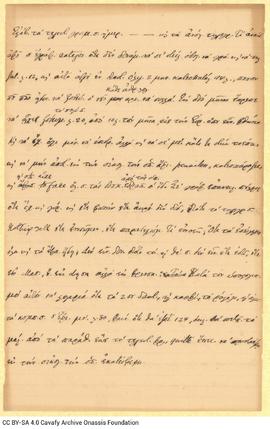
Cavafy, C. P.Handwritten draft letter by Cavafy, probably to his brother John, in two double sheet notepapers. The last two pages are blank. Reference to the journal Grammata and to persons supporting Cavafy's poetic work as well as to members of his family. Number "3" in one of the pages. Cancellations and emendations; abbreviations.
Cavafy, C. P.Handwritten draft letter by John Cavafy to his brother, George Cavafy, on four sheets, the first, third and fourth of which are numbered. John informs him of the departure of their brother, Aristeidis, for Marseilles after having abandoned his wife, and of the relevant letters sent by Aristeidis to members of his family. His wife's family (Vouros) threatens to take harsh measures if Aristeidis does not return soon. The sender asks George to convince Aristeidis to return to Egypt as soon as possible. The draft letter has been written by at least two different persons, but not by John (seemingly by some of his brothers). Even John's name on the last page is written in a handwriting different from his own. (Alexandria)
Cavafy, JohnHandwritten draft letter by C. P. Cavafy to his brother, Aristeidis, from the 1889 correspondence series, on both sides of a sheet. Cancellations, emendations and abbreviations. Use of English and French words and phrases. Reference to the absence of Aristeidis Cavafy abroad and to the need for his return as well as to financial matters.
Cavafy, C. P.Handwritten draft letter by C. P. Cavafy to his brother, Aristeidis, from the 1889 correspondence series. Cancellations, emendations and abbreviations. Use of English words and phrases. Reference to the absence of Aristeidis abroad, and to financial matters.
Cavafy, C. P.Handwritten draft letter by C. P. Cavafy to his brother, Aristeidis, from the 1889 correspondence series, on both sides of two sheets and on the recto of a third sheet that has been cut in half. Cancellations, emendations and abbreviations. Use of English and French words and phrases. Reference to the absence of Aristeidis and its negative consequences for the family. Extensive commentary on the legal aspect of the matter arising from the abandonment of his wife, Maria Vourou, and the squandering of her dowry.
Cavafy, C. P.Handwritten draft letter by C. P. Cavafy to his brother, Aristeidis, on all sides of a bifolio. Emendations. Use of English and French words and phrases. Reference to Aristeidis's decision to return to his wife, Maria Vourou, and her family.
Cavafy, C. P.Handwritten draft letter by C. P. Cavafy to his brother, Aristeidis, on both sides of a sheet. Cancellations, emendations and abbreviations. Use of English and French words and phrases. Number "14" written at the bottom of the recto. Reference to the postponement of Aristeidis's return from abroad.
Cavafy, C. P.Handwritten draft letter by C. P. Cavafy to his brother, Aristeidis, from the 1889 correspondence series, on both sides of a sheet. Cancellations, emendations and abbreviations. Use of English and French words and phrases. Reference to Aristeidis's decision to return to his wife, Maria Vourou, and her family.
Cavafy, C. P.Handwritten texts on five sheets, including the draft letter by Charikleia Cavafy to Aristeidis Cavafy, from the 1889 correspondence series, split in two parts. The first part includes three documents (two sheets and a bifolio with a printed crest "For Christ and Caesar" [in Greek], with notes on all sides). The second part includes two pieces of cut sheets (one of which with text on both sides) and contains additions to the first part. C. P. Cavafy is referred to as a third person. Cancellations, emendations and abbreviations. Use of English and French words and phrases. Reference to the matter of the continuing absence of Aristeidis Cavafy abroad and to the need for his return, as well as to financial matters.
Cavafy, C. P.Handwritten draft letter by C. P. Cavafy to his brother, George in a bifolio, written to the recto of the second sheet. Few emendations. Frequent use of English and French words and expressions. Reference to the matter of the absence of Aristeidis Cavafy abroad, to the need for his return as well as to financial matters.
Cavafy, C. P.Handwritten draft letter by C. P. Cavafy to his brother George ("23 Sept.") from the 1889 correspondence series, on two sheets, written to the recto of the second sheet. Cancellations, emendations and abbreviations. Additions at the end of the text. Frequent use of English and French words and phrases. Reference to the matter of the absence of Aristeidis Cavafy abroad, to the need for his return as well as to financial matters.
Cavafy, C. P.Handwritten draft letter by C. P. Cavafy to Maria Vourou, wife of Aristeidis Cavafy, dated 28 October, from the 1889 correspondence series, on both sides of a sheet. Cancellations, emendations and abbreviations. Use of French words and phrases. Reference to the postponement of Aristeidis' return from abroad, to the Vouros family as well as to financial matters.
Cavafy, C. P.Handwritten letter by Aristeidis Cavafy to his wife, Marie Cavafy, in a bifolio. He refers to the medical treatment he is receiving abroad and to the time of his return to Egypt. The text continues to the recto of the second sheet. Of note is the use of French words and phrases.
[Cavafy], AristeidisHandwritten letter by Cavafy to his brother, Aristeidis, on the first and third pages of a bifolio. The second and fourth pages are blank. News on the prices of cotton and cottonseed. The poet mentions that the family is moving to a new house. Signed: "Constantine F. C.". (Alexandria)
Cavafy, C. P.Handwritten letter by Charikleia Cavafy (Valieri) to C. P. Cavafy, on one side of a letterhead of the Tewfik Palace Hotel in Heluan. Blank verso. Update on John's health and his bad mood; thanks for the despatch of a letter and a poem. Accompanied by a paperboard notebook cover; on the label, the note "Letters of John Cavafy & Charikleia A. Cavafy", most probably by Rica Singopoulo. (Heluan)
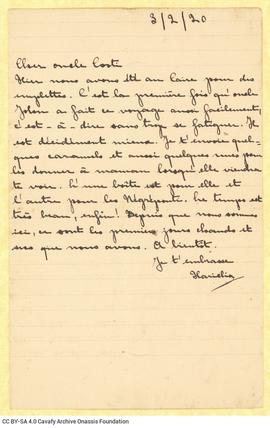
[Cavafy (Valieri)], HaricliaHandwritten letter by Charikleia Cavafy (Valiery) to Cavafy on the first page of a bifolio. The remaining pages are blank. Reference to the improvement of John's health. [Cairo]
[Cavafy (Valieri)], HaricliaHandwritten letter by Charikleia Cavafy (Valieri) to Cavafy on the first three pages of a bifolio. The last page is blank. Announcement of the death of Paul in Hyères, France, and reference to various procedural matters. [Cairo]
[Cavafy (Valieri)], HaricliaHandwritten letter by Charikleia Cavafy (Valieri) to Cavafy on both sides of a letterhead of the Tewfik Palace Hotel. She invites the poet to visit her and John at Heluan. Update on John's health and reference to his relation to a certain Madame D. (Heluan)
[Cavafy (Valieri)], HaricliaHandwritten letter by Charikleia Cavafy to her son, George, in the first three pages of a bifolio. The last page is blank. Reference to health-related issues and the weather as well as to the family of her son, Aristeidis. Also, references to the social life in Cairo. Interpolated words in French. [Alexandria]
K., X. [Cavafy (Fotiadi), Charikleia]Handwritten letter by John Cavafy to C. P. Cavafy in the first three pages of a bifolio. The last page is blank. Comments on the Italian translation by Atanasio Catraro of poems by C. P. Cavafy. Reference to his health and his bad mood. (Heluan)
Cavafy, JohnHandwritten diary-type letter by Paul Cavafy to C. P. Cavafy from Hyères, France, on both sides of two sheets. The letter is written on three different days, marked separately. In the first part, Paul expresses his nostalgia for his family and, on the occasion of the news from Alexandria he reads in the Press sent by the poet, he refers to various individuals (Zervoudakis, etc.) expressing his opinion either on their overall activities or on current events. In the rest of the letter he describes the state of general De Horsey's health, gives information on his family in England and describes his way of living. Of note is the frequent use of English and French words and phrases in the flow of written discourse. (Hyères)
[Cavafy], Polis [Paul]Handwritten letter by Paul Cavafy to C. P. Cavafy from Hyères, France. He expresses his worry about the interruption of the correspondence between the two brothers as well as his concern about securing his pension, on the occasion of events in Egypt.
[Cavafy], Polis [Paul]Handwritten diary-type letter by Paul Cavafy to C. P. Cavafy from Paris, according to the letterhead, on five sheets, two of which are bifolios. The text is completed gradually on different days and at different times of the day, all of which are noted. It is a long letter, in which Paul informs the poet of his very poor financial situation and asks him to assist him and help him with any procedures that might be necessary for him to escape the impasse he is in. The style of the text is highly charged and intense. There are several mentions of Paul's poverty and hunger as well as of people he intends to approach for assistance. Additions in the margin and page numbering ("1" through "13") in pencil. Of note is the use of English and French words and phrases.
[Cavafy], Polis [Paul]Handwritten letter by Paul Cavafy to C. P. Cavafy from Hyères, France, on both sides of a letterhead. It is a reply to a letter by the poet. Paul conveys his strong impressions from his experience of observing an airplane (biplane) flight; he comments extensively on issues relating to their family and to their social circle - mostly individuals from his prior service with the Municipality of Alexandria. He refers to his personal diaries, which apparently are gradually sent by C. P. Cavafy, and informs him on his trips and his stay at a seaside place in the area. Of note is the use of English and French words and phrases in the flow of written discourse. (Hyères)
[Cavafy], Polis [Paul]Handwritten diary-type letter by Paul Cavafy to C. P. Cavafy from Hyères, France, written over three days, in a bifolio with notes on all sides. It is a reply to a letter by C. P. Cavafy, dated 26 March. Commentary on subjects and individuals apparently mentioned in the letter by C. P. Cavafy. Account of Paul's everyday life after the death of general De Horsey, with references to his financial situation and to his plan to publish a newspaper, which was postponed due to the war. He informs his brother about his membership in a club (Circle d’agriculture) and the opportunity he has to use the library - he is presently reading the comedies The Wasps and The Clouds by Aristophanes, as well as Les Caractères by La Bruyère. Finally, on the occasion of a trip he made to Nice and Monte Carlo, he provides information on the common acquaintances he met there. Of note is the frequent use of English and French words and phrases in the flow of written discourse.
[Cavafy], Polis [Paul]Handwritten letter by Paul Cavafy to C. P. Cavafy from Hyères, France, on both sides of a sheet. It is a reply to a letter by C. P. Cavafy, dated 24 July. Paul comments on the news of individuals he probably learned through his brother and expresses nostalgia for the life of Alexandria. He refers to the matter of his return to Egypt and asks that his brother intervenes so as to confirm the remittance of his pension. Of note is the use of English and French words and phrases in the flow of written discourse. Line in blue pencil in the margin of the last paragraph. Small piece of paper with handwritten notes (possibly names) by C. P. Cavafy attached to the letter.
[Cavafy, C. P.]Handwritten letter by Paul Cavafy to C. P. Cavafy from Hyères, France, on both sides of a cut sheet. It is a reply to a letter by the poet, dated 20 December. Reference to Paul's journalistic activity with the The Riviera News newspaper and to the privileges stemming thereof (admittance to the casino and the theatre); comments on their common friends and family. Of note is the use of English and French words and phrases in the flow of written discourse. (Hyères)
[Cavafy], Polis [Paul]Handwritten, diary-type letter by Paul Cavafy to C. P. Cavafy, in a bifolio, with notes to the recto of the second sheet. It is a reply to a card he had received from the poet who was in Athens at the time. Mention of family members, with emphasis on John and the condition of his health. The text is interrupted and continues on the following day (25/8/1903). We also learn that Paul encloses newspapers (The Egyptian Gazette) in his letter. Of note is the frequent use of English and French words and phrases. (Alexandria)
[Cavafy], P[aul]Announcement of the wedding of Aristeidis Cavafy and Maria Vourou. Mention of people who attended the ceremony.
Elpis (Alexandria), newspaperHandwritten notes by Rica Singopoulo on the recto of eight sheets. Blank versos, except for the one of the fourth sheet. All sheets are numbered 1 to 8 at top right. Biographical notes, pertaining to the life, habits and social encounters of Cavafy. Also, information about the members of his family (parents and siblings). It appears that the notes were written after the poet's death and the information comes from Singopoulo's own knowledge as well as from the remains of Cavafy's belongings. Certain inaccuracies are observed, such as the poet's date of birth (1865 instead of 1863).
[Singopoulo, Rica]Personal scrapbook of many sheets with attached printed and handwritten invites addressed to Paul and the Cavafy family for various social events, some newspaper publications as well as other relevant souvenirs (menus, lists with balls etc.). On some pages, handwritten notes, either of chronological indications noting the changing of the years or, rarely, clarifying notes about an invitation etc.
[Cavafy, Paul]Photograph of Maria (Marie) Cavafy, wife of Aristeidis Cavafy, née Vourou, with their daughter Charikleia in her arms. It is probably a photograph from the infant's christening. The logo of the photo shop in the bottom part of the recto, as well as on the verso. The photograph should be dated to 1896-1897.
Fettel & BernardHandwritten prose text by Cavafy on 14 sheets and 9 double sheet notepapers. Pages 4-38 are numbered. The upper half of page 30 is typewritten. The text narrates the history of the Cavafy family from the 18th century (1728) and Peter Cavafy to the time and family of the poet, citing all known information on every person, providing more details and placing greater emphasis on the members of his own family as well as on members of other (often related) families linked to it. Cancellations; abbreviations. Interpolated words in Greek. The date indication ("1903") is provided by the author of the text (page 19).
Cavafy, C. P.Series of handwritten notes referring mostly to the poet's mother, Charikleia (Fotiadi) Cavafy, in two parts. The first includes three loose sheets folded in bifolios; they are written on both sides and enclosed in a folded sheet entitled "T. Last D. 1899". Pages 2-7 are numbered. The notes pertain to the last days of Charikleia Cavafy – the narration starts on 15 January 1899. The second part includes seven loose sheets of various sizes, written both on the recto and the verso, with one page number (4) marked. The content has the same subject, however it follows an inverse narrative sequence, starting on 3 February and ending on 27 January 1899. Both texts abbreviated. Cancellations and emendations.
Cavafy, C. P.