Handwritten musical score on all sides of a double sheet notepaper. Composition for voice and piano, based on the poem "In Stock" by Cavafy. Page numbers "2" and "4"are indicated. The verses of the poem are written above the notes. Initials and signature at the end of the score.
Poniridy, G.Handwritten musical score on both sides of a sheet. Composition for voice and piano, based on the poem "To Pleasure" by Cavafy. Number "2" on the second page. The verses the poem are written above the notes. Initials and signature at the end of the score.
Poniridy, G.Handwritten musical score on the three pages of a double sheet notepaper. Composition for voice and piano, based on the poem "Come Back" by Cavafy. Page numbers are noted: "2" and "3". The verses of the poem written above the notes. Initials and signature at the end of the score.
Poniridy, G.Visiting card by J. Chaîne & Simonson, managers of the Galerie des artistes modernes in Paris. On verso, the names are written with pencil.
Chaîne, JulesFour-page theatre programme issued by the French newspaper L’illustration on the theatrical plays Le Dépit amoureux by Moliere and Le Monde où l’on s’ennuie by Édouard Pailleron at the theatre Comédie Française. Portrait of the French actress Suzanne Reichenberg on the front cover. There are 2 inserted tickets from the Royal Lyceum Theatre of London.
L’illustration (newspaper)Two copies of a four-page theatrical programme issued by the French newspaper L’illustration for the plays Le Joie fait peur by Mme Émile [Delphine] de Girardin and Le Barbier de Séville by Pierre-Augustin Caron de Beaumarchais at the Comédie Française theatre. On the front cover, portrait of the French actor Coquelin Cadet (Alexandre Honoré Ernest Coquelin).
L’illustration (newspaper)Theatre programme issued by the French newspaper L’illustration for the play Faust by Jules Barbier and Michel Carré at Opéra de Paris. Portrait of the French actress Lucy Berthet on the front cover. Advertisements on back cover and inside the programme.
L’illustration (newspaper)Theatre programme issued by the French newspaper L’illustration for the plays at Théâtre du Palais-Royal in Paris. Information on the actors and contributors of the play Le Dindon by Georges Feydeau. The price of the programme is on the front cover: “Dix Centimes”.
L’illustration (newspaper)Theatre programme issued by the French newspaper L’illustration for the plays at Théâtre de l’Ambigu-Comique in Paris. Information on the actors and contributors of the play Les Deux Gosses by Pierre Decourcelle. The price of the programme is on the front cover: “Dix Centimes”.
L’illustration (newspaper)Theatre programme issued by the French newspaper L’illustration for the plays at Théâtre du Gymnase in Paris. Information on the actors and contributors of the play La carrière by Abel Hermant. The price of the programme is on the front cover: “Dix Centimes”.
L’illustration (newspaper)Theatre programme issued by the French newspaper L’illustration for the plays at Théâtre du Vaudeville in Paris. Information on the plays La Douloureuse by Maurice Donnay and En visite by Henri Lavedan. Advertisements on back cover and inside the pamphlet.
L’illustration (newspaper)Two copies of a four-page theatrical programme issued by the French newspaper L’illustration for the plays L’Autographe by Henri Meilhac and Oedipe roi (Oedipus Rex by Sophocles translated by Jules Lacroix) at the Comédie Française theatre. On the front cover, portrait of the French actor Jean-Sully Mounet.
L’illustration (newspaper)Theatre programme issued by the French newspaper L’illustration for the plays at Théâtre de l’Odéon in Paris. Information on the actors and contributors of the play Le Chemineau by Jean Richepin. The price of the programme is on the front cover: “Dix Centimes”.
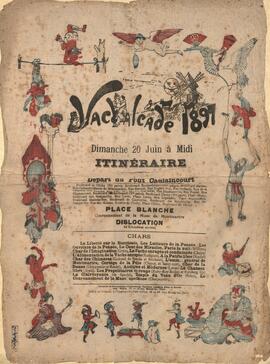
L’illustration (newspaper)Four-page concert programme at the venue Alcazar d’Été. The illustrator of the poster, Adolphe Willette, is mentioned on the front cover. The programme is an insert in the French journal Le Courrier français; its details are mentioned on the back cover. The price of the programme is on the front cover: “Quinze Centimes”.
Le Courrier français (journal)Handwritten draft of the poem "The Bishop Pegasius" or "The Temple of Athena" on both sides of a sheet. The title on one side and the text on the other. Handwritten notes on the recto of a piece of paper. Handwritten abbreviated notes, quotes from 1876 and 1930 publications as well as bibliographical references on both sides of a ruled sheet. Paperboard with the handwritten title of the poem and the date.
Cavafy, C. P.Envelopes and parts of envelopes with the details of the recipient C. P. Cavafy (approximately 75). The items bear postage stamps and seals, while some also bear handwritten notes with enumeration details and information regarding the date they were received. Handwritten notes by C . P. Cavafy and his brother, John Cavafy, on one envelope; another envelope is accompanied by a short note with date indication and the signature "John" written by the poet's brother. The envelopes accompany the letters sent by Paul Cavafy to C. P. Cavafy during the former's stay abroad.
[Cavafy, Paul]Handwritten prose text by Cavafy on 14 sheets and 9 double sheet notepapers. Pages 4-38 are numbered. The upper half of page 30 is typewritten. The text narrates the history of the Cavafy family from the 18th century (1728) and Peter Cavafy to the time and family of the poet, citing all known information on every person, providing more details and placing greater emphasis on the members of his own family as well as on members of other (often related) families linked to it. Cancellations; abbreviations. Interpolated words in Greek. The date indication ("1903") is provided by the author of the text (page 19).
Cavafy, C. P.Handwritten text by Cavafy on both sides of a sheet. Abbreviations, cancellations and emendations. The poet refers to locations where he had coffee or dined or attended performances in France. He also refers to a person which cannot be identified.
Cavafy, C. P.Four-page programme with the events at the cafe chantant Concert des Ambassadeurs. The illustrator of the poster, Adolphe Willette, is mentioned on the front cover. The programme is an insert in the French journal Le Courrier français; its details are mentioned on the back cover. An inserted musical score of the song “Mon pauvre Grégoire” is found inside the programme, stating the composers, Louis Michaud and P. Bourgès. The price of the programme is on the front cover: “Quinze Centimes”.
Le Courrier français (journal)Four-page programme with the events at the cafe chantant Concert des Ambassadeurs. The illustrator of the poster, Adolphe Willette, is mentioned on the front cover. The programme is an insert in the French journal Le Courrier français; its details are mentioned on the back cover. The price of the programme is on the front cover: “Quinze Centimes”.
Le Courrier français (journal)Advertising event programme for the Olympia music hall in Paris. Information and ticket prices are stated.
Olympia (Paris)Two copies of the four-page event programme of the cafe chantant Concert des Ambassadeurs in Paris. The illustrator of the poster, Adolphe Willette, is mentioned on the front cover. The programme is an insert in the French journal Le Courrier français; its details are mentioned on the back cover. The price of the programme is on the front cover: “Quinze Centimes”.
Le Courrier français (journal)Clipping from the Athenian newspaper Dimokratia. The article by Giorgos Kotzioulas "O "Kyklos" gia ton Kavafi", regarding the issue of the Athenian journal Kyklos dedicated to his poetry appears in the second page.
Dimokratia (newspaper)Postcard from Versailles. On recto, the publisher, Albert Lévy.
Lévy, AlbertPhotograph of a man in a suit and sitting on a rock, from the photo shop of N. Fettel & Cie of Alexandria. The photo shop's name in the lower part of the recto. The full logo on the verso. At top right of the verso, faded illegible handwritten dedication in ink to J.C.C. (most likely John Cavafy) and the date; the name of the person depicted ("captain Th[eodore?] Osborne") and the name of the steamboat ("Mareotis").
N. Fettel & Cie (ancienne maison E. Béchard)Personal scrapbook of many sheets with attached printed and handwritten invites addressed to Paul and the Cavafy family for various social events, some newspaper publications as well as other relevant souvenirs (menus, lists with balls etc.). On some pages, handwritten notes, either of chronological indications noting the changing of the years or, rarely, clarifying notes about an invitation etc.
[Cavafy, Paul]Pamphlet of the bookstore Librairie Arnaud in Paris. Includes almanac. On the back cover, details of the bookstore’s address.
Librairie ArnaudFoldable theatre programme of the musical theatre Casino de Paris. Advertisements inside and on the back cover.
Casino de ParisPamphlet of the apparel store J. Lafon. Guidelines on taking measurements and prices of clothing items.
Lafon, J.Pamphlet of an apparel shop in Paris, under the brand name P. Mitaine. Various apparel items with their prices are included.
Mitaine, P.Pamphlet of the French circus Nouveau Cirque. On the back cover, the price of sale: “20 Cent.”.
Nouveau CirqueFour-page pamphlet of Comédie Française dedicated to the French actor Eugène Silvain. The pamphlet contains excerpts of reviews from important theatrical plays of the actor.
Comédie FrançaiseSmall pamphlet (pocketsize), 23 pages, enitemd “Utile dulci, petit mémento de poche”. It contains advertisements, a guide to libraries and museums (Paris), a horse racing calendar etc.
UnknownFour-page pamphlet with the musical score and the verses to the song “Quand on n’a pas” by Sulbac, under the music supervision of Félix Mortreuil, Paul Briollet, Eugène Rimbault and Lucien Delormel. The music performance took place at Alcazar d’Été in Paris.
Édition Répertoire comiqueFoldable pamphlet of the Olympia music hall in Paris, where other events and performances also took place. On recto, the price (0.20 C.), advertisements on the inside.
Olympia (Paris)Four-page pamphlet with the musical score and the verses to the song “Les deux cabots” by the composers Louis Michaud and Lucien Carron.
Michaud, LouisTheatre programme of the Théâtre du Grand Guignol in Paris with information on the upcoming performances.
Théâtre du Grand Guignol (Paris)Four-page pamphlet with the musical score and the verses to the song “L’Aveugle et le paralytique” by the composers Paul Briollet, Lucien Hiks, Lucien Delormel and Joël Tiska. The music performance took place at Alcazar d’Été in Paris.
Édition RépertoireFour-page pamphlet with the musical score and the verses to the song “Eve interviewée” written by Eugène Rimbault, Joël Tiska and Lucien Delormel. The music performance took place at Alcazar d’Été in Paris.
Édition Répertoire comiqueReceipt for a car ride by the French company Compagnie voitures métropolitaines in Paris. On verso, the regulations of the service.
Compagnie voitures métropolitainesPamphlet about dance performances at the Moulin Rouge in Paris. Information on the various dance styles with photographs of the dancers on recto and on verso.
Moulin Rouge (Paris)Entrance ticket to the Olympia music hall in Paris, where other events and performances took place. The price of the ticket is included: “2 f.”.
Olympia (Paris)Handwritten notes by Rica Singopoulo on the recto of eight sheets. Blank versos, except for the one of the fourth sheet. All sheets are numbered 1 to 8 at top right. Biographical notes, pertaining to the life, habits and social encounters of Cavafy. Also, information about the members of his family (parents and siblings). It appears that the notes were written after the poet's death and the information comes from Singopoulo's own knowledge as well as from the remains of Cavafy's belongings. Certain inaccuracies are observed, such as the poet's date of birth (1865 instead of 1863).
[Singopoulo, Rica]Handwritten text by Rica Singopoulo on the recto of thirteen sheets from a notepad. Blank versos. Seven sheets have been torn off the notepad. Rica Singopoulo's notes pertain to the history of the poet's paternal and maternal family, for the members of which is provided all the information she collected from the poet himself as well as from his notes. Extensive reference to the life of the poet and that of his brothers. Cancellations and emendations.
[Singopoulo, Rica]Handwritten notes by Rica Singopoulo on seven sheets and three double sheet notepapers. The notes pertain to Cavafy's life and to the members of his family (mainly his mother and brothers). Some of the information recorded derives from the family correspondence as well as from the remnants of the poet's belongings.
[Singopoulo, Rica]Handwritten notes by John Cavafy on two sides of the envelope from St Petersbourg hotel in Paris. The starting and end points of various routes in Paris are mentioned along with several well-known landmarks. The item should be dated back to 1897, when John traveled to Paris with C. P. Cavafy.
Cavafy, JohnHandwritten note by Paul Cavafy on a postcard to C. P. Cavafy, with notes on both sides. It is mentioned that Paul is leaving for London and Paris, having Alexandria as his final destination. Of note is the use of English words and phrases. The card bears a postage stamp; mail service rubber stamps (Buxton, Port Said – Alexandria); the address is written in French; handwritten notes in pencil. (Buxton)
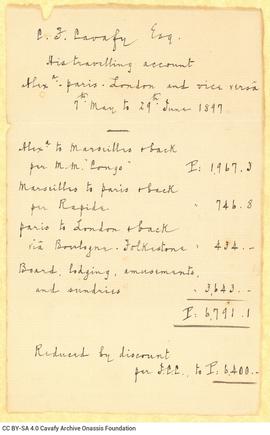
[Cavafy], Polis [Paul]Handwritten note by John Cavafy with a list of his expenses during a trip he made together with C. P. Cavafy in the period May-June 1897 to Paris and London, via Marseilles. Written on one side of a piece of paper. Blank verso.
Cavafy, JohnHandwritten note by Apostolopoulos to Cavafy, with reference to the poems "The City" and "Ithaca". (Paris)
Apostolopoulos, [Apostolis]Issue of the French sports newspaper Paris-courses: Journal quotidien de sport in Paris.
Paris-courses: Journal quotidien de sport (newspaper)Issue numbered 135 of the French newspaper Le Vaudeville: Journal quotidien, indépendant.
Le Vaudeville: Journal quotidien, indépendant (newspaper)Issue of the French newspaper Le Palais-Royal: Journal quotidien indépendant in Paris.
Le Palais-Royal: Journal quotidien indépendant (newspaper)Issue of the French newspaper Le Jockey in Paris.
Le Jockey (newspaper)Issue of the French newspaper La Presse in Paris.
La Presse (newspaper)Issue of the French newspaper La Patrie in Paris. On the front page of the newspaper, references to the Greek-Turkish war of 1897 and a publication of the poem “L’Aigle de la Crète”.
La Patrie (newspaper from Paris)Issue of the French newspaper La Comédie française: Journal quotidien indépendant, in Paris.
La Comédie française: Journal quotidien, indépendant (newspaper)Issue numbered 136 of the French newspaper La Comédie française: Journal quotidien, indépendant.
La Comédie française: Journal quotidien, indépendant (newspaper)Issue numbered 117 of the French newspaper La Comédie française: Journal quotidien, indépendant.
La Comédie française: Journal quotidien, indépendant (newspaper)Issue of the French newspaper L’Orchestre: revue théatrale & financière with the daily programme of the theatrical plays and concerts.
L’Orchestre: revue théatrale & financière (newspaper)Issue of the French newspaper L’Orchestre: revue théatrale & financière with the daily programme of the theatrical plays and concerts.
L’Orchestre: revue théatrale & financière (newspaper)Issue of the French newspaper L’Opéra: Journal quotidien indépendant, in Paris.
L’Opéra: Journal quotidien, indépendant (newspaper)Issue of the French newspaper L’Éclair: Journal de Paris politique quotidien absolument indépendant.
L’Éclair: Journal de Paris politique quotidien absolument indépendant (newspaper)Issue of the French newspaper L’Avant-Scène.
L’Avant-Scène (newspaper)Issue of the French newspaper Gil Blas in Paris.
Gil Blas (newspaper)Ticket for the Oller museum in Paris. The price of the ticket is included: “1 Franc”.
Musée OllerFour-page menu of the French Grand Hôtel in Paris. There is a list with Greek wines.
Grand Hôtel (Paris)Member card for horse races in Bois de Boulogne in Paris by the organisation Société d’Encouragement. Price on recto and on verso: “20 Francs”.
Société d’EncouragementIssue of the French journal La Lanterne de Bruant with Aristide Bruant as editor. Includes French novels, songs with musical scores and drawings. On the front and back cover, the price of the journal: “10 Centimes”/ “Prix excepitionnel: 5 Centimes”.
La Lanterne de Bruant (journal)Illustrated list of the Grévin museum in Paris, 56 pages, publication date 1897. The price of the list is on the front cover: “1 Franc”.
Musée Grévin (Paris)Two copies of a typewritten letter by Theodoros Griva(-Gardikiotis) to Raymond Queneau of the Gallimard publishing house, on the recto of two sheets. Blank versos. The sender attempts to settle a misunderstanding concerning the French publication of Cavafy's Collected Works and his own participation therein. Below the typewritten text, handwritten note in Greek to Alekos Singopoulo, in which he proposes to Singopoulo to collaborate with the Gallimard publishing house on the aforementioned publication. (Bern)
Griva, Th.Two (digitally reproduced) handwritten letters by Dimitri Mitropoulos to Cavafy, sent from Athens. In the first letter (15/7/1926), in four numbered pages, he informs Cavafy about the setting to music of poems of his and asks for their translations into French. In the second letter (16/8/1926) he thanks him for the despatch of the French translations.
Mitropoulos, D.Typewritten letter from the Renaud & Texier paper company of Paris to Alekos Singopoulo on one side of a letterhead of the company. Blank verso. Reference to various qualities of paper in the letter, which is about an order made by Singopoulo. The signature of the company representative is illegible.
Renaud & TexierHandwritten letter by Stephen Schilizzi to Cavafy on all sides of a bifolio. The author expresses his concern regarding the receipt of the correspondence by Cavafy. Commentary on people from their friendly circle as well as from the broader social circle of Alexandria. Cancellations; use of French words and expressions in the flow of written discourse. (Alexandria)
[Schilizzi, Stephen]Handwritten diary-type letter by Stephen Schilizzi to Cavafy on all sides of two bifolios. The author describes the trip of his return from England to Egypt. He gives detailed information on the sights he visited while in London (Tower of London, St. Paul's Cathedral, Big Ben, The Monument to the Great Fire of London, Houses of Parliament, Westminster Abbey, National Gallery, British Museum, Madame Tussauds Exhibition, The International Fisheries Exhibition) and Paris (Musée des arts et métiers-Conservatoire national des arts et métiers, Notre Dame, Panthéon, Morgue de Paris). Commentary on people from their friendly circle as well as from the broader social circle of Alexandria. Reference to the cholera epidemic in Egypt. Cancellations and additions. The author's initials at the end of the first bifolio. The date "[...] 31st Oct 1883" in the second bifolio.
Schilizzi, S.Handwritten letter by Stephen Schilizzi to Cavafy on all sides of a bifolio and of a small-size loose sheet. It is a reply to a letter dated 31 March. The author proposed to Cavafy the use of an encryption system, in order to protect the content of their correspondence; the letter records the alphabet with the respective cryptographic elements. He provides information about persons of their friendly circle as well as of the broader social circle of Alexandria. He comments on current events, such as the works of the Indemnity Commission and the anniversary celebration of the national independence. He mentions the publications Le Moniteur [égyptien] and Le Phare [d'Alexandrie]. Cancellations, emendations and additions; use of French words and phrases in the flow of written discourse. Note in pencil next to the date indication (question mark and number "3") on the front page of the document. (Alexandria)
Schilizzi, S.Handwritten letter by Stephen Schilizzi to Cavafy on all sides of two bifolios. It is a reply to two letters from December. The author expresses his views on personal remarks made by Cavafy in their previous correspondence, which appear to cause conflict between them. Extensively detailed reference to performances and events he attended while in London ("Bluebeard", "Promenade Concerts", "Iolanthe [or the Peer and the Peri]", "M.P.", "A private wire") and Paris ("Faust", "L'Africaine", "Les Rantzau", "Le jour et la nuit", 'Frou Frou", "Excelsior"). Reference to the cholera epidemic in Egypt and to a fire in the city of Alexandria. Commentary on people from their friendly and broader social circle. Reference to the publications The Egyptian Gazette and Union Egyptienne. Cancellations, underlinings; use of Greek and French words and phrases in the flow of written discourse. (Alexandria)
[Schilizzi, Stephen]Handwritten letter by Sévastie Verhaeghe de Naeyer to her nephew, Paul Cavafy, in two bifolios. Her first name printed on the first page of each bifolio. She mentions her impressions and events from a trip she had taken to Europe as well as personal and family news. The letter is accompanied by a small piece of paper with a handwritten note by Cavafy: "1883 probablement". (Ghent)
[Verhaeghe de Naeyer], SévastieHandwritten letter by Photius Fotiadis, uncle of Cavafy (his mother's brother), to Charikleia Cavafy in two bifolios of the Ottoman Empire Healthcare Administration. Update on the health of their sister, Sévastie, who is hospitalised in Paris. Description of the situation in Istanbul and reference to his two sons, George and Constantine. Interpolated words in French. (Istanbul)
Fotiadis, Ph.Handwritten letter by Paul Cavafy to his brothers, John and C. P. Cavafy, from Paris, on all sides of a bifolio. In an apologetic tone for the disturbance he has caused to his family, he refers to his stay in Paris and to city landmarks ("Île de la Cité, Notre Dame, Quartier Latin, Louvre"); he expresses fears for his health and, remembering life in Alexandria, he repeats that he intends to return in due time. He comments on the matter of the frequency in which he may disburse his pension, a fact that seems to trouble him. Of note is the use of English and French words and phrases.
[Cavafy], Polis [Paul]Handwritten letter by Paul Cavafy from France to C. P. Cavafy, on a bifolio, with notes on all sides except for the recto of the second sheet. Reference to his dire financial situation and to a remittance he received from his service in Alexandria (Municipality). Extensive commentary on his poor health. It is noted that the letter is addressed to John Cavafy. Of note is the use of English and French words and phrases. (Paris)
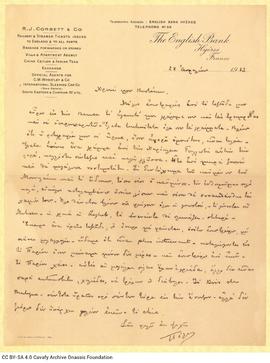
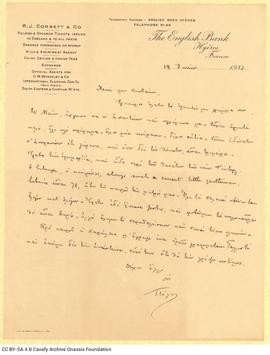
[Cavafy], Polis [Paul]Handwritten letter by Paul Cavafy to C. P. Cavafy from Hyères, France, according to the letterhead. Paul refers to members of family and to friends, and comments on his recent visit to Paris. Of note is the use of French words and phrases in the flow of written discourse. (Hyères)
[Cavafy], Polis [Paul]Handwritten letter by Paul Cavafy to C. P. Cavafy on both sides of a sheet. Paul comments on his dire financial situation and his debts. From the content it is surmised that he is still in Hyères, France. He expresses his concern for the fact that he is still to receive his pension, while he stresses that he is alone and that his health is impaired. Of note is the use of English and French words and phrases. (Hyères)
[Cavafy], P[aul]Handwritten letter by Paul Cavafy to C. P. Cavafy from Hyères, France, on all sides of a bifolio. It is a reply to a letter by the poet. He informs him of his plans to stay in L'Almanarre as escort to general De Horsey for a few more months and extensively comments on developments regarding his former service with the Municipality of Alexandria, referring to individuals. He expresses his strong interest in the issue, urging C. P. Cavafy to send him newspapers, so that he may receive information. Of note is the use of English and French words and phrases in the flow of written discourse. (Hyères)
[Cavafy], Polis [Paul]Handwritten letter by Paul Cavafy to C. P. Cavafy from Hyères, France, according to the letterhead. Paul refers to members of family and to friends. Of note is the use of French words and phrases in the flow of written discourse. (Hyères)
[Cavafy], Polis [Paul]Handwritten letter by Paul Cavafy to C. P. Cavafy from Hyères, France, according to the letterhead, on both sides of two sheets. It is a reply to a letter by the poet, dated 30 September. Arguments raised by Paul in favour of his stay in France, contrary to the suggestion of John Cavafy to return to Alexandria. Comments on World War I events, which is still in progress, and are linked to the previous subject. Reference to members of their family; Paul thanks C. P. Cavafy for intervening in a matter regarding Paul's pension. Of note is the use of English and French words and phrases in the flow of written discourse. (Hyères)
[Cavafy], Polis [Paul]Handwritten letter by Paul Cavafy to C. P. Cavafy from France, according to the content and the sequence of his previous and following letters. The text is on both sides of a sheet. It is a reply to a letter by the poet, in which Paul expresses his personal thoughts on his life; he refers to news he learns from his brother regarding their circle of family and friends as well as to details regarding his journalistic activities. He also asks his brother to send him a photograph of their mother. Of note is the use of interpolated English and French words and phrases.
[Cavafy], Polis [Paul]Handwritten letter by Paul Cavafy to C. P. Cavafy from Tours, France, according to the letterhead, on all sides of a bifolio. It is a description of the trip Paul is making in France, accompanying the Englishman Warde-Aldam. He refers extensively to the cities they have already visited, to monuments and sights they have seen and to their itinerary; he also expresses his strong admiration for France. Of note is the use of French words and phrases in the flow of written discourse. (Tours)
[Cavafy], Polis [Paul]Handwritten letter by Paul Cavafy to C. P. Cavafy from France, dated "16 March 1912", in the first three pages of a bifolio. It is a reply to a letter he had received from Cavafy. Update on his health, his plans to stay at Hyères as well as on other current matters. He also comments on theatrical events, as he went to the play by Henry Kistemaeckers, La flambée. Of note is the frequent use of English and French words and phrases in the flow of written discourse.
[Cavafy], Polis [Paul]Handwritten letter by Paul Cavafy to C. P. Cavafy from Hyères, France, on a bifolio with notes to the recto of the second sheet. It is a reply to a letter by C. P. Cavafy, dated 22 November - the date is noted in different ink. Comments on individuals related to their family and social circle as well as other matters set forth in the previous letter by C. P. Cavafy. He describes his place of residence, mentions the collection of letters of P. Mérimée Lettres à une inconnue, and informs about his health, mentioning events of the past. Of note is the use of French words and phrases in the flow of written discourse.
[Cavafy], Polis [Paul]Handwritten letter by Paul Cavafy to C. P. Cavafy on both sides of two sheets. Paul expresses his thanks to the poet, who sent him a photograph of their mother. In the largest part of the letter refers to his health, comments on people he has met in Alexandria and elsewhere as well as on various events. He requests to receive the newspaper The Egyptian Gazette, also mentioning La Réforme. He describes his living conditions and repeats his warm feelings for his two brothers. Of note is the use of interpolated English words and phrases.
[Cavafy], Polis [Paul]Handwritten letter to Cavafy. Admiration for his work; reference to Psichari and Rodin. Signed: "Polys [Modinos]». (Paris)
[Modinos], PolysHandwritten diary-type letter by Paul Cavafy to his brothers and mother on five numbered bifolios, three of which bear the logo of St George's Club in London. Paul expresses his enthusiasm about the city. He details his impressions from the stores in London and describes the guesthouse in which he is staying. He also refers to a visit he made in the area and to the house where he lived in his childhood. Extensive use of English and French words and phrases. Accompanied by envelope with John Cavafy's address at R. J. Moss & Co. (London)
[Cavafy], Polis [Paul]Handwritten diary-type letter by Paul Cavafy to his mother on all sides of a bifolio. The address "30, Westbourne Terrace, Hyde Park, W." at top right of the first page. Paul is preparing to leave London and return to Egypt via Paris and Marseille. He expresses his enthusiasm about the city. Use of interpolated English and French words and phrases. (London)
[Cavafy], Polis [Paul]Handwritten diary-type letter by Paul Cavafy to his mother on two numbered bifolios, with the embossed logo of St George's Club in London. Paul visits London, from where he describes in detail his stay in the city and his activities. Extensive use of interpolated English words and phrases. [London]
[Cavafy], Polis [Paul]Handwritten letter to Cavafy on both sides of a letterhead of the Waldorf hotel. The author informs the poet about a meeting he had with Ε. M. Forster and their discussion regarding the publication of translated poems by Cavafy. Signed: "Pericles" (most probably Anastasiadis). Accompanied by envelope. (London)
[Anastasiadis], PericlesTypewritten letter by Nicolas Calas (Nico Calamaris) to Alekos Singopoulo on the recto of two sheets. Blank versos. Calas proposes Cavafy's poems be published in the United States, translated by Mavrogordatos and with an introduction by Yourcenar. He refers Singopoulo to the publishing house so as to arrange the financial matters of the publication. He asks that a photograph of Cavafy be sent and refers to common acquaintances of theirs. Accompanied by envelope. (New York)
Calamaris, NicoHandwritten letter by Mike Ralli to Cavafy on two sheets, with notes on all sides. Account of everyday life in Alexandria and urge to Cavafy to return to Egypt. Commentary on social life and people of their social circle as well as on the new house of the family of Th. Ralli at the Rosetta Gate. The author refers to the work Memoirs of a physician by Al. Dumas père as well as to the other books in the series, which he is reading in English; he expresses great interest in the publications of texts by T. Macauley. Underlinings of words and phrases in French. The second sheet is numbered. (Alexandria)
Ralli, M[ichael Th.]Handwritten letter by Mike Ralli to Cavafy in the first three pages of a bifolio. Information about the author's stay in Paris and comments on his financial situation. Of note is the use of English and French words and expressions in the flow of written discourse. Numbers written in a pen different to that of the main text, on the fourth page. (Paris)
[Ralli], Mikes [Th.]Handwritten letter by Mike Ralli to Cavafy in two bifolios, with notes on all sides. It is a reply to a letter dated 5 January. Comments on remarks apparently made by Cavafy regarding life in Istanbul. The author expresses his views regarding the author Georges Ohnet, with reference to works of his (Le Maître de forges, La comtesse Sarah); views regarding the journal The Athenaeum. Information about people from the social circle of Alexandria. In the postscript, he describes a wedding ceremony making use of expressions in French. (Alexandria)
Ralli, M[ichael Th.]Handwritten letter by Mike Ralli to Cavafy on two sheets, with notes on all sides. Extensive reference to people and facts related to the social circle of Alexandria. Commentary on Cavafy's protracted absence in Istanbul; the poet is urged to return to Egypt. (Alexandria)
Ralli, M[ichael Th.]