Issue 5405 of the newspaper Omonoia. Announcement of the death and funeral of Cavafy's mother, Charikleia Cavafy. Mention of the cause of death and of the ceremony.
Omonoia (Alexandria), newspaperHandwritten musical score on all sides of a double sheet notepaper. Composition for voice and piano, based on the poem "In Stock" by Cavafy. Page numbers "2" and "4"are indicated. The verses of the poem are written above the notes. Initials and signature at the end of the score.
Poniridy, G.Handwritten musical score on both sides of a sheet. Composition for voice and piano, based on the poem "To Pleasure" by Cavafy. Number "2" on the second page. The verses the poem are written above the notes. Initials and signature at the end of the score.
Poniridy, G.Handwritten musical score on the three pages of a double sheet notepaper. Composition for voice and piano, based on the poem "Come Back" by Cavafy. Page numbers are noted: "2" and "3". The verses of the poem written above the notes. Initials and signature at the end of the score.
Poniridy, G.Handwritten draft of the poem "Zenobia" on both sides of a ruled sheet. Paperboard with the handwritten title and date.
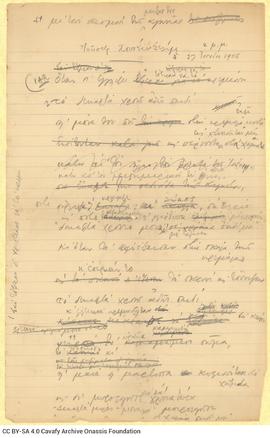
Cavafy, C. P.Manuscript of the poem "Yussef Hussein Selim, 27 June 1906 2 P.M." on one side of a ruled sheet. Cancellations and emendations. Variation of the first verse, marked "Var[iante]". Note over the title. Blank verso.
Cavafy, C. P.Typewritten English translation of the poem "Young Men of Sidon (400 A.D.)" by G. Valassopoulo on the recto of two sheets. The second sheet is numbered. Handwritten emendations in ink. Blank versos.
Valassopoulo, G.Handwritten English translation of the poem "Young Men of Sidon (400 A.D.)" by G. Valassopoulo on both sides of a sheet; handwritten cancellations, emendations and notes by Cavafy. Copy of Valassopoulo's translation by Cavafy on both sides of a sheet with entered corrections. Handwritten note with part of the same poem in English, written by Cavafy on the verso of a broadsheet with the original poem, printed in 1923. Handwritten notes by Cavafy and quotes from historical editions in English and French, on the verso of a printed broadsheet with the poem "Very Rarely" as well as on three pages of a double sheet notepaper.
Valassopoulo, G.Handwritten poem by Angelos Sikelianos ("Ymnos tou megalou Nostou") on one side of seven numbered large-size sheets. The poet's name and location in the last sheet (Delphi).
Sikelianos, AngelosManuscript with words in Greek and French drawn from the dictionary by F. D. Dehèque Dictionnaire grec moderne-français (Paris, 1825) on both sides of a ruled sheet.
Cavafy, C. P.Printed broadsheet with the poem "Whenever They Are Aroused" on the recto. Handwritten emendation in the first verse. Handwritten note on the verso.
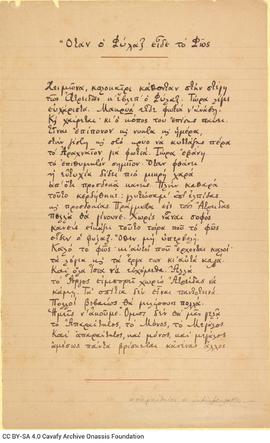
Cavafy, C. P.Manuscript of the poem "When the Watchman Saw the Light" on one side of a ruled sheet. Handwritten note in pencil, regarding the translation of a word in English, at bottom right. The title has been underlined and there is a line in red ink at the end of the poem.
Cavafy, C. P.Handwritten English translation of the poem "When Julian observed much lukewarmness" on one side of a ruled sheet. The poem is written by a hand other than Cavafy's (most likely Valassopoulo's). Cancellations and emendations by Cavafy in pencil. Blank verso.
Cavafy, C. P.Handwritten prose text (essay) on both sides of a piece of paper. Abbreviations. Brief assessment of the life and work of the jurist, scholar and poet Athanasios Christopoulos.
Cavafy, C. P.Handwritten text in English on both sides of a sheet. Notes on the translation of a poem by Cavafy ("The Satrapy"). Cancellations and emendations.
Cavafy, C. P.Wedding photo album with 21 photos featuring members of the Cavafy family. The brand name of the photographic studio is mentioned on several photos: “Fiorillo Phot.”. On the photos of the wedding ceremony, Paul Cavafy and Charikleia Cavafy are among the attendees.
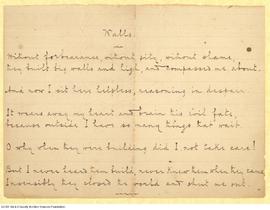
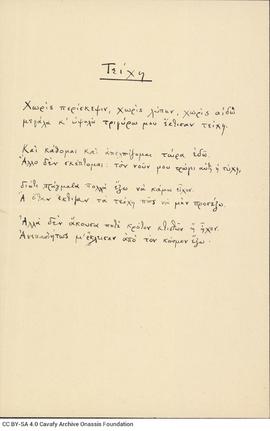
Fiorillo Phot.Manuscript of the poem "Walls" on the recto of a ruled sheet. Cancellations and emendations. Number "157" at top right and date indication ("Sept. 1896") at bottom right. The crossed out handwritten poem "The Windows" on the verso. Number "158" at top left. Underlined titles and line in red ink below each poem.
Cavafy, C. P.Handwritten English translation of Cavafy's poem "Walls", made and written down by John Cavafy on one side of a piece of paper. Blank verso.
Cavafy, JohnFour-page print with the poem "Walls" (in Greek) in the second page and its English translation by John Cavafy in the third page. Handwritten emendations by Cavafy in the Greek text. The first and last pages, in the stead of front and back cover respectively, bear typographical ornaments, as well as different date indications.
Cavafy, C. P.Manuscript of the poem "Walls" on one side of a sheet.
Cavafy, C. P.Signed manuscript of the poem "Walls". The title has been underlined and there is a line underneath the poem. Blank verso.
Cavafy, C. P.Two loose sheets with printed text on all sides. They include two printed poems by Cavafy ("Waiting for the Barbarians" and "Monotony"), as well as the title and a verse from a third poem ("The Windows"), marked in a handwriting other than the poet's. On the recto of the second sheet, affixed addition with two verses handwritten by Cavafy. On the verso, the poem "Monotony" has been striken through entirely. The printed page numbers ("21" through 24") have been striken through and another numbering has been marked ("1" through 3"). There are handwritten notes in pencil, in the margin; underlinings of words and phrases. The page numbering and the typographical features of text allude to the publication C. P. Cavafy. Poems, Kasimatis & Ionas, Alexandria 1910, from a copy of which the sheets appear to have been removed.
Cavafy, C. P.Printed eight-page pamphlet with the poem "Waiting for the Barbarians". The first page serves as a front cover. The poem title at top left; the name of the Lagoudakis printing house and the year of publication at bottom right. The text of the poem occupies pages 3 to 5. The poet's signature and the indication "December 1898" in the lower part of the fifth page. Pages 2 and 6 to 8 are blank. Accompanied by 19 copies, one of which has a front cover of paperboard.
Cavafy, C. P.Manuscript of the poem "Waiting for the Barbarians" on both sides of a ruled sheet. Notes in English in the margin. The title has been underlined and there is a line in red ink at the end of the poem.
Cavafy, C. P.Two printed sheets with the poem "Waiting for the Barbarians". The verso of the second sheet, the lower part of which has been cut off, is blank. The poem's title at top left of the recto of the first sheet. Handwritten cancellations and emendations in several verses. Added handwritten verses as well as cancellations of other verses in the second and third pages. The printed text, the font and the layout are similar to those of the eight-page 1904 publication of the poem by the Lagoudakis printing house and this should be considered a copy thereof.
Cavafy, C. P.Handwritten comments and notes on the poem "Waiting for the Barbarians" on both sides of a ruled sheet and on three pieces of paper. The title in red ink on the recto of the ruled sheet.
Cavafy, C. P.Manuscript of the poem "Waiting for the Barbarians", on one side of three ruled sheets. Page numbers indicated ("1, 2, 3") at top right of the recto of each sheet. The poet's name, crossed out, at the end of the poem. Cancellations and emendations. The versos of all sheets are blank.
Cavafy, C. P.Two printed sheets with the poem "Waiting for the Barbarians". Some verses crossed out in pencil. Handwritten emendations, verse variations and notes by Cavafy. Printed date ("December 1898") at bottom left of the recto of the second sheet. Handwritten notes by Cavafy on the verso of the second sheet.
Cavafy, C. P.Manuscript of the poem "Waiting for the Barbabrians" on a double sheet notepaper, with an addition pasted on the second page. The text continues on the verso of the first sheet; the remaining pages are blank. Cancellations and emendations. Signed: "C. P. Cavafy".
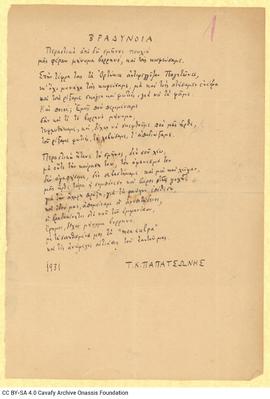
Cavafy, C. P.Manuscript of the poem "Vradynoia". The name "T. C. Papatzoni" as well as date indication ("1931") below the poem. Number "1" is marked.
Papatsonis, T. K.Manuscript of the poem "Voices" on one side of a ruled sheet. Number "79" at top right. Blank verso.
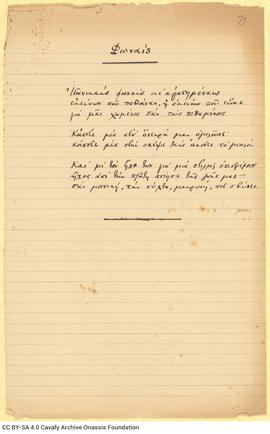
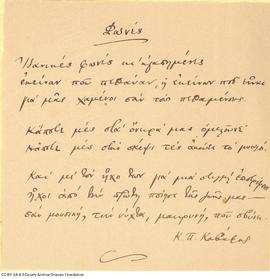
Cavafy, C. P.Autograph manuscript of the poem "Voices" on one side of a cut sheet.
Cavafy, C. P.Four printed visiting cards, one of Paul Cavafy and three of his brother, Peter-John Cavafy, in French. The cards of the latter also mention his job title. Two visiting cards reading "The Grand Logothete", one in Greek and one in French. Printed invitation to Charikleia Cavafy from the baroness De Menasce. Printed invitation to one of the Cavafy brothers (possibly George) to a ball of the Khedive of Egypt for the 15 of May 1899. All of the above are enclosed in a handmade folder of paperboard, with the note "Various familial, curious, etc."» on the recto, handwritten by Rica Singopoulo. On the verso, an abbreviated note by Cavafy on English ("bl[ack] + whi[te]").
[Cavafy, Paul]Three visiting cards: two printed ones of Charikleia Cavafy and a handwritten one of C. P. Cavafy. One of Charikleia's cards mentions that she accepts visits every second and last Friday of the month.
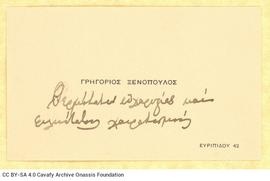
[Cavafy (Fotiadi), Charikleia]Handwritten note of thanks by Grigorios Xenopoulos to Cavafy on a printed visiting card.
Xenopoulos, GrigoriosVisiting card by J. Chaîne & Simonson, managers of the Galerie des artistes modernes in Paris. On verso, the names are written with pencil.
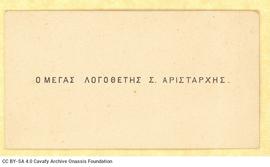
Chaîne, JulesPrinted visitng card of the Grand Logothete of the Ecumenical Patriarchate, Stavrakis Aristarchis.
[Stavrakis, Aristarchis]Printed visiting card of N. D. Pappos. It is most probably the son of D. Pappos and Amalia Pitaridi Pappou, Cavafy's cousin and godmother.
[Pappos, N. D. ]Handmade viviting card of Mrs Di Revs and her daughters. Invitation to Cavafy to tennis and table tennis. Sketch in ink on one side.
Di Revs, familyVisiting card of Paul Vanderborght with handwritten note. Accompanied by a printed single-column entitled "Appel du Comité Rupert Brooke", with handwritten note regarding its publication in the press and typographical corrections.
Vanderborght, PaulPrinted visiting card of Cavafy.
Cavafy, C. P.Printed visiting card of Ch. Callinus, second husband of Cavafy's aunt, Amalia (Fotiadi Psylliari), who was working with the Belgian diplomatic delegation as interpreter.
[Callinus, Ch.]Handwritten draft of the poem "Visions" in pencil, on the first side of a double sheet graph paper. The other pages are blank, the last two of which are cut approximately in half.
Cavafy, C. P.18-page programme of the exhibition Victorian Era Exhibition at Earl’s Court in London by The London Exhibition Ltd with general director Imre Kiralfy. Detailed information is mentioned on the organisation of events, music competitions, performances and concerts. Advertisements are found scattered across the printed medium. The price is on the front cover: “Price 2”.
London Exhibitions, LtdHandwritten verses from poems by Solomos and Valaoritis as well as from folk songs, on a handmade notepad comprising six sheet, with the last one blank, and on a small piece of paper. Bibliographical references.
Cavafy, C. P.Piece of paperboard (perhaps from a handmade folder), entitled "Valassopoulo's translation work. Finished". The handwriting is probably that of Rica Singopoulo but the last word has been written by Cavafy.
[Singopoulo, Rica]Handwritten prose text on the first two pages of a double sheet notepaper. The other two pages are blank. Cavafy briefly examines the poetry of Aristotelis Valaoritis and draws parallels to that of Dionysios Solomos. A few titles of poems by Valaoritis are mentioned.
Cavafy, C. P.Manuscript of an untitled poem on both sides of a sheet. Page numbers are indicated: "39" on the recto, "40" on the verso. The note "Fragment" at the bottom of the verso. Cancellations and emendations. The central part of the sheet has been detached but is preserved.
Cavafy, C. P.Handwritten poem and introductory note with abbreviations.
Cavafy, C. P.Manuscript of an untitled poem on one side of a ruled sheet. Cancellations and emendations.
Cavafy, C. P.Manuscript of the poem "Two Young Men, 23 to 24 Years Old" on one side of two ruled sheets. Number "75" at top right of the recto of the first sheet. The signature "C. P. Cavafy" on the recto of the second sheet, at the end of the poem. Affixed clipping from a printed medium with date annotation ("14 June 1927") and the brand name of the Kasimatis and Ionas printing house. The day and year of the date have been emended in ink by the poet. The versos of both sheets are blank. Printer's copy.
Cavafy, C. P.Two copies of the four-page theatre programme of St. James’s Theatre in London for Arthur W. Pinero’s play The Princess and the Butterfly, with George Alexander’s artistic direction. Advertisements on back cover.
St. James's Theatre (London)Handwritten poem on the recto of two ruled sheets. The verso of both sheets is blank. The signature "J.C.C." (John Cavafy) below the poem.
Cavafy, JohnManuscript of the poem "Trojans" on both sides of a ruled sheet.
Cavafy, C. P.Manuscript of the poem "Trojans". Cancellations and emendations. Sheet number marked at top right: "12". Numbers written in pencil in the text margin.
Cavafy, C. P.Handwritten notes on the poem "Trojans" in ink, on a piece of paper. The poem title, the annotation "late in 1905" and a note in pencil, at top left. Extensive use of abbreviations.
Cavafy, C. P.Manuscript containing a series of four translated poems by Cavafy into English ("Herodes Atiicus", "The Satrapy", "The Glory of the Ptolemies") on four sheets, two of which bear notes on both sides. Cancellations, emendations and abbreviations. In all poems, except for "Philhellene", John Cavafy's name is noted ("J. C. Cavafy") as the translator.
Cavafy, C. P.Typewritten translations of poems by Cavafy in Italian. The poems "Voices", "The City", "Desires" and "Unfaithfulness" on the rectos of five sheets. Each translation is signed by A. Catraro in pencil. Three typewritten translations of the poem "The God Abandons Antony" in the first and third pages of a double sheet notepaper and in the recto of a ruled sheet. Handwritten note by Cavafy, mentioning Catraro as the translator of the last poem.
Catraro, A.Printed Dutch translations of poems by Cavafy ("Priester van het Serapeion", " "Che Fece... il Gran Rifiuto" ", "In de Maand Athyr") on three sheets. Page numbers are indicated: "340" to "342". According to a note in the text, the translator is G. H. Blanken.
Blanken, G. H.Typewritten French translations of poems by Cavafy ("Au mois d’Athyr", "Sur Ammonis mort à 29 ans, en 610", "Ithaque"), on two sheets and two double sheet notepapers; the poem "Ithaque" written on the latter. On each double sheet notepaper, the same part of the poem is repeated twice, on the first and third pages; this is why number "2" is noted on each sheet of the second double sheet notepaper. On the rest of the sheets, numbers "2" and "4" are noted in pencil. Handwritten emendations on the poem "Au mois d'Athyr" as well as typewritten explanatory footnote, regarding a verse of the poem. The name of H. Pernot Pernot as translator is noted, either handwritten or typewritten.
[Pernot, H.]Typewritten French translations of poems by Cavafy ("De la Boutique", "Gris", "Durer", etc.), on one side of many sheets, of various sizes and qualities. Some of the poems are found in more than one copies. On one of the sheets, number "3" is noted in pencil. Aison Kyriacopoulo is mentioned as the translator at the end of each poem.
[Kyriacopoulo, Ai.]Typewritten French translations of poems by Cavafy on seven sheets. Some are found in more than one copies.
UnknownTypewritten French translations of poems by Cavafy («Loin.....», «La Cité») on one side of two small sheets as well as in the first and third pages of a bifolio. A. Catraro's typewritten name indicates him as the translator. Handwritten emendation in one of the sheets.
Catraro, A.Handwritten text by Cavafy, including 21 poems of his translated into English ("An o[ld] man", "Candles", "Voices", etc.) by his brother, John Cavafy, on six double sheet notepapers with notes on all sides; the last page of the last notepaper is blank. The text is abbreviated and is underlined all across. The poems are numbered in pencil (1-21, omitting 11).
Cavafy, C. P.Handwritten text in English on four sheets, with notes on the recto. They are translations of three of Cavafy's poems ("Morning Sea", "The God Abandons Antony" and "Alexandrian Kings") by John Cavafy, whose is the handwriting of the text. Reference to the journal The Athenaeum of 25 April 1919.
J.C.C. [Cavafy, John Constantine]List of Cavafy's poem titles in English, in a four-page folder. Handwritten note in Greek ("Translations") on the cover; the list in the inner pages. The titles are divided in three parts, numbered accordingly (1-3), while there is an additional note on part 1.
Cavafy, C. P.Manuscript of the poem "Tragoudia tou paliou kairou". The title is followed by the mark "I"and number "1" is written in pencil. Cancellation in the last stanza.
Malakasis, M.Handwritten poem ("Towards the Fall") on the first page of a ruled double sheet notepaper, written by Cavafy. The title has been crossed out. Notes in pencil in the left margin and at the bottom of the page; verse emendation. Note "Galva (as the title)" at bottom left. The remaining pages are blank.
Cavafy, C. P.Handwritten poem ("Tomb of Lanes") on one side of a ruled sheet, with cancellations and emendations on the body of the poem and notes at the bottom of the page.
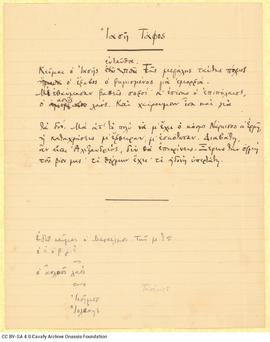
Cavafy, C. P.Handwritten poem ("Tomb of Iases") on the first page of a ruled double sheet notepaper. Cancellations, emendations and notes below the poem. Underlined title and line at the end of the poem. The remaining pages are blank.
Cavafy, C. P.Handwritten text on one side of fourteen numbered large-size sheets. It is a poem by Angelos Sikelianos and an introductory explanatory note, in which other works of his are cited. The handwriting of the main text is not that of Sikelianos, who signs it on the last sheet. Most sheets have been initialed in the bottom.
Sikelianos, AngelosManuscript of the poem "To Stay" on both sides of a ruled sheet. Cancellation and emendation. Notes on the verso below the poem.
Cavafy, C. P.Handwritten musical score on the three pages of a double sheet notepaper. Copy of a composition by George Poniridy for voice and piano, based on the poem "To Pleasure" by Cavafy. The verses of the poem written above the notes.
UnknownManuscript of the poem "To Pleasure" on one side of a ruled sheet. Cancellation and emendation. Notes below the poem. Blank verso. Accompanied by two small pieces of paper with handwritten notes in English, on one side.
Cavafy, C. P.Handwritten prose text by Ioannis Mainaliotis, entitled "To kavafiko ergo" [Cavafy's Work], on the recto of eleven sheets. The text, an extensive analysis of Cavafy's poetic work, is divided into ten units, numbered in Roman numerals. Sheets 2-11 are numbered at top right. Some words and phrases are underlined. Location and date indication as well as the author's signature at the end of the text.
Mainaliotis, IoannisTypewritten poem by M. B. Davies in English; handwritten emendation.
Davies, M. B.Handwritten English translation of the poem "To Antiochus Epiphanes" on both sides of a ruled sheet. Cancellations and emendations. The note "Translation by F. L." in brackets on the verso.
Cavafy, C. P.Typewritten English translation of the poem "For Antiochus Epiphanes". The poem is found twice, on a broadsheet and on the first page of a double sheet notepaper. Handwritten emendations. The note "(Translated by L.F.)" below the poem.
Cavafy, C. P.Manuscript of the poem "Timolaus the Syracusan" and note on both sides of a sheet. Line numbering in the margin. The title has been underlined and there is a line in red ink at the end of the poem. On the verso, the note: "Published in the aig. imerologion of G. V. Tsokopoulos, 1895". Cancellations and emendations. The main text has most likely been transcribed by Cavafy’s brother, Aristeidis Cavafy.
Cavafy, C. P.Handwritten draft of the poem "Tigranocerta" on two sheets. The verso of the second sheet is blank. Handmade folder with the handwritten title and date.
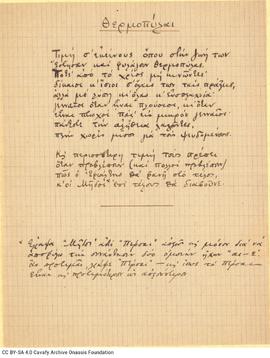
Cavafy, C. P.Manuscript of the poem "Thermopylae" on one side of a sheet. The title has been underlined and there is a line in red ink at the end of the poem. At the bottom of the page, explanatory note (instruction) regarding the choice of specific words in order to avoid hiatus.
Cavafy, C. P.Manuscript of the poem "Theophilus Palaeologus", written in pencil on one side of a sheet. Accompanied by four pieces of paper with notes (mostly short quotes from historical publications on the fall of Constantinople and bibliographical references).
Cavafy, C. P.Autograph manuscript of the poem "Theodotus" on the first page of a ruled double sheet notepaper. The remaining pages are blank. Cancellation and emendation. Handwritten notes on the same page, on the recto of a sheet and on the recto of three pieces of paper, the last two of which bear numbers (2, 3) and date at top right ("3.10.'11").
Cavafy, C. P.Handwritten text in English on both sides of a sheet. It is a translation of the poem "Theodotus". At the end of the text, John Cavafy is mentioned as the translator.
Cavafy, C. P.Manuscript of the poem "Their Beginning" in the first page of a ruled double sheet notepaper. Variations, marked "Variantes", below the poem. The remaining pages are blank.
Cavafy, C. P.Two theatre tickets for a performance by the Tavoularis-Pantopoulos United Troupes. They bear an embossed state seal with date indication. Seat numbers "365" and "367".
[Inomenoi Thiasoi Tavoulari-Pantopoulou (Tavoularis-Pantopoulos United Troupes)]Four printed theatre programmes of amateur performances in theatres of Alexandria (Alhambra, Concordia, (Ex-) Union Artistique Française). Two of the programmes bear date indications (1921 and 1923). Alekos Singopoulo and Rica Agallianou (later Singopoulo) participate in some of the plays. One of the performances included a stage adaptation of the poem by Cavafy "An Old Man" (referred to as "The Old Man") . The performance is dated to 1924, on the basis of a publication by N. Giokarinis in the newspaper Tachydromos of Alexandria.
Ex-Union Artistique FrançaiseTwo copies of the theatre programme of the Royal Lyceum Theatre in London for the play Madame Sans-Gêne by Victorien Sardou and Émile Moreau under the artistic direction of Henry Irving. The adaptation of the play was undertaken by J. Comyns Carr.
Royal Lyceum Theatre (London)Theatre programme by the Empire Theatre of Varieties in London. Advertisements inside the programme as well as an inserted theatre ticket. On the front cover are the names of the artistic directors.
The Empire Theatre of Varieties (London)Four-page theatre programme issued by the French newspaper L’illustration on the theatrical plays Le Dépit amoureux by Moliere and Le Monde où l’on s’ennuie by Édouard Pailleron at the theatre Comédie Française. Portrait of the French actress Suzanne Reichenberg on the front cover. There are 2 inserted tickets from the Royal Lyceum Theatre of London.
L’illustration (newspaper)Two copies of a four-page theatrical programme issued by the French newspaper L’illustration for the plays Le Joie fait peur by Mme Émile [Delphine] de Girardin and Le Barbier de Séville by Pierre-Augustin Caron de Beaumarchais at the Comédie Française theatre. On the front cover, portrait of the French actor Coquelin Cadet (Alexandre Honoré Ernest Coquelin).
L’illustration (newspaper)Theatre programme issued by the French newspaper L’illustration for the play Faust by Jules Barbier and Michel Carré at Opéra de Paris. Portrait of the French actress Lucy Berthet on the front cover. Advertisements on back cover and inside the programme.
L’illustration (newspaper)Theatre programme issued by the French newspaper L’illustration for the plays at Théâtre du Palais-Royal in Paris. Information on the actors and contributors of the play Le Dindon by Georges Feydeau. The price of the programme is on the front cover: “Dix Centimes”.
L’illustration (newspaper)Theatre programme issued by the French newspaper L’illustration for the plays at Théâtre de l’Ambigu-Comique in Paris. Information on the actors and contributors of the play Les Deux Gosses by Pierre Decourcelle. The price of the programme is on the front cover: “Dix Centimes”.
L’illustration (newspaper)Theatre programme issued by the French newspaper L’illustration for the plays at Théâtre du Gymnase in Paris. Information on the actors and contributors of the play La carrière by Abel Hermant. The price of the programme is on the front cover: “Dix Centimes”.
L’illustration (newspaper)Theatre programme issued by the French newspaper L’illustration for the plays at Théâtre du Vaudeville in Paris. Information on the plays La Douloureuse by Maurice Donnay and En visite by Henri Lavedan. Advertisements on back cover and inside the pamphlet.
L’illustration (newspaper)Two copies of a four-page theatrical programme issued by the French newspaper L’illustration for the plays L’Autographe by Henri Meilhac and Oedipe roi (Oedipus Rex by Sophocles translated by Jules Lacroix) at the Comédie Française theatre. On the front cover, portrait of the French actor Jean-Sully Mounet.
L’illustration (newspaper)Theatre programme issued by the French newspaper L’illustration for the plays at Théâtre de l’Odéon in Paris. Information on the actors and contributors of the play Le Chemineau by Jean Richepin. The price of the programme is on the front cover: “Dix Centimes”.
L’illustration (newspaper)Four-page concert programme at the venue Alcazar d’Été. The illustrator of the poster, Adolphe Willette, is mentioned on the front cover. The programme is an insert in the French journal Le Courrier français; its details are mentioned on the back cover. The price of the programme is on the front cover: “Quinze Centimes”.
Le Courrier français (journal)Four-page theatre programme of the "Nea Skini" of Konstantinos Christomanos. It refers to the performance of the works Alcestis and The left hand in the Athens Municipal Theatre in 1902. It bears a photograph of the leading actress on the cover and the logo of "Nea Skini" in the upper part of the second page. Festive performance in honour of athletes.
Nea Skini (of Konstantinos Christomanos)