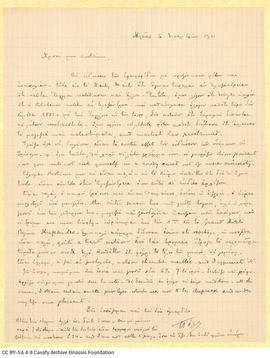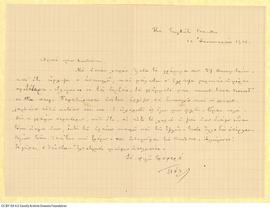
Handwritten letter by Tellos Agras to Rica Singopoulo on both sides of a small paper. He announces his collaboration with the journal *Alexandrini Techni". (Athens)
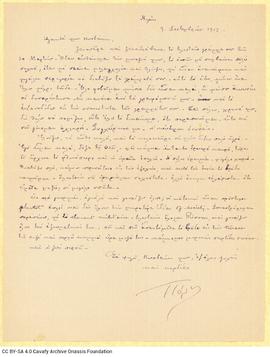
Agras, TellosHandwritten letter by Tellos Agras to Cavafy in a bifolio of the Ministry of Agriculture (the printed details have been crossed out) with notes on all sides. Cavafy's poetic work is commented upon extensively; remarks regarding the publications until that time and reference to poem titles ("Candles", "Waiting for the Barbarians" etc.). Also recorded are the author's views on the genre classification of Cavafy's work as well as his intention to proceed with a relevant publication. (Athens)
Agras, TellosHandwritten letter by Totty Ralli to Cavafy in the first three pages of a bifolio. The last page is blank. Account of a horse race attended by the sender. (Liverpool)
[Ralli], TottyHandwritten letter by Totty Ralli to Cavafy on both sides of a letterhead of the company Ralli & Psicha. Announcement of his return to Alexandria by ship. Social news. (Liverpool)
[Ralli], TottyHandwritten letter by Timos Malanos to Cavafy in the first page of a small-size bifolio. In a short text, the author addresses the poet intensely, commenting on actions that Cavafy attributes to him. Reference to the journal Isis. Accompanied by the envelope which contained the letter with the recipient's name on it.
Malanos, T.Handwritten letter by Timos Malanos to Alekos Singopoulo on one side of a sheet. Blank verso. The sender informs about the publication of an issue of the review Nea Estia commemorating the twentieth anniversary of Cavafy's death; he suggests that a work by the poet is sent for publication, preferably an unpublished one.
[Malanos], TimosHandwritten letter by Timos Malanos to Alekos Singopoulo on one side of a sheet. Blank verso. The sender asks to be sent the luxury edition of Cavafy's poems.
[Malanos], TimosHandwritten letter by Timos Malanos to Alekos Singopoulo, on one side of a sheet. Blank verso. The sender informs about the publication of his study on Cavafy and wonders whether another publication is foreseen for the twenty years since the poet's death.
[Malanos], TimosHandwritten letter by Takis Kalmouchos to Cavafy on both sides of a small paper. He mediates for the despatch of a collection by the poet to a German professor. (Berlin)
Kalmouchos, T.Handwritten letter by Stylianos I. Theocharidis to Cavafy. He expresses his admiration for the work of the poet, which he asks to be sent. (Nicosia)
Theocharidis, Styl. I.Handwritten letter by Stephen Schilizzi to Mike Th. Ralli and Cavafy, on both sides of a sheet. The author refers to his activities as well as to members of his family.
[Schilizzi, Stephen]Handwritten letter by Stephen Schilizzi to Cavafy on all sides of a bifolio. Information about the author's return to Alexandria following his stay in Athens, Tinos and Syros. Commentary on people of their friendly and broader social circle. (Syros)
Schilizzi, S.Handwritten letter by Stephen Schilizzi to Cavafy on both sides of a small-size sheet. Information about the author's departure for Liverpool. References to people of their friendly and broader social circle. Commentary on the cholera epidemic in Egypt. Underlinings; use of a French expression in the flow of written discourse.
Schilizzi, S.Handwritten letter by Stephen Schilizzi to Cavafy on all sides of two bifolios. Detailed description of the author's trip to Scotland with reference to the places he visited (Glasgow, Scottish Lochs, Edinburgh Castle, Glasgow Cathedral). Comments on the development of the cholera epidemic as well as on the Casamicciola earthquake, on the island of Ischia, Italy. Information about people from their family circle as well as the broader social circle of Alexandria. Reference to The Lady of the Lake by W. Scott. Cancellations.
[Schilizzi, Stephen]Handwritten letter by Stephen Schilizzi to Cavafy on all sides of a bifolio. The author expresses his concern regarding the receipt of the correspondence by Cavafy. Commentary on people from their friendly circle as well as from the broader social circle of Alexandria. Cancellations; use of French words and expressions in the flow of written discourse. (Alexandria)
[Schilizzi, Stephen]Handwritten letter by Stephen Schilizzi to Cavafy in three pages of a bifolio. The author expresses his disappointment for the fact that the correspondence is not received in its entirety by Cavafy. Commentary on people from the broader social circle of Alexandria. Reference to the Volos Railroad Station becoming operational. Cancellations and emendations; use of French and Greek words and phrases in the flow of written discourse. (Alexandria)
[Schilizzi, Stephen]Handwritten letter by Stephen Schilizzi to Cavafy on three pages of a bifolio. It is a reply to a letter by the poet. Commentary various issues raised by Cavafy as well as on people and events from the broader social circle of Alexandria. Reference to the arrival of the Greek warship "Navarchos Miaoulis". Cancellations. (Alexandria)
[Schilizzi, Stephen]Handwritten letter by Stephen Schilizzi to Cavafy on all sides of a bifolio. The author refers to the re-opening of the school of Konstantinos Papazis, describing in detail the classes he attends and their syllabus. He comments on persons from his friendly circle and the broader social circle of Alexandria as well as on events related to them; he also expresses his interest in rumours of a war between England and Turkey. He refers to the journal Parnassos and to Lord Byron's Childe Harold's Pilgrimage. Cancellations and emendations. Numbers in pencil at the top of the first page. (Alexandria)
Schilizzi, S.Handwritten diary-type letter by Stephen Schilizzi to Cavafy on all sides of a bifolio and of two loose sheets. Commentary on current affairs (events in honour of Queen Victoria). Reference to individuals from their friendly circle as well as to his everyday life (classes, entertainment). He expresses his discontent for the fact that Cavafy does not share information regarding his personal life, unlike the author, who makes detailed confessions of a personal nature. Cancellations, emendations, underlinings; use of French words in the flow of written discourse. On the verso of the last sheet, notes in pencil in a different handwriting, among which the names "Aristeidis, Peter, John, Alekos" are included. (Alexandria)
Schilizzi, S.Handwritten diary-type letter by Stephen Schilizzi to Cavafy on all sides of two bifolios. The author describes the trip of his return from England to Egypt. He gives detailed information on the sights he visited while in London (Tower of London, St. Paul's Cathedral, Big Ben, The Monument to the Great Fire of London, Houses of Parliament, Westminster Abbey, National Gallery, British Museum, Madame Tussauds Exhibition, The International Fisheries Exhibition) and Paris (Musée des arts et métiers-Conservatoire national des arts et métiers, Notre Dame, Panthéon, Morgue de Paris). Commentary on people from their friendly circle as well as from the broader social circle of Alexandria. Reference to the cholera epidemic in Egypt. Cancellations and additions. The author's initials at the end of the first bifolio. The date "[...] 31st Oct 1883" in the second bifolio.
Schilizzi, S.Handwritten letter by Stephen Schilizzi to Cavafy on two sides of a bifolio. It is a reply to a letter dated 17 February. Information regarding the spectacles offered at that time by an Arabian troupe; reference to the performance "Sarlaman imperador Frangi [or Charlemagne emperor of the French]". Commentary on people from the broader social circle of Alexandria as well as on events related to them. Of note is the use of French words and phrases in the flow of written discourse. (Alexandria)
[Schilizzi, Stephen]Handwritten letter by Stephen Schilizzi to Cavafy on two sides of a bifolio. Explanations regarding the interruption of the correspondence between them. Reference to the death of Victor Hugo and to rumours regarding the outbreak of a cholera epidemic in France. Concern for the possibility of war on the pretext of the Suez Canal. Information about free time activities (hunting) as well as about people from the social circle of Alexandria. (Alexandria)
[Schilizzi, Stephen]Handwritten letter by Stephen Schilizzi to Cavafy on all sides of two bifolios, apart from the last page. It is a reply to a letter by the poet. Extensive commentary on people from their friendly circle as well as from the broader social and political circle of Alexandria and Egypt. Reference to the works of the Indemnity Commission and other current matters, such as the relocation of the seat of the Stock Exchange and the impression caused by the implementation of "electricity" in a public space as well as to entertainment habits, which reflect the mores of the time. Reference, among other things, to the British publications The Peterborough Advertiser; The Norfolk Chronicle [and Norwich Gazette]; [Louth and North] Lincolnshire Advertiser. Cancellations, emendations an additions; use of words and phrases in Greek, French and Latin. (Alexandria)
Schilizzi, S.Handwritten letter by Stephen Schilizzi to Cavafy on all sides of a bifolio. It is a reply to a letter dated 25 June. Extensive commentary on the cholera epidemic that has broken out in Egypt and record of deaths due to the disease. Description of an honorary event attended by the Khedive. Reference to the matter of Cavafy's eyesight as well as to a distinction awarded to a member of his family. Cancellations; use of French and Greek words and phrases in the flow of written discourse. (Alexandria)
Schilizzi, S.Handwritten letter by Stephen Schilizzi to Cavafy on all sides of a bifolio. Commentary on people from their friendly circle and from the broader social circle of Alexandria as well as on relevant events (title of knighthood granted to Konstantinos Zervoudakis). Information about the author's professional activities. Cancellations.
Schilizzi, S.Handwritten letter by Stephen Schilizzi to Cavafy in one sheet two bifolios. The last page is blank. Comments on remarks apparently made by Cavafy in previous letters and expression of the disappointment of the author for the fact that he does not confide personal matters in him. Information about people from the broader social circle of Alexandria as well as about facts related to the life in the city (criminal trial, procession of a dead person with honours paid to him). Reference to the Sudan Campaign. Cancellations, additions; use of Greek and French words and phrases in the flow of written discourse. (Alexandria)
[Schilizzi, Stephen]Handwritten letter by Stephen Schilizzi to Cavafy on all sides of a bifolio. Extensive reference to the issue between the Synadinos family and a bank (Banque Générale) and its financial repercussions. Commentary on people from the broader social circle of Alexandria as well as on events related to them. Reference to newspaper The Egyptian Gazette, as well as to George Ohnet's Lise Fleuron. Cancellations, additions; use of French words and expressions in the flow of written discourse. (Alexandria)
[Schilizzi, Stephen]Handwritten letter by Stephen Schilizzi to Cavafy on all sides of a bifolio and of a small-size loose sheet. It is a reply to a letter dated 31 March. The author proposed to Cavafy the use of an encryption system, in order to protect the content of their correspondence; the letter records the alphabet with the respective cryptographic elements. He provides information about persons of their friendly circle as well as of the broader social circle of Alexandria. He comments on current events, such as the works of the Indemnity Commission and the anniversary celebration of the national independence. He mentions the publications Le Moniteur [égyptien] and Le Phare [d'Alexandrie]. Cancellations, emendations and additions; use of French words and phrases in the flow of written discourse. Note in pencil next to the date indication (question mark and number "3") on the front page of the document. (Alexandria)
Schilizzi, S.Handwritten letter by Stephen Schilizzi to Cavafy on all sides of two bifolios. It is a reply to two letters from December. The author expresses his views on personal remarks made by Cavafy in their previous correspondence, which appear to cause conflict between them. Extensively detailed reference to performances and events he attended while in London ("Bluebeard", "Promenade Concerts", "Iolanthe [or the Peer and the Peri]", "M.P.", "A private wire") and Paris ("Faust", "L'Africaine", "Les Rantzau", "Le jour et la nuit", 'Frou Frou", "Excelsior"). Reference to the cholera epidemic in Egypt and to a fire in the city of Alexandria. Commentary on people from their friendly and broader social circle. Reference to the publications The Egyptian Gazette and Union Egyptienne. Cancellations, underlinings; use of Greek and French words and phrases in the flow of written discourse. (Alexandria)
[Schilizzi, Stephen]Handwritten letter by Stephen Schilizzi to Cavafy on all sides of a bifolio. Extensive reference to remarks apparently made by Cavafy in a previous letter, regarding the contents of the correspondence. Reference to the stay of the Greek warship "Navarchos Miaoulis" in Alexandria as well as to a criminal trial. Cancellations. (Alexandria)
[Schilizzi, Stephen]Handwritten diary-type letter by Stephen Schilizzi to Cavafy on all sides of a bifolio and of one loose sheet. It is a reply to a letter by the poet. The author describes in detail his experience on the island of Tinos (criticising what he observed in the church of the Evangelistria and the domination of the religious element) as well the conditions of his stay on Syros. Description of life in Alexandria after the bombardment; mention of people and events. Reference to the newspaper Omonoia and to Edmond About's La Grèce contemporaine. Cancellations, emendations and additions; use of Greek and French words and phrase in the flow of written discourse. (Alexandria)
Schilizzi, S.Handwritten letter by Stephen Schilizzi to Cavafy on all sides of a bifolio. The author comments on people from his friendly circle and the broader social circle of Alexandria as well as on events related to them. He expresses his views on the political situation in Egypt. He refers, among other things, to the publications of the works Egypt by Baron de Malortie and Arabian Nights: The Book of the Thousand Nights and One Night. He addresses a question to Cavafy regarding his return to Alexandria. Cancellations and emendations. (Alexandria)
Schilizzi, S.Handwritten letter by Stephen Schilizzi and M. Ralli [Mike Th. Ralli] to Cavafy on all sides of two bifolios. The content is divided into two distinct sections, with different authors and dates. It is a reply to a letter by the poet. Commentary on people from their friendly circle as well as from the broader social and political circle of Alexandria and Egypt. Description of social events and happenings. Information about their everyday activities (classes, entertainment). Reference to the newspaper The Egyptian Gazette. Cancellations; use of Greek and French words and phrases in the flow of written discourse. The letters are accompanied by an envelope with the sender's details in French and mail rubber stamps. (Alexandria)
Schilizzi, S.Handwritten letter by Spyros Kontogiannis, Hellenic Navy cadet, to Cavafy in a bifolio with notes on all sides. It is a reply by the sender to a letter he had received from Cavafy. The sender comments on social entartainment in Alexandria and Athens, he mentions his trip to Tunis and asks Cavafy to send him photographs of locals as well as of women. Of note is the frequent use of French words and phrases in the flow of written discourse. (Athens)
Kontogiannis, SpyrosHandwritten letter by Sévastie Verhaeghe de Naeyer, Cavafy's aunt, to the poet. The letter is written in all four pages of a double sheet letterhead, with her first name in print. She proposes to Cavafy and his brother, Aristeidis, to travel and work in China, where they could have a career as customs officials. She details the working conditions and salaries. (Sévastie is in China with her family, as her husband served with the Belgian diplomatic delegation in Shanghai at the time.)
[Verhaeghe de Naeyer], SévastieHandwritten letter by Sévastie Verhaeghe de Naeyer to her nephew, Alexandros (Alekos) Cavafy, in two bifolios with mourning border. The letter has been written onboard, after Sévastie left Egypt, en route to Colombo. She expresses her feelings and her thanks for the hospitality and love of the Cavafy brothers during her stay in Egypt; she hopes that they will visit her in the future. She kindly asks that they convey her warm greetings to the sister, Charikleia.
[Verhaeghe de Naeyer], SévastieHandwritten letter by Samuel Baud-Bovy to Cavafy on both sides of a sheet. He asks the poet to despatch the ensemble of his poetic work for the needs of his university classes. (Geneva)
Baud-Bovy, SamuelHandwritten letter by Sévastie Verhaeghe de Naeyer to her nephew, Paul Cavafy, in two bifolios. Her first name printed on the first page of each bifolio. She mentions her impressions and events from a trip she had taken to Europe as well as personal and family news. The letter is accompanied by a small piece of paper with a handwritten note by Cavafy: "1883 probablement". (Ghent)
[Verhaeghe de Naeyer], SévastieHandwritten letter by Stamatis Kartoulis to Cavafy in two bifolios. Personal news. Reference to the student unions in Germany, where Kartoulis is studying, and to the duels they organise among them. The author also refers to a newspaper of Alexandria, which he does not name (Anonymous of Nikolis Karalis). Interpolated words in German are used. (Halle [an der Saale])
Kartoulis, StamatiosTypewritten letter with handwritten additions, by Richard Dawkins to Rica Singopoulo, on two sheets with notes on all sides. It is a reply to a previous letter by Singopoulo, along with which the sender appears to have also received works by Cavafy. Positive comments on the style and language of Cavafy's poetry and its reception England. Mention of the poet's poor health and his hospitalisation in Athens. In a postscript, Dawkins asks Singopoulo's assistance in locating a publication on Greek popular poetry (Ν. Mavris / E. Papadopoulos, Dodekanisiaki lyra. Tomos protos. Kasiaki lyra, itoi dimodis poiisis kai mousiki tis nisou Kasou. Port Said 1928, print. Nea Icho). The citation, in Greek, is not written by the author, who has made handwritten additions in English. Emendations in the typewritten text. The postscript is written on a smaller piece of paper - it is possible that it was added after the main text had been finalised by its author. (Oxford)
Dawkins, Richard M.Typewritten letter by Richard MacGillivray Dawkins to Cavafy on both sides of a sheet. The signature and some of the emendations are handwritten. Dawkins expresses his admiration for Cavafy's work, which he read from Collections he borrowed from others, and asks the poet to send him his works. (Oxford)
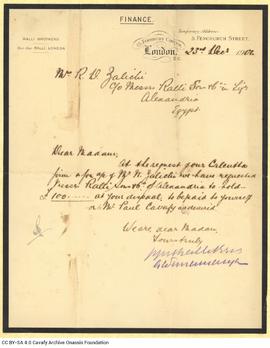
Dawkins, Richard M.Handwritten letter on a letterhead of Ralli Brothers with mourning border to Romylia Zalichi. Reference to a sum of one hundred pounds, collectable by her or Paul Cavafy. (London)
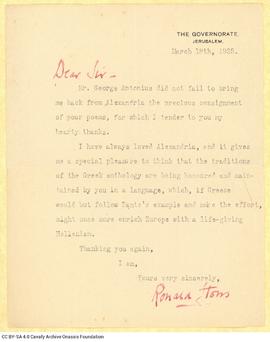
Ralli BrothersTypewritten letter by Ronald Storrs to Cavafy, on one side of a letterhead ("The Governorate" at top right and embossed British blazon at top left). Blank verso. The salutation and signature handwritten in ink. Thanks for the despatch of poems by Cavafy. (Jerusalem)
Storrs, RonaldTypewritten letter by Raymond Queneau to Alekos Singopoulo on one side of a letterhead of the Gallimard publishing house. Blank verso. The sender expresses the interest of the publishing house in undertaking the publication of Cavafy's Collected Works in French. (Paris)
Queneau, RaymondHandwritten letter by Robert Allason Furness to Rica Singopoulo on both sides of a sheet and on the recto of a second sheet, the verso of which is blank. The sender consents to the planned English publication of the poems by Cavafy, for which he says that Mavrogordato has already translated approximately one hundred poems. (Cairo)
Furness, R. A.Typewritten letter by Richard MacGillivray Dawkins to Alekos Singopoulo on both sides of a sheet. The signature and some of the emendations are handwritten. Dawkins thanks Singopoulo for the despatch of Cavafy's poems and refers to a planned publication thereof in English. He expresses himself negatively about a publication by Vlastos, who is attacking Cavafy and his work. (Oxford)
Dawkins, Richard M.Handwritten letter by Raphael Demos to Takis Kalmouchos on both sides of a sheet. The sender, professor of philosophy at Harvard University and translator of Cavafy's poems, asks Kalmouchos to send him a draft printout of the planned publication of the poet's Complete Works. The letter is accompanied by two pages from the journal The New Republic containing the English translations of the poems "Waiting for the Barbarians" and "Thermopylae", together with a brief introduction to the life and work of Cavafy. (Athens)
Demos, RaphaelHandwritten letter by Rae Dalven to Alekos Singopoulo on the recto of two sheets. Blank versos. The second page is numbered. Dalven asks Singopoulo's permission to publish poems by Cavafy in an anthology of modern Greek poetry she is preparing in English. The financial terms are clarified and the titles of twelve poems are mentioned. (New York)
Dalven, RaeHandwritten letter by Robert Allason Furness to Alekos Singopoulo on both sides of a sheet. He asks for a meeting with him in order to discuss the matter of the English publication of Cavafy's poems. (Cairo)
Furness, R. A.Handwritten letter by Polys Modinos to Cavafy in three sheets, with notes to the recto of the last. References to Hubert Pernot –Modinos urges Cavafy to write to him–, to J. Kefalinos, K. Varnalis –for whom there are comments on his personal opinion on K. Palamas– as well as to a poet who wrote a sonnet dedicated to Cavafy and intends to visit him in Alexandria. Extended reference to Miltos Kountouras and the opinion he expressed regarding Cavafy's poetry as well as to Psichari. The sheets are numbered (2, 3). Handwritten note in pencil ("Modinos"). at the end of the text, below the sender's name (Polys). (Paris)
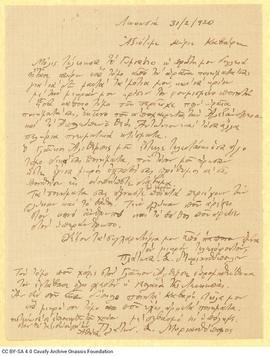
[Modinos], PolysHandwritten letter by Platon S. Myrianthopoulos to Cavafy, in which he expresses his admiration for the poet's work and asks to be sent a volume with his poems. He mentions that he became acquainted with Cavafy's work thanks to Glafkos Alithersis and notes that it is by now widespread amongst the youths of Nicosia, whence he is sending his letter. (31/2/1920 [sic])
Myrianthopoulos, Platon S.Handwritten letter by Photius Fotiadis, uncle of Cavafy (his mother's brother), to Charikleia Cavafy in two bifolios of the Ottoman Empire Healthcare Administration. Update on the health of their sister, Sévastie, who is hospitalised in Paris. Description of the situation in Istanbul and reference to his two sons, George and Constantine. Interpolated words in French. (Istanbul)
Fotiadis, Ph.Handwritten letter by Paul Cavafy to his brother, John, on both sides of a sheet. He refers to the improvement of his health as well as to the prices of commodities in France.
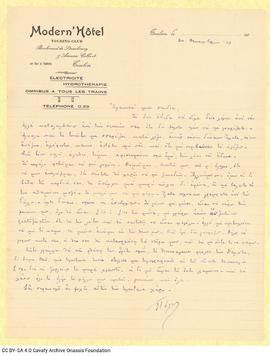
[Cavafy], PaulHandwritten letter by Paul Cavafy from France to C. P. Cavafy and John Cavafy, on both sides of a sheet. Reference to the pension he might receive from the Municipality of Alexandria; extensive commentary, in an apologetic tone, on his lifestyle and the accumulation of debts –which appears to be a point of friction among the brothers– as well as on his health, which does not yet allow him to return to Alexandria. Paul has already been through Marseilles; his current expenses are being covered by a friendly person. He assures his brothers that he will see them again in a month. Of note is the use of English and French words and phrases. (Toulon)
[Cavafy], Polis [Paul]Handwritten letter by Paul Cavafy to John Cavafy on both sides of a sheet. It is a reply to a letter by John, dated 25 February. Commentary on Paul's health and his personal debts. On several occasions, he expresses his refusal to return to Alexandria. Reference to the matter of the pension –he claims that he is considered a beneficiary as of 5 January– and promises to concede his income to C. P. Cavafy, as he intends -after settling his financial obligations- to reside in Boulogne and work there. Despite all that, he repeats his ongoing request for financial assistance. Of note is the use of English and French words and phrases.
[Cavafy], Polis [Paul]Handwritten letter by Paul to John and C. P. Cavafy, on a cut sheet. In a short text, he expresses wishes for the new year and describes the condition of his health.
[Cavafy], Polis [Paul]Handwritten letter by Paul Cavafy from France to C. P. Cavafy and John Cavafy, on both sides of a sheet. Comments on telegrams sent by Paul to his two brothers, on his health and the required medical care; the request for financial assistance is repeated. Reference to the matter of the pension, to Ralli's assistance and to the benefit he hopes to receive – on this particular matter, he urges C. P. Cavafy to seek illness-related documents "on cholera", in order to support the request for a benefit. References to the assistance he received from persons known and unknown. Enclosed is a letter by the hotel owner, L. Vallet (20/2/1909), who is asking Paul to settle his financial obligations to the business. Of note is the use of English and French words and phrases.
Vallet, L.Handwritten letter by Paul Cavafy to his brothers, John and C. P. Cavafy, from Paris, on all sides of a bifolio. In an apologetic tone for the disturbance he has caused to his family, he refers to his stay in Paris and to city landmarks ("Île de la Cité, Notre Dame, Quartier Latin, Louvre"); he expresses fears for his health and, remembering life in Alexandria, he repeats that he intends to return in due time. He comments on the matter of the frequency in which he may disburse his pension, a fact that seems to trouble him. Of note is the use of English and French words and phrases.
[Cavafy], Polis [Paul]Handwritten letter by Paul Cavafy from France to C. P. Cavafy and John Cavafy. It is a continuation of previous letters, in which Paul is trying to change the negative attitude of his brothers towards him. Reference to the matter of his pension and request for a sum of money. (Toulon)
[Cavafy], Polis [Paul]Handwritten letter by Paul Cavafy to C. P. Cavafy and John Cavafy, on both sides of a cut sheet. In a short text he comments on the matter of his pension as well as on his health. Of note is the use of English words and phrases in the flow of written discourse. Accompanied by a document of financial content (stock dividend of The Egyptian Delta Light Railways Limited), in which the letter is referred to, dated 24/12/1908.
[Cavafy], Polis [Paul]Handwritten letter by Paul Cavafy from France to C. P. Cavafy, on a bifolio, with notes on all sides except for the recto of the second sheet. Reference to his dire financial situation and to a remittance he received from his service in Alexandria (Municipality). Extensive commentary on his poor health. It is noted that the letter is addressed to John Cavafy. Of note is the use of English and French words and phrases. (Paris)
[Cavafy], Polis [Paul]Handwritten letter by Paul to Constantine Cavafy with date indication ("presumably 24/2/1909"), which is noted in pencil by the poet himself. The text continues on the verso. References to his poor health. The request for financial assistance is repeated, as is the mention of the matter of the pension, of Ralli's assistance and of a benefit he hopes to receive.
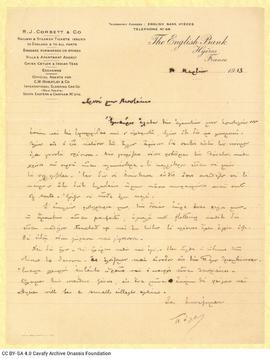
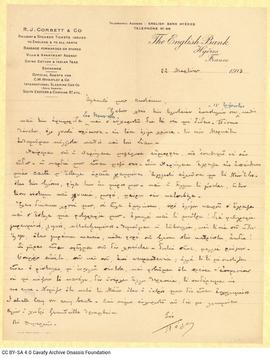
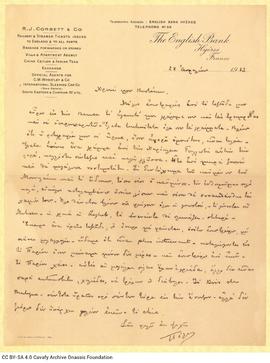
[Cavafy], Polis [Paul]Handwritten letter by Paul Cavafy to C. P. Cavafy from Hyères, France, on a small-sized sheet: one side records the content of the letter and the other the recipient's details. Reference to a positive development regarding the matter of his pension, as well as to the benefit he has requested which, according to Ralli, will be used to pay off his debts. Of note is the use of English and French words and phrases. The document bears a postage stamp and mail service rubber stamps (Hyères, Port Said – Alexandria). The address is written in French; number 10 is noted in pencil.
[Cavafy], Polis [Paul]Handwritten letter by Paul Cavafy to C. P. Cavafy from Hyères, France, according to the notepaper, on all sides of two bifolios and one sheet. Page numbers in pencil in the margin "1" through "9" (number "4" is repeated twice). Paul comments extensively on his dire financial situation, his debts and the matter of his pension, referring also to his impaired health. He asks C. P. Cavafy to communicate with him and help him. His intensifying stress is highlighted by the use of capital letters and underlining in parts of the text. Of note is the use of English and French words and phrases. (Hyères)
[Cavafy], Polis [Paul]Handwritten letter by Paul Cavafy to C. P. Cavafy from Hyères, France, on both sides of a sheet. Paul mentions that he has received two letters from the poet, as well as an amount of money he sent him. He comments extensively on the developments regarding his financial issues and on the matter of the pension. From the content it is surmised that he is still in Hyères, from where he describes his difficult living conditions. He refers to his impaired health and expresses his love for his two brothers. Of note is the use of English and French words and phrases. (Hyères)
[Cavafy], P[aul]Handwritten letter by Paul Cavafy to C. P. Cavafy from Hyères, France, according to the printed details of the sheet and the sender's address ("Hôtel d’Europe"). On one side of a small-size sheet, the text and on the other the sender's details. Paul expresses his concern regarding the fact that he has not received a letter from C. P. Cavafy in the last two months. The document bears postage stamps and mail service rubber stamps (Hyères, Port Said – Alexandria); the address written in French and the indication "18A" in pencil. (Hyères)
[Cavafy], Polis [Paul]Handwritten letter by Paul Cavafy to C. P. Cavafy from Hyères, France, on both sides of a sheet. Paul expresses his concern, as he has not received correspondence from the poet. Subsequently, he informs him about the state of his health and about details of his social life, referring to high-society individuals with whom he consorts. Of note is the frequent use of English and French words and phrases in the flow of written discourse. (Hyères)
[Cavafy], Polis [Paul]Handwritten letter by Paul Cavafy to C. P. Cavafy from Florence, Italy, according to the letterhead, on both sides of a sheet folded into a bifolio. Paul informs his brother, Constantine, of the trip he is making to Italy, accompanying an English family. He describes the places and landmarks he has visited; he refers to artists whose works he saw in Italy and provides information on the rest of his tour schedule. Of note is the use of French words and phrases in the flow of written discourse. (Florence)
[Cavafy], Polis [Paul]Handwritten diary-type letter by Paul Cavafy to C. P. Cavafy from Hyères, France, on both sides of two sheets. The letter is written on three different days, marked separately. In the first part, Paul expresses his nostalgia for his family and, on the occasion of the news from Alexandria he reads in the Press sent by the poet, he refers to various individuals (Zervoudakis, etc.) expressing his opinion either on their overall activities or on current events. In the rest of the letter he describes the state of general De Horsey's health, gives information on his family in England and describes his way of living. Of note is the frequent use of English and French words and phrases in the flow of written discourse. (Hyères)
[Cavafy], Polis [Paul]Handwritten letter by Paul Cavafy to C. P. Cavafy from Hyères, France, according to the letterhead. Paul refers to the deaths of people they both knew and expresses his own fear of dying. He informs the poet that he encloses a photograph of his. Finally, he comments on the liberation of Ioannina, as the First Balkan War is in progress. Of note is the use of English words and phrases in the flow of written discourse. (Hyères)
[Cavafy], Polis [Paul]Handwritten letter by Paul Cavafy to C. P. Cavafy from Hyères, France, according to the letterhead. Paul comments on his health, expressing his concern, while he refers nostalgically to members of their family. (Hyères)
[Cavafy], Polis [Paul]Handwritten letter by Paul Cavafy to C. P. Cavafy from Hyères, France, according to the letterhead. Paul refers to members of family and to friends, and comments on his recent visit to Paris. Of note is the use of French words and phrases in the flow of written discourse. (Hyères)
[Cavafy], Polis [Paul]Handwritten letter by Paul Cavafy to C. P. Cavafy from Hyères, France, on all sides of a bifolio. It is a reply to a letter by the poet, dated 24 July. Paul comments on issues apparently mentioned by C. P. Cavafy, such as his absence from his work and his health problems, and describes his own situation in detail. He also refers to people they both know in Alexandria and informs him of a book he published as well as of his intention to broaden his journalistic activity. Of note is the use of English words and phrases in the flow of written discourse. (Hyères)
[Cavafy], Polis [Paul]Handwritten letter by Paul Cavafy to C. P. Cavafy from Hyères, France, according to the letterhead. Paul refers to members of the family and wants to learn their news; he briefly describes what he did in the time since his last letter and repeats his request for the despatch of his personal notes (diaries). Of note is the use of English words and phrases in the flow of written discourse. (Hyères)
[Cavafy], Polis [Paul]Handwritten letter by Paul Cavafy to C. P. Cavafy from Hyères, France, on both sides of a sheet. Reference to Paul's change of residence after the death of general De Horsey as well as to his short trip to Marseilles. Commentary on his health. Of note is the frequent use of English words and phrases in the flow of written discourse. (Hyères)
[Cavafy], Polis [Paul]Handwritten letter by Paul Cavafy to C. P. Cavafy from Hyères, France. He expresses his worry about the interruption of the correspondence between the two brothers as well as his concern about securing his pension, on the occasion of events in Egypt.
[Cavafy], Polis [Paul]Handwritten letter by Paul Cavafy to C. P. Cavafy from Hyères, France, on both sides of a cut sheet. Update on his health and expression of gratitude to his brother, Constantine. According to the text, C. P. Cavafy sent a letter to Paul (14 January 1918), which had not been received.
[Cavafy], Polis [Paul]Handwritten letter by Paul Cavafy from England to C. P. Cavafy, on a cut sheet with notes on both sides. He informs his brother of his overall situation, which is characterised as disappointing and correlates to the purpose of his trip. He mainly refers to his hospitalisation, which impeded his departure, while he assures him that he will return to Alexandria. Of note is the use of English words and phrases. Date indication in pencil ("7.7.08").
[Cavafy], Polis [Paul]Handwritten, diary-type letter by Paul Cavafy from France to C. P. Cavafy, on two sheets with notes on all sides. In the first part (5 January) Paul's intention to depart from France on the following day is expressed, provided he receives financial assistance from C. P. Cavafy, in order to pay off his debts there. In the second part (6 January, morning and noon) the content changes and there are comments on his dire financial situation; he promises C. P. Cavafy to authorise him as proxy to his pension and to seek employment with a journal or newspaper in order to secure an income. In the letter, Paul very often also addresses John, while he mentions the assistance of Ralli and a benefit he hopes to receive – on this particular matter, he urges C. P. Cavafy to seek certificates, in order to support the request for a benefit. Of note is the use of English and French words and phrases. (Toulon)
[Cavafy], Polis [Paul]Handwritten letter by Paul Cavafy to C. P. Cavafy from Hyères, France, on both sides of a sheet. Comments on his dire financial situation; he asks for his brother's help and refers to the pension he is waiting to receive. He also refers to Aristeidis and Alexandros (Alekos) Cavafy highlighting their absence.
[Cavafy], Polis [Paul]Handwritten diary-type letter by Paul Cavafy to C. P. Cavafy from Hyères, France. The text of the letter is written in two sections, one of which is a bifolio and the other a sheet written on the recto. Paul has received a letter from C. P. Cavafy and in the first part (6 April) he comments on health and debts and provides an update on his pension (as reported by Ralli); he promises to return to Alexandria. In the second part (7 April), he refers to a notice he received regarding his pension and quotes it in French. Of note is the use of French words and phrases.
[Cavafy], Polis [Paul]Handwritten letter by Paul Cavafy to C. P. Cavafy on both sides of a sheet. Paul comments on his dire financial situation and his debts. From the content it is surmised that he is still in Hyères, France. He expresses his concern for the fact that he is still to receive his pension, while he stresses that he is alone and that his health is impaired. Of note is the use of English and French words and phrases. (Hyères)
[Cavafy], P[aul]Handwritten letter by Paul Cavafy to C. P. Cavafy on both sides of a sheet. Paul expresses his concern for the fact that he is still to receive a remittance with his pension as well as his fear that it might have been seized by his creditors, and gives the poet detailed instructions regarding this matter. From the content it is surmised that he is still in France. Of note is the use of English words and phrases.
[Cavafy], P[aul]Handwritten diary-type letter by Paul Cavafy to C. P. Cavafy from Paris, according to the letterhead, on five sheets, two of which are bifolios. The text is completed gradually on different days and at different times of the day, all of which are noted. It is a long letter, in which Paul informs the poet of his very poor financial situation and asks him to assist him and help him with any procedures that might be necessary for him to escape the impasse he is in. The style of the text is highly charged and intense. There are several mentions of Paul's poverty and hunger as well as of people he intends to approach for assistance. Additions in the margin and page numbering ("1" through "13") in pencil. Of note is the use of English and French words and phrases.
[Cavafy], Polis [Paul]Handwritten letter by Paul Cavafy to C. P. Cavafy from Hyères, France. Paul refers to riots in Alexandria and the intervention of the English, and expresses his concern for his brothrer. Update on his living conditions and his activities in Hyères as well as on his health. Of note is the use of English and French words and phrases in the flow of written discourse. (Hyères)
[Cavafy], Polis [Paul]Handwritten letter by Paul Cavafy to C. P. Cavafy from Hyères, France, dated "23 April 1912", in three of the pages of a bifolio. It is a reply to a letter he had received from Cavafy. Paul describes the conditions of his trip to Italy and the comforts he had enjoyed, while he repeats his admiration for the places he visited and the monuments and works of arts he saw. He concludes with references to technological developments. Of note is the use of English and French words and phrases in the flow of written discourse.
[Cavafy], Polis [Paul]Handwritten letter by Paul Cavafy to C. P. Cavafy from Hyères, France, on all sides of a bifolio. It is a reply to a letter by the poet. He informs him of his plans to stay in L'Almanarre as escort to general De Horsey for a few more months and extensively comments on developments regarding his former service with the Municipality of Alexandria, referring to individuals. He expresses his strong interest in the issue, urging C. P. Cavafy to send him newspapers, so that he may receive information. Of note is the use of English and French words and phrases in the flow of written discourse. (Hyères)
[Cavafy], Polis [Paul]Handwritten letter by Paul Cavafy to C. P. Cavafy from Hyères, France, on both sides of a sheet. Paul comments extensively on matters and individuals related to his prior service with the Municipality of Alexandria; he urges his brother to visit him. Of note is the use of French words and phrases in the flow of written discourse. (Hyères)
[Cavafy], Polis [Paul]Handwritten letter by Paul Cavafy to C. P. Cavafy from Hyères, France, on three pages of a small-sized four-page leaflet. Paul expresses his appreciation for Ambrose Ralli, on the occasion of his death. He informs C. P. Cavafy of his health and assures him, following a remark by the poet, that in the future he will address all correspondence to him using the initials "C.P.", rather than "C. F[otiadi]". Of note is the use of French words and phrases in the flow of written discourse. (Hyères)
[Cavafy], Polis [Paul]Handwritten letter by Paul Cavafy to C. P. Cavafy from Hyères, France, according to the letterhead. Paul refers to his health and informs him that he has returned from L'Almanarre. He also comments on the death of common acquaintances. Of note is the use of English words and phrases in the flow of written discourse. (Hyères)
[Cavafy], Polis [Paul]Handwritten letter by Paul Cavafy to C. P. Cavafy from Hyères, France, according to the letterhead. Paul refers to members of family and to friends. Of note is the use of French words and phrases in the flow of written discourse. (Hyères)
[Cavafy], Polis [Paul]Handwritten letter by Paul Cavafy to C. P. Cavafy from Hyères, France, on both sides of a letterhead. It is a reply to a letter by the poet. Paul conveys his strong impressions from his experience of observing an airplane (biplane) flight; he comments extensively on issues relating to their family and to their social circle - mostly individuals from his prior service with the Municipality of Alexandria. He refers to his personal diaries, which apparently are gradually sent by C. P. Cavafy, and informs him on his trips and his stay at a seaside place in the area. Of note is the use of English and French words and phrases in the flow of written discourse. (Hyères)
[Cavafy], Polis [Paul]Handwritten letter by Paul Cavafy to C. P. Cavafy from Hyères, France, according to the letterhead, on both sides of two sheets. It is a reply to a letter by the poet, dated 30 September. Arguments raised by Paul in favour of his stay in France, contrary to the suggestion of John Cavafy to return to Alexandria. Comments on World War I events, which is still in progress, and are linked to the previous subject. Reference to members of their family; Paul thanks C. P. Cavafy for intervening in a matter regarding Paul's pension. Of note is the use of English and French words and phrases in the flow of written discourse. (Hyères)
[Cavafy], Polis [Paul]Handwritten letter by Paul Cavafy to C. P. Cavafy from Hyères, France, according to the letterhead, on two sheets, to the recto of the second. It is a reply to a letter by the poet, dated 19 November. Paul comments on World War I; mention of problems and delays regarding the remittance of his pension; interest in individuals from their family circle; detailed account of his everyday life. Of note is the frequent use of English and French words and phrases in the flow of written discourse. A small part of the text is written entirely in French. (Hyères)
[Cavafy], Polis [Paul]Handwritten letter by Paul Cavafy to C. P. Cavafy from Hyères, France, according to the letterhead, dated "27 April 1915". The largest part of the letter is devoted to the news regarding the death of general De Horsey, at whose service Paul Cavafy was, and the consequences of the event on himself. Paul is no longer worried about the interruption in the correspondence with his brother, C. P. Cavafy, after a letter he received from his niece, Charikleia. Of note is the use of English words and phrases in the flow of written discourse. (Hyères)
[Cavafy], Polis [Paul]Handwritten letter by Paul Cavafy to C. P. Cavafy from France. It is a reply to a letter by C. P. Cavafy, dated 27 December. In a short text, he expresses his joy for communicating with his brother as well as his fear for old age and death. Of note is the frequent use of English words and phrases in the flow of written discourse.
[Cavafy], Polis [Paul]Handwritten diary-type letter by Paul Cavafy to C. P. Cavafy from Hyères, France, written over three days, in a bifolio with notes on all sides. It is a reply to a letter by C. P. Cavafy, dated 26 March. Commentary on subjects and individuals apparently mentioned in the letter by C. P. Cavafy. Account of Paul's everyday life after the death of general De Horsey, with references to his financial situation and to his plan to publish a newspaper, which was postponed due to the war. He informs his brother about his membership in a club (Circle d’agriculture) and the opportunity he has to use the library - he is presently reading the comedies The Wasps and The Clouds by Aristophanes, as well as Les Caractères by La Bruyère. Finally, on the occasion of a trip he made to Nice and Monte Carlo, he provides information on the common acquaintances he met there. Of note is the frequent use of English and French words and phrases in the flow of written discourse.
[Cavafy], Polis [Paul]Handwritten letter by Paul Cavafy to C. P. Cavafy from Hyères, France, on both sides of a sheet. It is a reply to a letter by C. P. Cavafy, dated 24 July. Paul comments on the news of individuals he probably learned through his brother and expresses nostalgia for the life of Alexandria. He refers to the matter of his return to Egypt and asks that his brother intervenes so as to confirm the remittance of his pension. Of note is the use of English and French words and phrases in the flow of written discourse. Line in blue pencil in the margin of the last paragraph. Small piece of paper with handwritten notes (possibly names) by C. P. Cavafy attached to the letter.
[Cavafy, C. P.]Handwritten letter by Paul Cavafy to C. P. Cavafy from Hyères, France, on one side of a sheet. Concern for the interruption in the correspondence between the two brothers – last letter by C. P. Cavafy on 30 March. He describes his everyday life in Hyères and his social encounters. Of note is the use of French words and phrases in the flow of written discourse.
[Cavafy], Polis [Paul]Handwritten letter by Paul Cavafy to C. P. Cavafy from Hyères, France, on a small-size paper. The text continues on the verso. He expresses his relief about the end of World War I. He refers to his health, while he also mentions the matter of his pension. Handwritten note in pencil, in the text margin.
[Cavafy], Polis [Paul]