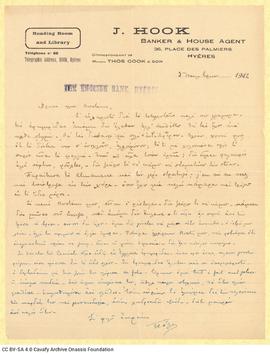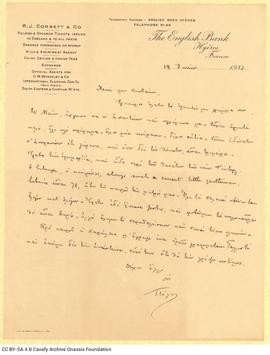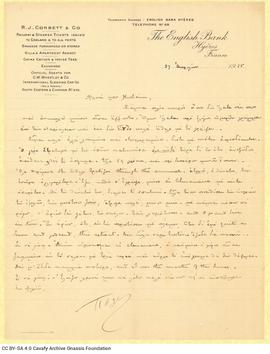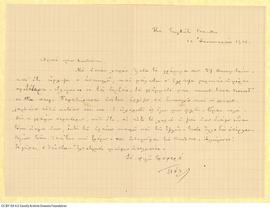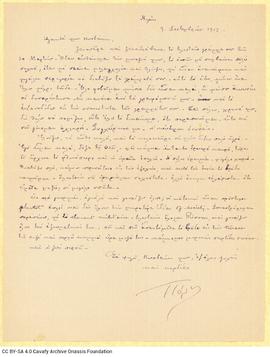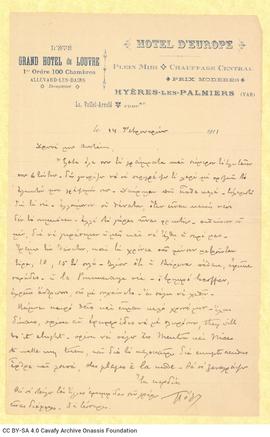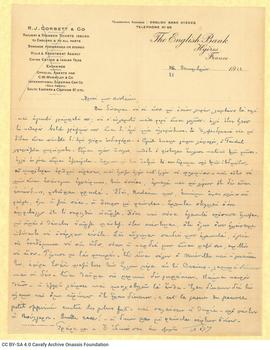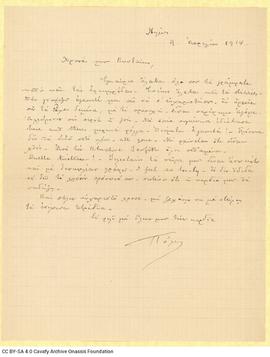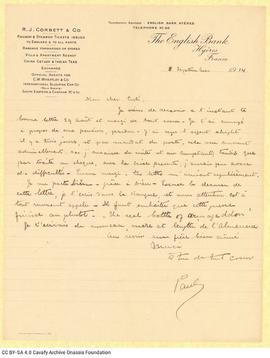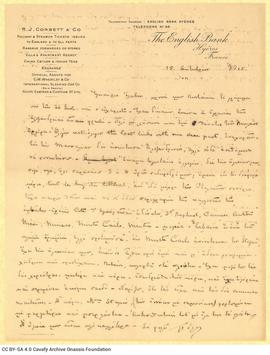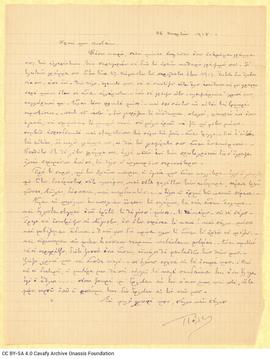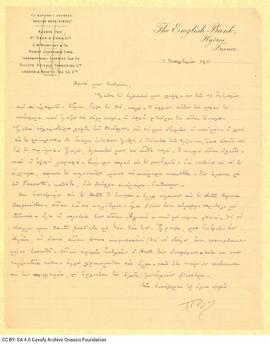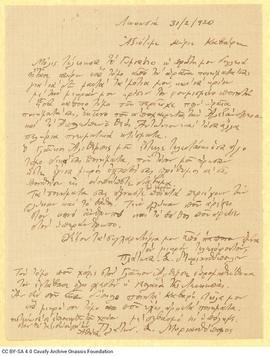
Handwritten letter by Paul Cavafy from France to C. P. Cavafy and John Cavafy. It is a continuation of previous letters, in which Paul is trying to change the negative attitude of his brothers towards him. Reference to the matter of his pension and request for a sum of money. (Toulon)
[Cavafy], Polis [Paul]Letter
692 Archival description results for Letter
Handwritten letter by Paul Cavafy to C. P. Cavafy and John Cavafy, on both sides of a cut sheet. In a short text he comments on the matter of his pension as well as on his health. Of note is the use of English words and phrases in the flow of written discourse. Accompanied by a document of financial content (stock dividend of The Egyptian Delta Light Railways Limited), in which the letter is referred to, dated 24/12/1908.
[Cavafy], Polis [Paul]Handwritten letter by Paul Cavafy from France to C. P. Cavafy, on a bifolio, with notes on all sides except for the recto of the second sheet. Reference to his dire financial situation and to a remittance he received from his service in Alexandria (Municipality). Extensive commentary on his poor health. It is noted that the letter is addressed to John Cavafy. Of note is the use of English and French words and phrases. (Paris)
[Cavafy], Polis [Paul]Handwritten letter by Paul to Constantine Cavafy with date indication ("presumably 24/2/1909"), which is noted in pencil by the poet himself. The text continues on the verso. References to his poor health. The request for financial assistance is repeated, as is the mention of the matter of the pension, of Ralli's assistance and of a benefit he hopes to receive.
[Cavafy], Polis [Paul]Handwritten letter by Paul Cavafy to C. P. Cavafy from Hyères, France, on a small-sized sheet: one side records the content of the letter and the other the recipient's details. Reference to a positive development regarding the matter of his pension, as well as to the benefit he has requested which, according to Ralli, will be used to pay off his debts. Of note is the use of English and French words and phrases. The document bears a postage stamp and mail service rubber stamps (Hyères, Port Said – Alexandria). The address is written in French; number 10 is noted in pencil.
[Cavafy], Polis [Paul]Handwritten letter by Paul Cavafy to C. P. Cavafy from Hyères, France, according to the notepaper, on all sides of two bifolios and one sheet. Page numbers in pencil in the margin "1" through "9" (number "4" is repeated twice). Paul comments extensively on his dire financial situation, his debts and the matter of his pension, referring also to his impaired health. He asks C. P. Cavafy to communicate with him and help him. His intensifying stress is highlighted by the use of capital letters and underlining in parts of the text. Of note is the use of English and French words and phrases. (Hyères)
[Cavafy], Polis [Paul]Handwritten letter by Paul Cavafy to C. P. Cavafy from Hyères, France, on both sides of a sheet. Paul mentions that he has received two letters from the poet, as well as an amount of money he sent him. He comments extensively on the developments regarding his financial issues and on the matter of the pension. From the content it is surmised that he is still in Hyères, from where he describes his difficult living conditions. He refers to his impaired health and expresses his love for his two brothers. Of note is the use of English and French words and phrases. (Hyères)
[Cavafy], P[aul]Handwritten letter by Paul Cavafy to C. P. Cavafy from Hyères, France, according to the printed details of the sheet and the sender's address ("Hôtel d’Europe"). On one side of a small-size sheet, the text and on the other the sender's details. Paul expresses his concern regarding the fact that he has not received a letter from C. P. Cavafy in the last two months. The document bears postage stamps and mail service rubber stamps (Hyères, Port Said – Alexandria); the address written in French and the indication "18A" in pencil. (Hyères)
[Cavafy], Polis [Paul]Handwritten letter by Paul Cavafy to C. P. Cavafy from Hyères, France, on both sides of a sheet. Paul expresses his concern, as he has not received correspondence from the poet. Subsequently, he informs him about the state of his health and about details of his social life, referring to high-society individuals with whom he consorts. Of note is the frequent use of English and French words and phrases in the flow of written discourse. (Hyères)
[Cavafy], Polis [Paul]Handwritten letter by Paul Cavafy to C. P. Cavafy from Florence, Italy, according to the letterhead, on both sides of a sheet folded into a bifolio. Paul informs his brother, Constantine, of the trip he is making to Italy, accompanying an English family. He describes the places and landmarks he has visited; he refers to artists whose works he saw in Italy and provides information on the rest of his tour schedule. Of note is the use of French words and phrases in the flow of written discourse. (Florence)
[Cavafy], Polis [Paul]Handwritten diary-type letter by Paul Cavafy to C. P. Cavafy from Hyères, France, on both sides of two sheets. The letter is written on three different days, marked separately. In the first part, Paul expresses his nostalgia for his family and, on the occasion of the news from Alexandria he reads in the Press sent by the poet, he refers to various individuals (Zervoudakis, etc.) expressing his opinion either on their overall activities or on current events. In the rest of the letter he describes the state of general De Horsey's health, gives information on his family in England and describes his way of living. Of note is the frequent use of English and French words and phrases in the flow of written discourse. (Hyères)
[Cavafy], Polis [Paul]Handwritten letter by Paul Cavafy to C. P. Cavafy from Hyères, France, according to the letterhead. Paul refers to the deaths of people they both knew and expresses his own fear of dying. He informs the poet that he encloses a photograph of his. Finally, he comments on the liberation of Ioannina, as the First Balkan War is in progress. Of note is the use of English words and phrases in the flow of written discourse. (Hyères)
[Cavafy], Polis [Paul]Handwritten letter by Paul Cavafy to C. P. Cavafy from Hyères, France, according to the letterhead. Paul comments on his health, expressing his concern, while he refers nostalgically to members of their family. (Hyères)
[Cavafy], Polis [Paul]Handwritten letter by Paul Cavafy to C. P. Cavafy from Hyères, France, according to the letterhead. Paul refers to members of family and to friends, and comments on his recent visit to Paris. Of note is the use of French words and phrases in the flow of written discourse. (Hyères)
[Cavafy], Polis [Paul]Handwritten letter by Paul Cavafy to C. P. Cavafy from Hyères, France, on all sides of a bifolio. It is a reply to a letter by the poet, dated 24 July. Paul comments on issues apparently mentioned by C. P. Cavafy, such as his absence from his work and his health problems, and describes his own situation in detail. He also refers to people they both know in Alexandria and informs him of a book he published as well as of his intention to broaden his journalistic activity. Of note is the use of English words and phrases in the flow of written discourse. (Hyères)
[Cavafy], Polis [Paul]Handwritten letter by Paul Cavafy to C. P. Cavafy from Hyères, France, according to the letterhead. Paul refers to members of the family and wants to learn their news; he briefly describes what he did in the time since his last letter and repeats his request for the despatch of his personal notes (diaries). Of note is the use of English words and phrases in the flow of written discourse. (Hyères)
[Cavafy], Polis [Paul]Handwritten letter by Paul Cavafy to C. P. Cavafy from Hyères, France, on both sides of a sheet. Reference to Paul's change of residence after the death of general De Horsey as well as to his short trip to Marseilles. Commentary on his health. Of note is the frequent use of English words and phrases in the flow of written discourse. (Hyères)
[Cavafy], Polis [Paul]Handwritten letter by Paul Cavafy to C. P. Cavafy from Hyères, France. He expresses his worry about the interruption of the correspondence between the two brothers as well as his concern about securing his pension, on the occasion of events in Egypt.
[Cavafy], Polis [Paul]Handwritten letter by Paul Cavafy to C. P. Cavafy from Hyères, France, on both sides of a cut sheet. Update on his health and expression of gratitude to his brother, Constantine. According to the text, C. P. Cavafy sent a letter to Paul (14 January 1918), which had not been received.
[Cavafy], Polis [Paul]Handwritten, diary-type letter by Paul Cavafy from France to C. P. Cavafy, on two sheets with notes on all sides. In the first part (5 January) Paul's intention to depart from France on the following day is expressed, provided he receives financial assistance from C. P. Cavafy, in order to pay off his debts there. In the second part (6 January, morning and noon) the content changes and there are comments on his dire financial situation; he promises C. P. Cavafy to authorise him as proxy to his pension and to seek employment with a journal or newspaper in order to secure an income. In the letter, Paul very often also addresses John, while he mentions the assistance of Ralli and a benefit he hopes to receive – on this particular matter, he urges C. P. Cavafy to seek certificates, in order to support the request for a benefit. Of note is the use of English and French words and phrases. (Toulon)
[Cavafy], Polis [Paul]Handwritten letter by Paul Cavafy to C. P. Cavafy from Hyères, France, on both sides of a sheet. Comments on his dire financial situation; he asks for his brother's help and refers to the pension he is waiting to receive. He also refers to Aristeidis and Alexandros (Alekos) Cavafy highlighting their absence.
[Cavafy], Polis [Paul]Handwritten diary-type letter by Paul Cavafy to C. P. Cavafy from Hyères, France. The text of the letter is written in two sections, one of which is a bifolio and the other a sheet written on the recto. Paul has received a letter from C. P. Cavafy and in the first part (6 April) he comments on health and debts and provides an update on his pension (as reported by Ralli); he promises to return to Alexandria. In the second part (7 April), he refers to a notice he received regarding his pension and quotes it in French. Of note is the use of French words and phrases.
[Cavafy], Polis [Paul]Handwritten letter by Paul Cavafy to C. P. Cavafy on both sides of a sheet. Paul comments on his dire financial situation and his debts. From the content it is surmised that he is still in Hyères, France. He expresses his concern for the fact that he is still to receive his pension, while he stresses that he is alone and that his health is impaired. Of note is the use of English and French words and phrases. (Hyères)
[Cavafy], P[aul]Handwritten letter by Paul Cavafy to C. P. Cavafy on both sides of a sheet. Paul expresses his concern for the fact that he is still to receive a remittance with his pension as well as his fear that it might have been seized by his creditors, and gives the poet detailed instructions regarding this matter. From the content it is surmised that he is still in France. Of note is the use of English words and phrases.
[Cavafy], P[aul]Handwritten diary-type letter by Paul Cavafy to C. P. Cavafy from Paris, according to the letterhead, on five sheets, two of which are bifolios. The text is completed gradually on different days and at different times of the day, all of which are noted. It is a long letter, in which Paul informs the poet of his very poor financial situation and asks him to assist him and help him with any procedures that might be necessary for him to escape the impasse he is in. The style of the text is highly charged and intense. There are several mentions of Paul's poverty and hunger as well as of people he intends to approach for assistance. Additions in the margin and page numbering ("1" through "13") in pencil. Of note is the use of English and French words and phrases.
[Cavafy], Polis [Paul]Handwritten letter by Paul Cavafy to C. P. Cavafy from Hyères, France. Paul refers to riots in Alexandria and the intervention of the English, and expresses his concern for his brothrer. Update on his living conditions and his activities in Hyères as well as on his health. Of note is the use of English and French words and phrases in the flow of written discourse. (Hyères)
[Cavafy], Polis [Paul]Handwritten letter by Paul Cavafy to C. P. Cavafy from Hyères, France, dated "23 April 1912", in three of the pages of a bifolio. It is a reply to a letter he had received from Cavafy. Paul describes the conditions of his trip to Italy and the comforts he had enjoyed, while he repeats his admiration for the places he visited and the monuments and works of arts he saw. He concludes with references to technological developments. Of note is the use of English and French words and phrases in the flow of written discourse.
[Cavafy], Polis [Paul]Handwritten letter by Paul Cavafy to C. P. Cavafy from Hyères, France, on all sides of a bifolio. It is a reply to a letter by the poet. He informs him of his plans to stay in L'Almanarre as escort to general De Horsey for a few more months and extensively comments on developments regarding his former service with the Municipality of Alexandria, referring to individuals. He expresses his strong interest in the issue, urging C. P. Cavafy to send him newspapers, so that he may receive information. Of note is the use of English and French words and phrases in the flow of written discourse. (Hyères)
[Cavafy], Polis [Paul]Handwritten letter by Paul Cavafy to C. P. Cavafy from Hyères, France, on both sides of a sheet. Paul comments extensively on matters and individuals related to his prior service with the Municipality of Alexandria; he urges his brother to visit him. Of note is the use of French words and phrases in the flow of written discourse. (Hyères)
[Cavafy], Polis [Paul]Handwritten letter by Paul Cavafy to C. P. Cavafy from Hyères, France, on three pages of a small-sized four-page leaflet. Paul expresses his appreciation for Ambrose Ralli, on the occasion of his death. He informs C. P. Cavafy of his health and assures him, following a remark by the poet, that in the future he will address all correspondence to him using the initials "C.P.", rather than "C. F[otiadi]". Of note is the use of French words and phrases in the flow of written discourse. (Hyères)
[Cavafy], Polis [Paul]Handwritten letter by Paul Cavafy to C. P. Cavafy from Hyères, France, according to the letterhead. Paul refers to his health and informs him that he has returned from L'Almanarre. He also comments on the death of common acquaintances. Of note is the use of English words and phrases in the flow of written discourse. (Hyères)
[Cavafy], Polis [Paul]Handwritten letter by Paul Cavafy to C. P. Cavafy from Hyères, France, according to the letterhead. Paul refers to members of family and to friends. Of note is the use of French words and phrases in the flow of written discourse. (Hyères)
[Cavafy], Polis [Paul]Handwritten letter by Paul Cavafy to C. P. Cavafy from Hyères, France, on both sides of a letterhead. It is a reply to a letter by the poet. Paul conveys his strong impressions from his experience of observing an airplane (biplane) flight; he comments extensively on issues relating to their family and to their social circle - mostly individuals from his prior service with the Municipality of Alexandria. He refers to his personal diaries, which apparently are gradually sent by C. P. Cavafy, and informs him on his trips and his stay at a seaside place in the area. Of note is the use of English and French words and phrases in the flow of written discourse. (Hyères)
[Cavafy], Polis [Paul]Handwritten letter by Paul Cavafy to C. P. Cavafy from Hyères, France, according to the letterhead, on both sides of two sheets. It is a reply to a letter by the poet, dated 30 September. Arguments raised by Paul in favour of his stay in France, contrary to the suggestion of John Cavafy to return to Alexandria. Comments on World War I events, which is still in progress, and are linked to the previous subject. Reference to members of their family; Paul thanks C. P. Cavafy for intervening in a matter regarding Paul's pension. Of note is the use of English and French words and phrases in the flow of written discourse. (Hyères)
[Cavafy], Polis [Paul]Handwritten letter by Paul Cavafy to C. P. Cavafy from Hyères, France, according to the letterhead, on two sheets, to the recto of the second. It is a reply to a letter by the poet, dated 19 November. Paul comments on World War I; mention of problems and delays regarding the remittance of his pension; interest in individuals from their family circle; detailed account of his everyday life. Of note is the frequent use of English and French words and phrases in the flow of written discourse. A small part of the text is written entirely in French. (Hyères)
[Cavafy], Polis [Paul]Handwritten letter by Paul Cavafy to C. P. Cavafy from Hyères, France, according to the letterhead, dated "27 April 1915". The largest part of the letter is devoted to the news regarding the death of general De Horsey, at whose service Paul Cavafy was, and the consequences of the event on himself. Paul is no longer worried about the interruption in the correspondence with his brother, C. P. Cavafy, after a letter he received from his niece, Charikleia. Of note is the use of English words and phrases in the flow of written discourse. (Hyères)
[Cavafy], Polis [Paul]Handwritten letter by Paul Cavafy to C. P. Cavafy from France. It is a reply to a letter by C. P. Cavafy, dated 27 December. In a short text, he expresses his joy for communicating with his brother as well as his fear for old age and death. Of note is the frequent use of English words and phrases in the flow of written discourse.
[Cavafy], Polis [Paul]Handwritten diary-type letter by Paul Cavafy to C. P. Cavafy from Hyères, France, written over three days, in a bifolio with notes on all sides. It is a reply to a letter by C. P. Cavafy, dated 26 March. Commentary on subjects and individuals apparently mentioned in the letter by C. P. Cavafy. Account of Paul's everyday life after the death of general De Horsey, with references to his financial situation and to his plan to publish a newspaper, which was postponed due to the war. He informs his brother about his membership in a club (Circle d’agriculture) and the opportunity he has to use the library - he is presently reading the comedies The Wasps and The Clouds by Aristophanes, as well as Les Caractères by La Bruyère. Finally, on the occasion of a trip he made to Nice and Monte Carlo, he provides information on the common acquaintances he met there. Of note is the frequent use of English and French words and phrases in the flow of written discourse.
[Cavafy], Polis [Paul]Handwritten letter by Paul Cavafy to C. P. Cavafy from Hyères, France, on both sides of a sheet. It is a reply to a letter by C. P. Cavafy, dated 24 July. Paul comments on the news of individuals he probably learned through his brother and expresses nostalgia for the life of Alexandria. He refers to the matter of his return to Egypt and asks that his brother intervenes so as to confirm the remittance of his pension. Of note is the use of English and French words and phrases in the flow of written discourse. Line in blue pencil in the margin of the last paragraph. Small piece of paper with handwritten notes (possibly names) by C. P. Cavafy attached to the letter.
[Cavafy, C. P.]Handwritten letter by Paul Cavafy to C. P. Cavafy from Hyères, France, on one side of a sheet. Concern for the interruption in the correspondence between the two brothers – last letter by C. P. Cavafy on 30 March. He describes his everyday life in Hyères and his social encounters. Of note is the use of French words and phrases in the flow of written discourse.
[Cavafy], Polis [Paul]Handwritten letter by Paul Cavafy to C. P. Cavafy from Hyères, France, on a small-size paper. The text continues on the verso. He expresses his relief about the end of World War I. He refers to his health, while he also mentions the matter of his pension. Handwritten note in pencil, in the text margin.
[Cavafy], Polis [Paul]Handwritten letter by Paul Cavafy to C. P. Cavafy, on the first and fourth pages of a bifolio. Paul comments on the poet's reaction in a letter dated 21 May with reference to John Cavafy, while he also informs him that he is "at an impasse" and is planning on moving. Of note is the frequent use of English words and phrases. (Buxton)
[Cavafy], Polis [Paul]Handwritten letter by Paul Cavafy to C. P. Cavafy from Hyères, France. The text is written in two sheets and a bifolio. Notes on all sides except for the verso of the second sheet of the third section. Comments on Paul's dire financial situation and request for his brother's help; mention of the pension he is waiting to receive. He promises to return to Alexandria in October and urges him to send him a telegram, mainly due to the pressing situation caused by his debts. Of note is the use of English and French words and phrases. Page numbers in pencil in the text margin (1-4).
[Cavafy], Polis [Paul]Handwritten letter by Paul Cavafy to C. P. Cavafy on both sides of a sheet. Paul informs the poet that he received the remittance he was waiting for and the he is departing from Hyères. He refers to the hardship he endured and to his impaired health, while he also thanks him for the amount of money he sent him. Of note is the use of French words and phrases. (Hyères)
[Cavafy], Polis [Paul]Handwritten letter by Paul Cavafy to C. P. Cavafy from Hyères, France, according to the printed details of the sheet and the sender's address ("Hôtel d’Europe"). On one side of a small-size sheet, the text and on the other the sender's details. Paul comments on the life in Hyères, referring to his social status and his habits as well as to news he learns from the poet. He also expresses his inner worries and concerns. Of note is the use of interpolated English and French words and phrases. The document bears postage stamps and mail service rubber stamps (Hyères, Alexandria); the indication "21A" noted in pencil. (Hyères)
[Cavafy], Polis [Paul]Handwritten letter by Paul Cavafy to C. P. Cavafy from France, according to the content and the sequence of his previous and following letters. The text is on both sides of a sheet. It is a reply to a letter by the poet, in which Paul expresses his personal thoughts on his life; he refers to news he learns from his brother regarding their circle of family and friends as well as to details regarding his journalistic activities. He also asks his brother to send him a photograph of their mother. Of note is the use of interpolated English and French words and phrases.
[Cavafy], Polis [Paul]Handwritten letter by Paul Cavafy to C. P. Cavafy from Hyères, France, according to the letterhead. Paul comments on life in France; he refers to his health and expresses his tenderness for his two brothers, Constantine and John); he repeats his request for a photograph of their mother. Of note is the use of interpolated English words and phrases. (Hyères)
[Cavafy], Polis [Paul]Handwritten letter by Paul Cavafy to C. P. Cavafy from Hyères, France, on both sides of a letterhead. In the largest part of the letter he comments on the death of Thelxiopi Cavafy and expresses his concern on the future of her daughter, Eleni. Of note is the use of English and French words and expressions in the flow of written discourse. (Hyères)
[Cavafy], Polis [Paul]Handwritten letter by Paul Cavafy to C. P. Cavafy from Hyères, France, on both sides of a cut sheet. It is a reply to a letter by the poet, dated 20 December. Reference to Paul's journalistic activity with the The Riviera News newspaper and to the privileges stemming thereof (admittance to the casino and the theatre); comments on their common friends and family. Of note is the use of English and French words and phrases in the flow of written discourse. (Hyères)
[Cavafy], Polis [Paul]Handwritten letter by Paul Cavafy to C. P. Cavafy from Bellagio, Italy, according to the letterhead, on all sides of a bifolio. Extensive description of the trip he is making in Italy. He expresses his admiration for the places he visits and comments on the works of art he sees there ("Venus de Medici, Madonna della Sedie" etc.). He informs the poet about the impending trip schedule as well as of the identity and the status of the family he is accompanying. Of note is the use of French words and phrases in the flow of written discourse. (Bellagio)
[Cavafy], Polis [Paul]Handwritten letter by Paul Cavafy to C. P. Cavafy from Tours, France, according to the letterhead, on all sides of a bifolio. It is a description of the trip Paul is making in France, accompanying the Englishman Warde-Aldam. He refers extensively to the cities they have already visited, to monuments and sights they have seen and to their itinerary; he also expresses his strong admiration for France. Of note is the use of French words and phrases in the flow of written discourse. (Tours)
[Cavafy], Polis [Paul]Handwritten letter by Paul Cavafy to C. P. Cavafy from Hyères, France. Paul refers to his everyday life at Hyères and his duties at the service of general De Horsey as well as to current events related to the Second Balkan War, expressing his concern. Of note is the use of English words and phrases in the flow of written discourse. (Hyères)
[Cavafy], Polis [Paul]Handwritten letter by Paul Cavafy to C. P. Cavafy from Hyères, France, on both sides of a letterhead. It is a reply to a letter by the poet, dated 10 November. Paul expresses nostalgia for his family and Alexandria. He informs C. P. Cavafy on his plans to move to a larger house and refers to his health; he asks him to send him his personal notes (diaries). Of note is the use of English and French words and phrases in the flow of written discourse. (Hyères)
[Cavafy], Polis [Paul]Handwritten letter by Paul Cavafy to C. P. Cavafy from Hyères, France, on two sheets. The letter is written in parts, given that –as the author clarifies– the second part is added on the same date, but after the composition of the first was completed. Paul expresses his concern about the interruption of the correspondence between the two brothers -there are details regarding the dates of the last letters– which is restored in the second part of the letter. Paul finally receives a letter by C. P. Cavafy on the same day. Reference to individuals from their family circle, and mention of his acquaintance with a man of Greek origin in Hyères, who had served in Egypt. Extensive comments on writers and works, including: Letters by Madame de Sevigné; Agamemnon by Aeschylus; Stello by De Vigny; Crime and Punishment by Dostoevsky. Of note is the use of English and French words and phrases in the flow of written discourse.
[Cavafy], Polis [Paul]Handwritten, diary-type letter by Paul Cavafy to C. P. Cavafy, in a bifolio, with notes to the recto of the second sheet. It is a reply to a card he had received from the poet who was in Athens at the time. Mention of family members, with emphasis on John and the condition of his health. The text is interrupted and continues on the following day (25/8/1903). We also learn that Paul encloses newspapers (The Egyptian Gazette) in his letter. Of note is the frequent use of English and French words and phrases. (Alexandria)
[Cavafy], P[aul]Handwritten letter by Paul to C. P. Cavafy on both sides of a sheet. Comments on his health and his personal debts. Reference to the matter of the pension – he is already waiting to collect three months' worth of pension; he states that he is communicating regarding this issue with Ralli and other persons in order to receive an additional benefit. He is reluctant to return to Alexandria. Of note is the use of English and French words and phrases.
[Cavafy], Polis [Paul]Handwritten letter by Paul Cavafy to C. P. Cavafy from Hyères, France, according to the letterhead, on two sheets; the last page is blank. Paul comments extensively on his dire financial situation and his debts, noting that he might be imprisoned unless he settles his obligations. He also refers to the matter of his pension and wonders whether it has been seized by his creditors, while he asks the poet to communicate with him. Of note is the use of English words and phrases. (Hyères)
[Cavafy], Polis [Paul]Handwritten letter by Paul Cavafy to C. P. Cavafy from Hyères, France, on both sides of a letterhead. It is a reply to a letter by the poet, dated 9 April. Paul elaborates on the content of his previous letters (he repeats the difficulties he is facing due to his poor financial situation). He comments on the matter of his pension, providing details on the necessary actions, referring to persons, while he also refers to his health. Of note is the use of English and French words and phrases. (Hyères)
[Cavafy], Polis [Paul]Handwritten letter by Paul Cavafy to C. P. Cavafy from Hyères, France, on a bifolio and on one side of a small-size sheet. The purpose of the letter is to inform the poet of Paul's moving to L'Almanarre, Hyères, where he is now residing in the villa of an English general (Villa Pomponiana), serving as his secretary. Paul expresses his satisfaction for the conditions under which he is living and working, and comments extensively on general De Horsey himself and his acquaintances. Of note is the use of English and French words and phrases. (L'Almanarre, Hyères)
[Cavafy], Polis [Paul]Handwritten letter by Paul Cavafy to C. P. Cavafy from Hyères, France, according to the letterhead. It is a reply to letters by the poet. Paul comments on events of which he was informed (deaths of acquaintances). It is deduced from the context that he is writing articles for the Press; he provides information on the travels he intends to make within France. Of note is the use of interpolated English and French words and phrases. (Hyères)
[Cavafy], Polis [Paul]Handwritten letter by Paul Cavafy to C. P. Cavafy from France, dated "16 March 1912", in the first three pages of a bifolio. It is a reply to a letter he had received from Cavafy. Update on his health, his plans to stay at Hyères as well as on other current matters. He also comments on theatrical events, as he went to the play by Henry Kistemaeckers, La flambée. Of note is the frequent use of English and French words and phrases in the flow of written discourse.
[Cavafy], Polis [Paul]Handwritten letter by Paul Cavafy to C. P. Cavafy from Hyères, France, on both sides of a sheet. It is a reply to a letter by the poet, dated 25 June. Paul comments extensively, with references by name, on news and individuals related to his prior service with the Municipality of Alexandria. He briefly mentions his news and makes positive comments on the novels Lothair and Coningsby by B. Disraeli, remembering their mother. Of note is the use of English words and phrases in the flow of written discourse. (Hyères)
[Cavafy], Polis [Paul]Handwritten letter by Paul Cavafy to C. P. Cavafy from Hyères, France, according to the letterhead. Paul comments on his health, his life at Hyères as well as on news from Alexandria. He also refers to the First Balkan War in response to a remark apparently made by C. P. Cavafy in a previous letter. Of note is the use of English and French words and phrases in the flow of written discourse. (Hyères)
[Cavafy], Polis [Paul]Handwritten letter by Paul Cavafy to C. P. Cavafy from Hyères, France, on both sides of a letterhead. It is a reply to a letter by the poet, dated 21 September. Paul expresses his concern for his health and informs his brother on the details of the publication on Hyères, a copy of which he has already sent him. He refers to his readings, such as The History of Tom Jones by Henry Fielding. Finally, he states his interest in the armed conflict in the Balkans as well as in the apparent pro-German attitude of the King of Greece, Constantine I. Of note is the use of English words and phrases in the flow of written discourse. (Hyères)
[Cavafy], Polis [Paul]Handwritten letter by Paul Cavafy from France to C. P. Cavafy. The text continues on the verso. Reference to the social circle of Alexandria, with commentary on particular individuals. Paul thanks his brother and wishes him for 1914. Of note is the use of English and French words and phrases in the flow of written discourse. Handwritten note in pencil in the margin, regarding the dating of the text ("Jan.. 1914?").
[Cavafy], Polis [Paul]Handwritten letter by Paul Cavafy to C. P. Cavafy from Hyères, France. Paul thanks the poet for his letters as well as for the despatch of newspapers and of his personal diaries. He refers nostalgically to Alexandria and asks for the despatch of the rest of his personal documents. Of note is the use of English and French words and phrases in the flow of written discourse. (Hyères)
[Cavafy], Polis [Paul]Handwritten letter by Paul Cavafy to C. P. Cavafy from Hyères, France, on both sides of a letterhead. It is a reply to a letter by the poet, dated 16 May. Paul comments extensively on the Khedive's visit to Alexandria, stating his dislike. Having received his diaries, he talks of his nostalgia for the past and expresses his admiration for the early works of C. P. Cavafy that he located among his personal items. He also refers to the stay of his niece, Eleni, in Austria and his desire to meet his family soon. Of note is the use of English words and phrases in the flow of written discourse. (Hyères)
[Cavafy], Polis [Paul]Handwritten letter by Paul Cavafy to C. P. Cavafy from Hyères, France, on both sides of a letterhead. Paul expresses concern for the interruption of correspondence between the two brothers after 16 May, at which time the poet sent Paul a newspaper (La Réforme) and his personal diaries. He refers to various individuals from their social circle in Alexandria and London. He briefly comments on the political situation (whence the social change is perceived, with the example of England, in this case). He informs him on his everyday life, while he repeats some personal thoughts of his. Of note is the use of English words and phrases in the flow of written discourse. (Hyères)
[Cavafy], Polis [Paul]Handwritten letter by Paul Cavafy to C. P. Cavafy from Hyères, France, according to the letterhead. It is a reply to a letter by the poet, dated 29 August. Paul comments on an obstacle regarding his pension, while he also refers to World War I, with the wish that it ends soon. (Hyères)
[Cavafy], PaulHandwritten letter by Paul Cavafy to C. P. Cavafy from Hyères, France, on both sides of a sheet. It is a reply to a letter by the poet, dated 29 January. Paul refers to World War I and expresses his admiration for the French, the English and the Russians. On the occasion of a letter he received from his niece, Charikleia, he recalls memories of her. He describes in detail the dental problems he is facing. Of note is the use of English and French words and phrases in the flow of written discourse. (Hyères)
[Cavafy], Polis [Paul]Handwritten letter by Paul Cavafy to C. P. Cavafy from Hyères, France, on both sides of a sheet. It is a reply to a letter by the poet, dated 4 May. Paul refers in detail to everything that transpired after the death of general De Horsey (obligations he undertook, communication with the family), reminisces about Alexandria and mentions several individuals from their social and family circle. He expresses his interest in the health of his brother, C. P. Cavafy, and asks information regarding his place of residence. Incidentally, he comments on the novel Bruge-la-morte by Georges Rodenbach. Of note is the use of English and French words and phrases in the flow of written discourse. (Hyères)
[Cavafy], PaulHandwritten letter by Paul Cavafy to C. P. Cavafy, on all sides of a bifolio. It is a reply to a letter by the poet, dated 17 July. Detailed account of his health and expression of interest in his brother, C. P. Cavafy, and his niece, Charikleia. Reference to Tata and Le père Lebonnard by J. Aicard, Sedan ou les charniers by C. Lemmonier and Sketches by Boz by Ch. Dickens. Of note is the use of English and French words and phrases in the flow of written discourse.
[Cavafy], Polis [Paul]Handwritten letter by Paul Cavafy to C. P. Cavafy from Hyères, France, according to the letterhead. It is a reply to a letter by the poet, dated 26 September. Paul refers to a trip he made to the Côte d’Azur and to a meeting he had in Monte Carlo with an individual from their social circle. Of note is the use of English and French words and phrases in the flow of written discourse. (Hyères)
[Cavafy], Polis [Paul]Handwritten letter by Paul Cavafy to C. P. Cavafy from Hyères, France. Concern for the developments in Greece, considering they will affect him due to his nationality; concern also for his potential return to Alexandria. Of note is the use of English and French words and phrases in the flow of written discourse.
[Cavafy], Polis [Paul]Handwritten letter by Paul Cavafy to C. P. Cavafy from Hyères, France, on a bifolio with notes to the recto of the second sheet. It is a reply to a letter by C. P. Cavafy, dated 22 November - the date is noted in different ink. Comments on individuals related to their family and social circle as well as other matters set forth in the previous letter by C. P. Cavafy. He describes his place of residence, mentions the collection of letters of P. Mérimée Lettres à une inconnue, and informs about his health, mentioning events of the past. Of note is the use of French words and phrases in the flow of written discourse.
[Cavafy], Polis [Paul]Handwritten letter by Paul Cavafy to C. P. Cavafy. He expresses his concern for the interruption in the correspondence between the two brothers –last letter by C. P. Cavafy on 30 August 1917- as well as for his potential return to Egypt. He describes the condition of his health.
[Cavafy], Polis [Paul]Handwritten letter by Paul Cavafy to C. P. Cavafy on both sides of two sheets. Paul expresses his thanks to the poet, who sent him a photograph of their mother. In the largest part of the letter refers to his health, comments on people he has met in Alexandria and elsewhere as well as on various events. He requests to receive the newspaper The Egyptian Gazette, also mentioning La Réforme. He describes his living conditions and repeats his warm feelings for his two brothers. Of note is the use of interpolated English words and phrases.
[Cavafy], Polis [Paul]Handwritten letter by Paul Cavafy to C. P. Cavafy from Hyères, France, according to the letterhead. It is a reply to a letter he had received from Cavafy. He refers to the Theodorou family and to the death of Thelxiopi as well as to the change of hotel at Hyères. Of note is the use of French words and phrases in the flow of written discourse. (Hyères)
[Cavafy], Polis [Paul]Handwritten letter by Paul Cavafy to C. P. Cavafy from Hyères, France, according to the letterhead, on all sides of a bifolio. It is a reply to letters by the poet, dated 17 and 29 November. Paul comments extensively on current news from Alexandria regarding the change in financial and social interrelations among the representatives of the Greek community, referring to well-known families (Synadinos, Zervoudakis, etc.); he asks his brother to keep sending him newspapers, so that he may be informed. He concludes the letter with information on his personal and professional activities. Of note is the use of English and French words and phrases in the flow of written discourse. (Hyères)
[Cavafy], Polis [Paul]Handwritten letter by Paul Vanderborght to Cavafy on two sheets. The verso of the second sheet is blank. The second and third pages are numbered. The author refers to the enthusiastic reception of a forthcoming literary event in honour of the poet in Cairo, with music and poetry reading. He informs him in detail about the schedule and asks for his approval and assistance. (Cairo)
Vanderborght, P.Handwritten letter by Paul Vanderborght to Cavafy on the rectos of two sheets. Blank versos. The second page is numbered. The author refers to an imminent event in honour of the poet and asks him to participate in the committee on Rupert Brooke. The letter is accompanied by a typewritten text on one side of a sheet, regarding the erection of a monument to Brooke on Skyros. (Cairo)
Vanderborght, PaulHandwritten letter by Panos Stavrinos to Cavafy, in which he introduces him a young scholar associate of his. The sender hopes to see Cavafy in Cairo, should the latter decide to travel there, informs him about the plan to re-publish the journal Foinikas and looks forward to Cavafy's collaboration with it.
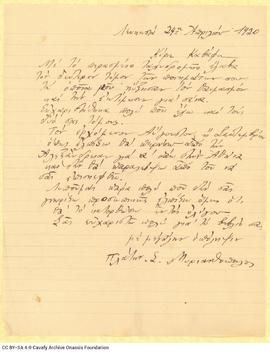
Stavrinos, PanosHandwritten letter by Platon S. Myrianthopoulos to Cavafy with thanks for the despatch of a poetry collection. (Nicosia)
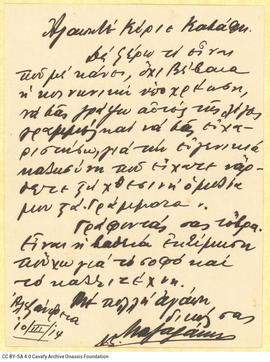
Myrianthopoulos, Platon S.Handwritten letter to Cavafy. Admiration for his work; reference to Psichari and Rodin. Signed: "Polys [Modinos]». (Paris)
[Modinos], PolysHandwritten letter by Panos Karanikolas to Cavafy, on three pages of a bifolio. The second page is blank. The author expresses his admiration and asks the poet to send him his work. (Athens)
Karanikolas, PanosHandwritten letter by Polyxeni Dimara to Cavafy. The author asks to be sent a poetry collection of his and informs him that she is sending him a volume by I. Gryparis (Skaravaioi kai terrakotes), which she has illustrated herself. Small photo affixed at the top right of the recto. (Athens)
Dimara, PolyxeniHandwritten diary-type letter by Paul Cavafy to his brothers and mother on five numbered bifolios, three of which bear the logo of St George's Club in London. Paul expresses his enthusiasm about the city. He details his impressions from the stores in London and describes the guesthouse in which he is staying. He also refers to a visit he made in the area and to the house where he lived in his childhood. Extensive use of English and French words and phrases. Accompanied by envelope with John Cavafy's address at R. J. Moss & Co. (London)
[Cavafy], Polis [Paul]Handwritten diary-type letter by Paul Cavafy to his mother and brothers on three numbered bifolios and on one side of a sheet. Enthusiastic impressions from his stay in London. Family and social news. Extensive use of English words and phrases. Accompanied by envelope with John Cavafy's address at R. J. Moss & Co. (London)
[Cavafy], Polis [Paul]Handwritten diary-type letter by Paul Cavafy to his mother on all sides of a bifolio. The address "30, Westbourne Terrace, Hyde Park, W." at top right of the first page. Paul is preparing to leave London and return to Egypt via Paris and Marseille. He expresses his enthusiasm about the city. Use of interpolated English and French words and phrases. (London)
[Cavafy], Polis [Paul]Handwritten diary-type letter by Paul Cavafy to his mother on two numbered bifolios, with the embossed logo of St George's Club in London. Paul visits London, from where he describes in detail his stay in the city and his activities. Extensive use of interpolated English words and phrases. [London]
[Cavafy], Polis [Paul]Handwritten letter by Panagis Batistatos to Cavafy, in which he expresses his admiration for his work and asks to be sent works and a photograph of him. The letter is written on a letterhead of the Ministry of Ecclesiastic Affairs and Public Education, and is accompanied by Batistatos' visiting card. (Athens)
Batistatos, PanagisHandwritten letter to Cavafy on both sides of a letterhead of the Waldorf hotel. The author informs the poet about a meeting he had with Ε. M. Forster and their discussion regarding the publication of translated poems by Cavafy. Signed: "Pericles" (most probably Anastasiadis). Accompanied by envelope. (London)
[Anastasiadis], PericlesHandwritten letter by Ntolis Nikvas (Vasileiadis) to Cavafy, in which he requests a photograph of the poet as well as the latter's comments on his books. (Athens)
Nikvas, Nt.Handwritten letter by Nikos Zelitas (Stefanos Pargas) to Cavafy on the first and last pages of a bifolio, sent from Cairo. Zelitas refers to an article that defends the poet and his work; he asks for the manuscript of his critique on the Grammaire du grec moderne by Pernot and mentions a planned lecture in Cairo on Cavafy's work.
Zelitas, NikosHandwritten letter by Napoleon Lapathiotis to Cavafy, in which he expresses his appreciation and asks to be sent all his recent works. (Athens)
Lapathiotis, NapoleonHandwritten letter by Napoleon Lapathiotis to Cavafy on one side of a sheet, in which he apologises for not visiting the poet during his stay in Alexandria. (Athens)
Lapathiotis, NapoleonHandwritten letter by Napoleon Lapathiotis to Cavafy, on three pages of a bifolio. The second page is blank. It includes an excerpt from a letter by Louis Roussel to Lapathiotis regarding Cavafy and his poem "Temethus, an Antiochene: 400 A.D.". Accompanied by envelope. (Athens)
Lapathiotis, NapoleonHandwritten letter by Napoleon Lapathiotis to Cavafy, on the first and third pages of a bifolio. The remaining pages are blank. He apologises for not having published in La Semaine égyptienne and reaffirms his sentiments of love and appreciation for the poet. (Athens)
Lapathiotis, NapoleonHandwritten letter by Napoleon Lapathiotis to Cavafy, on three pages of a bifolio. The second page is blank. Comments on a poem by the author, mimicking the style of Cavafy. Accompanied by a copy of a letter by Lapathiotis to L. Roussel on both sides of a sheet, with a quote pertaining to the same matter. (Athens)
Lapathiotis, NapoleonHandwritten letter by Napoleon Lapathiotis to Cavafy in a bifolio with notes on the first and third pages. The author expresses his joy for Cavafy's recovery after an illness.
Lapathiotis, Napoleon